
Pension Lump Sum or Monthly Check: How to Decide
Taking a pension? The lump sum almost always looks bigger. Here is how to weigh it against the monthly check — and why guaranteed income usually wins.

If you are lucky enough to have a pension, at some point you will get a letter that asks you to make one of the biggest financial decisions of your life with a single checkbox. It offers you two numbers: a large one-time lump sum, or a smaller check that arrives every month for the rest of your life.
The lump sum almost always looks like the obvious winner. A number with five or six zeros next to a check for a few thousand dollars a month does not feel like a fair fight. That instinct — anchoring on the big number — is exactly how people get this decision wrong. Here is how to think about it clearly.
Why the lump sum looks bigger than it is
You are not actually comparing a big number to a small number. You are comparing a pile of money you have to invest, manage, and make last for an unknown number of years against a paycheck that shows up every month no matter how long you live or what the market does.
Those are completely different things. The lump sum hands you flexibility and control — and every ounce of the risk that comes with them. Market risk, so that a bad stretch early in retirement does not force you to sell at the wrong time. Longevity risk, the chance you live to 95 and the money does not. And behavioral risk, the quiet danger that a six-figure account in your name is a lot harder to leave untouched than a check you never see as a balance.
The monthly check removes all three. It is guaranteed income for life — the one thing you literally cannot buy back once you have taken the lump sum and spent or lost it.
What the monthly check is really worth
In my bucket planning framework, a monthly pension is a near-perfect Soon bucket asset: a guaranteed income floor that covers your essential bills alongside Social Security, so your invested money is free to do its job without being your grocery fund. If you have read how to pay yourself from your buckets, you already know that a reliable monthly floor is the thing that makes the rest of the plan calm.
To replace that floor on your own, you would have to either buy a lifetime income annuity or withdraw carefully from invested assets. And here is the part people miss: to safely generate the same guaranteed, lifelong income the pension is offering, the capital you would need is often close to — or more than — the lump sum on the table.
A quick gut check is the payout rate: the annual pension divided by the lump sum. Take the monthly amount, multiply by twelve, and divide by the lump sum you are being offered. When that number is roughly 6% or higher, the monthly check is generally hard to replicate safely on your own. When it is low — closer to 4% — the lump sum starts to look more competitive. Treat this as a rough compass, not a formula, but it cuts through the anchoring in about thirty seconds.
Thomas’ Take: The monthly check is not the small number. It is a guaranteed, market-proof paycheck for as long as you live, and it is worth far more than its size next to the lump sum suggests. If you already struggle to watch a brokerage balance without tinkering, that is an argument for the check, not against it.
When the lump sum actually wins
This is not a one-sided decision, and anyone who tells you to always take the monthly check is skipping the real analysis. There are legitimate cases where the lump sum is the better call:
- Shorter life expectancy. A lifetime check is a bet on living a long time. Serious health issues tilt the math toward taking the money while you can.
- You already have plenty of guaranteed income. If a strong Social Security benefit and other income already cover your essentials, you may not need more floor — and the lump sum gives you growth and flexibility instead.
- Legacy goals. A single-life pension dies with you. A lump sum rolled into an IRA can pass to your heirs. If leaving money behind matters more than maximizing your own income, that is a real point in the lump sum’s favor.
- A shaky plan sponsor. Private pensions are insured by the Pension Benefit Guaranty Corporation, but only up to federal limits. If your monthly benefit is large and your former employer’s plan is poorly funded, that protection may not cover all of it.
The survivor question most people rush past
Before you ever get to lump sum versus monthly, there is usually a second fork: the single-life option, which pays you the most but stops entirely when you die, versus a joint-and-survivor option, which pays less each month but keeps paying your spouse after you are gone.
The higher single-life number is tempting for the same reason the lump sum is. But choosing it can leave a surviving spouse with a sudden, permanent income cut at the worst possible moment. This is the same principle behind the Social Security decision that protects your spouse: the right answer often means accepting a smaller check now to protect the person who outlives you. For many couples, the survivor election is the real decision — not lump versus monthly at all.
A hypothetical: Omar and Yasmin
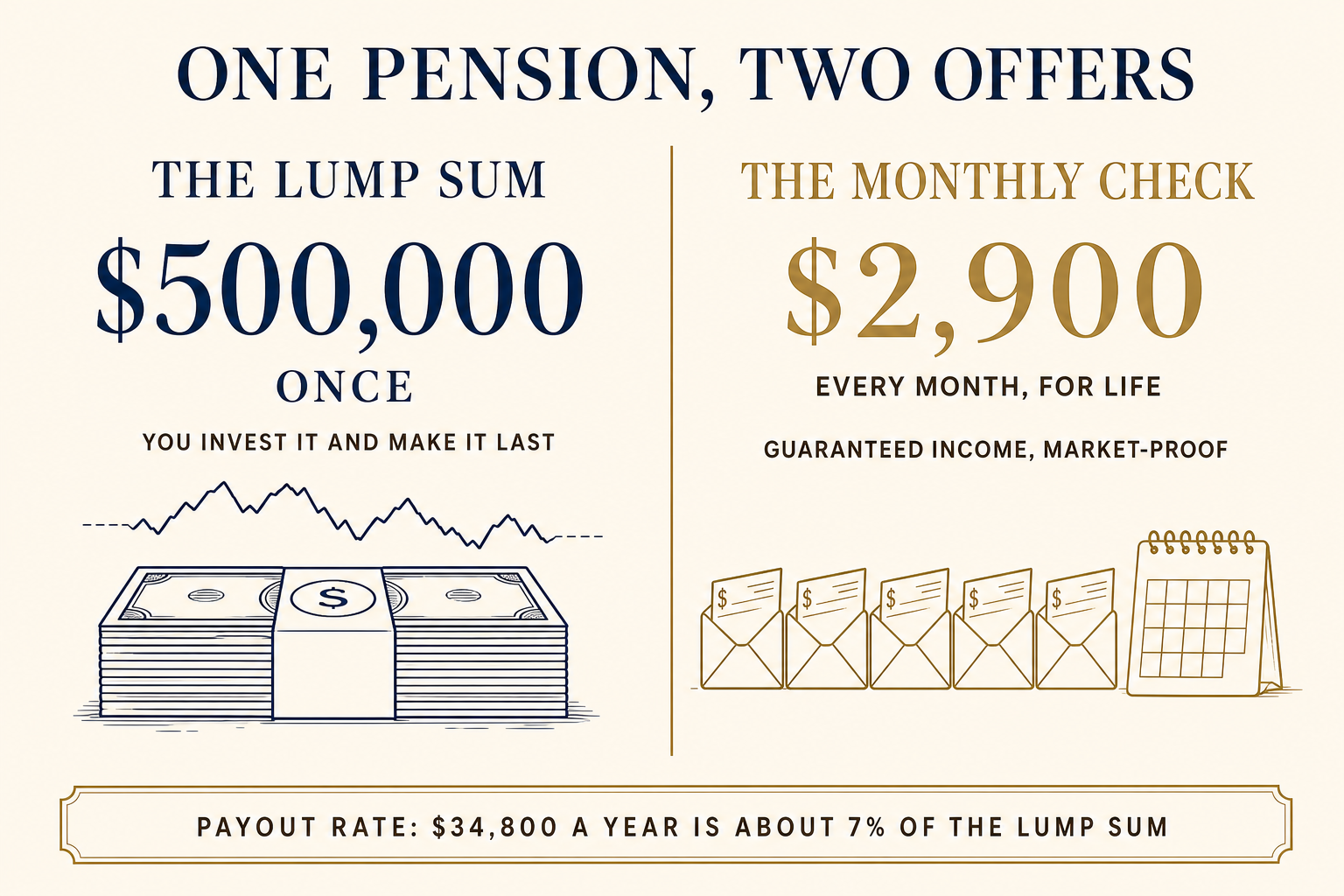
Consider a hypothetical couple, Omar and Yasmin, both in their early 60s. (The numbers are round and illustrative, not a projection of anyone’s actual situation.) Omar, 63, is retiring and his pension letter offers two choices: a $500,000 lump sum, or $2,900 a month for life on a joint-and-survivor basis that keeps paying Yasmin if he dies first.
Run the gut check. That is $34,800 a year against a $500,000 lump sum — a payout rate of about 7%. To reliably generate $34,800 a year of inflation-aware income from invested assets, at a conservative withdrawal rate, Omar would likely need well more than $500,000 to start — and even then the income would not be guaranteed the way the pension is. He would be taking on market and longevity risk to try to recreate something he is being handed for free.
For Omar and Yasmin, who still need a dependable income floor, the monthly check is the stronger anchor. It covers their essentials alongside Social Security, and it frees the rest of their portfolio to stay invested for growth instead of being drained for groceries in a down market — the exact trap I described in why being a forced seller, not volatility, is the real risk. Flip the facts, though — say Omar had a serious heart condition, or the couple already had $90,000 a year in guaranteed income — and the lump sum could easily become the better choice.
How to make the call
Federal consumer regulators walk through the same lump-sum-versus-lifetime-income trade-offs, and in practice the decision comes down to a handful of questions you can answer yourself. Work through them in this order:
- Get every option in writing — the lump sum, the single-life monthly amount, and each joint-and-survivor percentage (50%, 75%, 100%).
- Compute the payout rate (annual pension ÷ lump sum) as your first gut check.
- Ask the bucket planning question: do I still need more guaranteed income floor, or do Social Security and other income already cover my essentials? If you are still building your buckets, a pension is a ready-made Soon bucket.
- Factor health, longevity, and your spouse honestly. A lifetime check rewards a long life; a survivor election protects the person who outlives you.
- Check the plan’s funding and PBGC coverage if the monthly benefit is large.
- If you take the lump sum, roll it directly to an IRA. A direct rollover avoids the mandatory 20% withholding and keeps the money tax-deferred — see the IRS rules on rollovers before you touch a dollar.
The lump sum hands you a big number and all of the risk — market risk, longevity risk, and the discipline not to touch it. The monthly check hands you a smaller number and a promise. For most people who still need an income floor, that promise is worth more than it looks. The real question was never “which number is bigger.” It is “how much guaranteed income do I still need, and who is counting on it after I am gone?”
If you want to see how each choice plays out on your own numbers, it is worth modeling before you check the box. A planning tool like ProjectionLab lets you run the lump sum invested against the guaranteed monthly stream across a long retirement and a few bad markets, so you can watch which one actually holds up for your situation rather than guessing from the size of the number.
Disclosure: the ProjectionLab link above is an affiliate link. If you subscribe through it, I may earn a commission at no additional cost to you. I only point to tools I’d actually sit down and use.
This article is published by Confluence Media Group LLC, an independent publisher of educational financial content. Thomas Clark is a Series 65 Investment Advisor Representative. The information provided is for educational and informational purposes only and is not personalized financial, tax, or legal advice. Past performance does not guarantee future results. All investing involves risk, including potential loss of principal. Consult a qualified professional before making financial decisions.
Confluence Media Group LLC is a separate entity from Confluence Capital Management, the investment advisory practice through which Thomas Clark provides advisory services. Advisory services are not offered through this publishing platform.
About Thomas Clark
Thomas Clark is the founder of Confluence Media Group LLC and a Series 65 Investment Advisor Representative. He has spent nearly two decades working with families on retirement planning, with a focus on Social Security optimization, retirement income coordination, and the bucket planning approach to building a guaranteed income floor.
Thomas writes and publishes at thomasclarkadvisor.com and is the author of The Just in Case Binder — a 148-page printable family financial organizer for households who want to make sure the people they love know where everything is.
He lives in North Carolina with his family.
Subscribe to the weekly newsletter · Get the Just in Case Binder

Thomas Clark is a Series 65 licensed investment advisor and experienced trader. He specializes in investing, retirement planning, and market analysis, helping individuals build wealth and make informed financial decisions.
