
The Roth 5-Year Rule: The Clock Most Converters Miss
A Roth conversion is the easy part. The Roth 5-year rule is actually two separate clocks — one for tax-free earnings, one for the 10% penalty on converted money. Here's how both work.

A Roth conversion is one of the few tax moves with a hard December 31 wall, which is why I wrote last week about getting your 2026 conversion done before the deadline. But the conversion itself is the easy part. Click the button, pay the tax, and the money lands in your Roth.
The part that trips people up comes later, when they go to take the money out. Most people believe that once a dollar is sitting in a Roth IRA, it’s tax-free and penalty-free whenever they want it. That’s usually true. It is not always true. The difference is governed by something called the five-year rule.
And here’s the catch almost nobody is told at the moment they convert: there isn’t one five-year rule. There are two. They measure different things, they start on different dates, and satisfying one tells you nothing about the other. Understand both and the Roth becomes exactly the flexible, tax-free account you were promised. Confuse them and you can hand the IRS a bill you thought you’d already settled.
First, the part that’s actually simple
A Roth IRA holds up to three kinds of money, and they don’t all play by the same rules on the way out. Keeping them straight is the whole game.
The first kind is your direct contributions — money you put in from your paycheck or savings, money that was already taxed. You can withdraw your contributions at any age, at any time, for any reason, with zero tax and zero penalty. That rule has no clock on it at all. If you contributed $7,000 last year, that $7,000 is yours to pull back out tomorrow, no questions asked.
The second kind is converted money — dollars you moved from a traditional IRA or 401(k) into the Roth and paid income tax on at the time.
The third kind is earnings — the growth all of that money has thrown off while it sat in the account.
The two five-year rules exist to govern the second and third kinds. One clock watches your earnings. The other watches each conversion. They are not the same clock.
Rule one: the clock on your earnings
The first five-year rule decides whether your earnings come out completely tax-free. For a withdrawal of earnings to be “qualified” — the IRS term for fully tax-free and penalty-free — two things both have to be true. You need a qualifying reason, which for most people means being at least 59½ (death, disability, and a $10,000 first-home purchase also count). And your Roth has to have been open for at least five years.
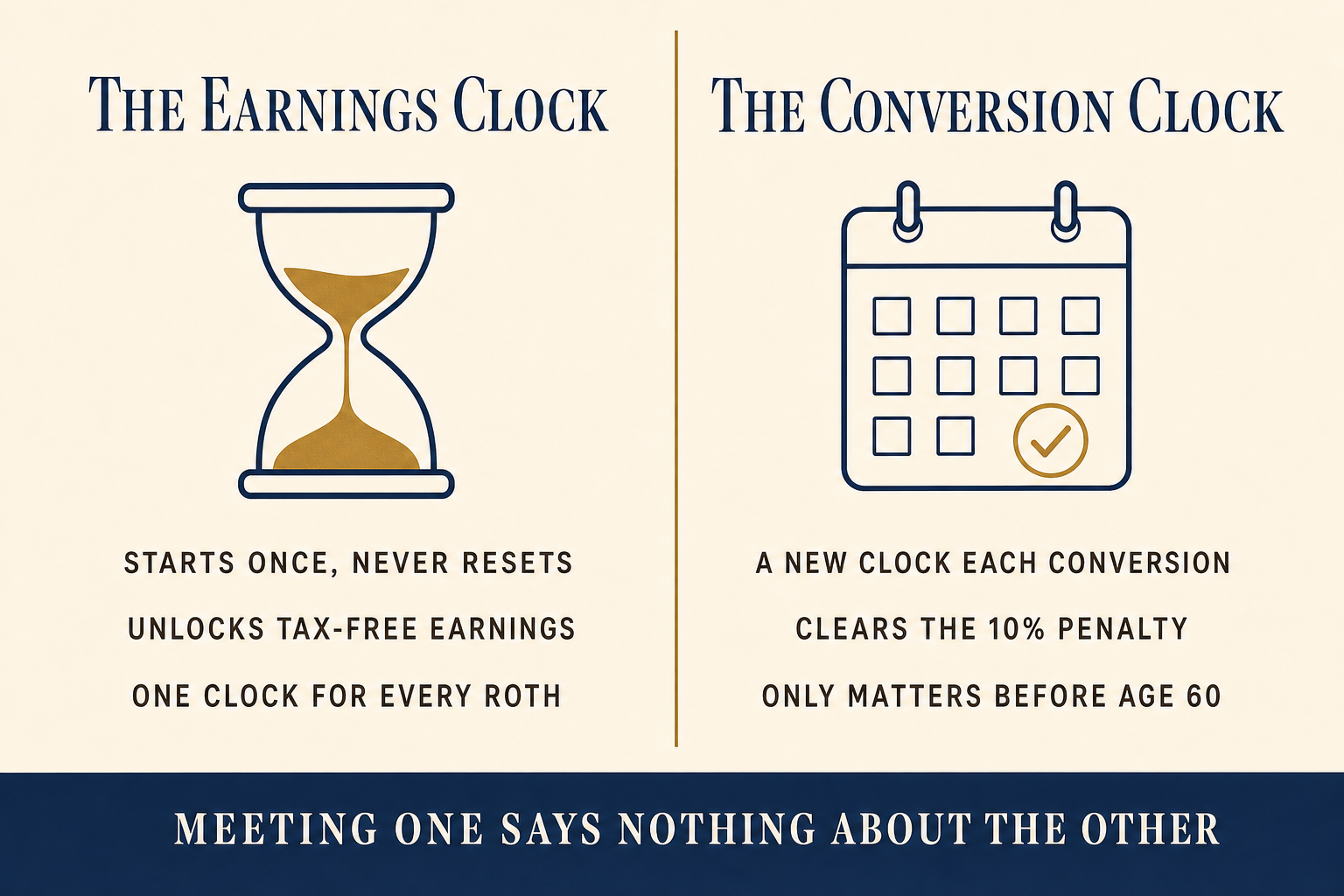
That five-year count starts on January 1 of the year you first put money into any Roth IRA — contribution or conversion, it doesn’t matter which. This is the part worth underlining: this clock starts once, and it never resets. Open your first Roth in 2026 and the clock starts ticking on January 1, 2026, for every Roth dollar you will ever own. A second Roth you open in 2030 rides on that same original clock. You start the five years once in your life, and then you’re done with it.
Because contributions and converted principal come out free anyway (more on the order in a moment), this rule really only bites in one spot: the earnings. And it bites hardest on someone who opens their very first Roth late in life.
Consider a hypothetical. Margaret, 63, just retired and did her first-ever Roth conversion this year — $40,000 moved from her traditional IRA during a low-income gap year, taxes paid. She’s well past 59½, so she assumes the whole account is now hers to use freely. For the $40,000 she converted, she’s right: she can pull that principal back out any time without tax or penalty. But suppose that money grows to $46,000 and she withdraws the full balance at 66. That $6,000 of growth is earnings, and her Roth is only three years old. Because the account hasn’t cleared the five-year mark, those earnings are taxable as ordinary income — even though she’s 66. Being past 59½ spared her the 10% penalty, but it did nothing for the five-year clock. Her earnings don’t turn fully tax-free until the account turns five, in 2031. (The dollar amounts here are illustrative.)
Thomas’s Take: The most common mistake I see isn’t greed or bad math — it’s the quiet assumption that turning 59½ unlocks everything. It unlocks the penalty. It does not start the clock. If you’re opening your first Roth in your sixties, open it knowing the earnings are spoken for until it turns five. The fix is almost absurdly simple: fund even a small Roth as early as you reasonably can, just to get the clock running.
Rule two: the clock on each conversion
The second five-year rule has nothing to do with taxing your earnings. It exists to stop people from using a conversion as a back door around the 10% early-withdrawal penalty — and it only matters if you’re under 59½.
Here’s the logic. If you’re 55 and pull money straight out of a traditional IRA, you normally owe a 10% penalty for being early. If you could convert that money to a Roth and then immediately withdraw it penalty-free, the penalty would mean nothing. So the rules say: when you withdraw converted dollars, each conversion has to have aged five years, or you’ll owe that 10% penalty on the amount that was taxable when you converted it.
The key difference from the first rule: every conversion starts its own separate five-year clock. Convert in 2026 and that batch is seasoned on January 1, 2031. Convert again in 2027 and that batch isn’t clear until January 1, 2032. There’s no single account-wide clock here — there’s one per conversion, each counting independently.
This is the engine behind the “Roth conversion ladder” that early retirees use to bridge the years before 59½, a cousin of the early-withdrawal strategies I’ve written about before.
Consider a second hypothetical. David, 56, retired early and is building a conversion ladder to fund the years before his other income kicks in. Each year he converts about $30,000 from his traditional IRA to his Roth, paying tax on it now while his bracket is low. His 2026 conversion becomes available penalty-free in 2031. His 2027 conversion in 2032, and so on — a rolling staircase, each step unlocking five years after he builds it. As long as he waits out each chunk’s five years, he taps that converted principal with no tax (he already paid it) and no penalty. But if David panics in 2028 and yanks his 2026 conversion early — under five years old, and he’s still under 59½ — he owes 10% on the $30,000 that was taxable when he converted it. One impatient move, a $3,000 penalty. (The figures are illustrative.)
Once David turns 59½, this entire second rule falls away. There’s no early-withdrawal penalty to recapture after 59½, so the conversion clock simply stops mattering. That’s why, for most retirees who are already past that age with an established Roth, neither rule ever actually bites.
The ordering rules that keep this from being a trap
Here’s the piece that pulls the stress out of all this. When you take money out of a Roth IRA, the IRS doesn’t let you choose which type of dollar you’re withdrawing. It applies a fixed order, and that order happens to be the friendliest one possible:
- Your contributions come out first — always tax-free, always penalty-free, no clock.
- Converted dollars come out next, oldest conversion first.
- Earnings come out last — and only after everything else is gone.
This matters more than any single rule, because it means you have to drain every dollar of contributions and every past conversion before you ever touch the earnings that rule one protects. For a retiree who has been funding a Roth for years, that’s an enormous buffer. The earnings — the only money the five-year clock can tax — sit at the very bottom of the stack, and most people never dig that deep.
For a visual, here’s how the two clocks line up side by side:
Who actually needs to watch the clock
If you’re over 59½ and you opened a Roth more than five years ago, you can mostly stop reading here — both clocks are behind you, and your Roth is as flexible as advertised. The people who genuinely need to plan around these rules fall into three groups.
Early retirees running a conversion ladder. If you’re under 59½ and converting each year to fund the bridge years, rule two is the backbone of your whole plan. Every conversion is a five-year promise, and the ladder only works if you respect the seasoning on each rung.
Anyone opening a first Roth late. If you’re in your late fifties or sixties and this is your first Roth, rule one means the earnings are off-limits tax-free until the account turns five, no matter your age. Plan to leave the growth alone for that window.
Big one-time converters. If you’re doing a large conversion and might need some of it back within five years while still under 59½, know which dollars you’d be touching and in what order.
For everyone, these rules are one more reason a Roth belongs in the growth-and-flexibility layer of a plan — the “Later” bucket in the Now, Soon, Later framework — money you’re deliberately not planning to spend first. The order you pull from your accounts is where the five-year rules actually show up in real life.
The honest challenge with a conversion ladder is that the clocks, your brackets, your future required distributions, and your Medicare premiums all move together, and a decision you make this year echoes for a decade. That’s too much to hold on a napkin. A planning tool like ProjectionLab lets you lay out a multi-year conversion schedule with your own numbers and watch how each year’s conversion seasons, what it does to your lifetime tax bill, and when each rung actually becomes available — instead of guessing at the dates.
Disclosure: the ProjectionLab link above is an affiliate link. If you subscribe, Confluence Media Group LLC may earn a commission at no additional cost to you. I only point to tools I’d actually use, and this is educational information, not a recommendation to buy any specific investment.
Key takeaways
- There are two five-year rules, not one. One governs whether your earnings are tax-free; the other governs the 10% penalty on converted money withdrawn before 59½.
- Your contributions ignore both clocks. Money you put in directly comes out tax- and penalty-free at any age, any time.
- The earnings clock starts once and never resets. It begins January 1 of the year of your first Roth of any kind and applies to every Roth dollar you’ll ever own.
- Each conversion gets its own separate five-year clock — and that rule disappears entirely once you turn 59½.
- The withdrawal order protects you. Contributions come out first, conversions next, earnings last — so most long-time Roth owners never reach the money the clock can tax.
Frequently asked questions
I’m over 59½ and just opened my first Roth this year. Am I really locked out of my earnings for five years?
Not locked out — but withdrawing the earnings before the account turns five makes those earnings taxable as ordinary income. Your contributions and any converted principal still come out freely. Only the growth is affected, and only the growth you’d reach after draining everything else first.
If I do a new conversion every year, does my earnings clock restart each time?
No. The earnings clock (rule one) starts with your very first Roth and never restarts. What each new conversion starts is its own separate penalty clock under rule two — which only matters if you’re under 59½.
Does a Roth 401(k) follow the same clock?
A Roth 401(k) has its own five-year clock that doesn’t carry over to a Roth IRA. If you roll a Roth 401(k) into a Roth IRA, the Roth IRA’s own clock governs — which is one more reason to open a Roth IRA early, even with a small amount, just to get that clock running. (Note that Roth 401(k)s no longer require minimum distributions during your lifetime, a change that took effect in 2024.)
What happens to the clock on an inherited Roth?
Earnings from an inherited Roth are tax-free to the beneficiary as long as the original owner had satisfied the five-year rule before death. Beneficiaries have their own distribution timeline to manage on top of that, which is a separate topic.
The bottom line
The Roth is the most flexible account most retirees will ever own, and nothing here changes that. Contributions are always yours. For anyone past 59½ with an established account, both clocks are already behind them. The two five-year rules matter at the edges — the first Roth opened late, the conversion ladder run early — and at those edges, knowing which clock you’re on is the difference between a clean tax-free withdrawal and a bill you didn’t see coming. The conversion is the easy part. The clock is the part worth understanding before you start it.
This article is published by Confluence Media Group LLC, an independent publisher of educational financial content. Thomas Clark is a Series 65 Investment Advisor Representative. The information provided is for educational and informational purposes only and is not personalized financial, tax, or legal advice. Past performance does not guarantee future results. All investing involves risk, including potential loss of principal. Consult a qualified professional before making financial decisions.
Confluence Media Group LLC is a separate entity from Confluence Capital Management, the investment advisory practice through which Thomas Clark provides advisory services. Advisory services are not offered through this publishing platform.
About Thomas Clark
Thomas Clark is the founder of Confluence Media Group LLC and a Series 65 Investment Advisor Representative. He has spent nearly two decades working with families on retirement planning, with a focus on Social Security optimization, retirement income coordination, and the bucket planning approach to building a guaranteed income floor.
Thomas writes and publishes at thomasclarkadvisor.com and is the author of The Just in Case Binder — a 148-page printable family financial organizer for households who want to make sure the people they love know where everything is.
He lives in North Carolina with his family.
Subscribe to the weekly newsletter · Get the Just in Case Binder

Thomas Clark is a Series 65 licensed investment advisor and experienced trader. He specializes in investing, retirement planning, and market analysis, helping individuals build wealth and make informed financial decisions.
