
The Stretch IRA Is Gone. The 10-Year Rule Took Its Place.
The SECURE Act ended the stretch IRA and replaced it with the 10-year rule: most heirs must now empty an inherited IRA within a decade. Here's what your beneficiaries face, and the moves that soften the tax hit before the countdown starts.

For most of the last two decades, a traditional IRA was one of the best things you could leave a child. Thanks to a provision called the “stretch IRA,” an heir could take small required withdrawals over their own life expectancy — a 45-year-old could spread an inherited account across nearly four decades, letting the bulk of it keep compounding tax-deferred the whole time.
That option is gone. The SECURE Act quietly ended the stretch for most heirs starting in 2020, and the IRS finalized the messy details in 2024. In its place is the “10-year rule” — and if you still think of your IRA as a clean gift to your kids, it’s worth understanding exactly what changed, because the new rules can hand your family a tax bill with a countdown timer attached.
What the stretch IRA was — and why its loss matters
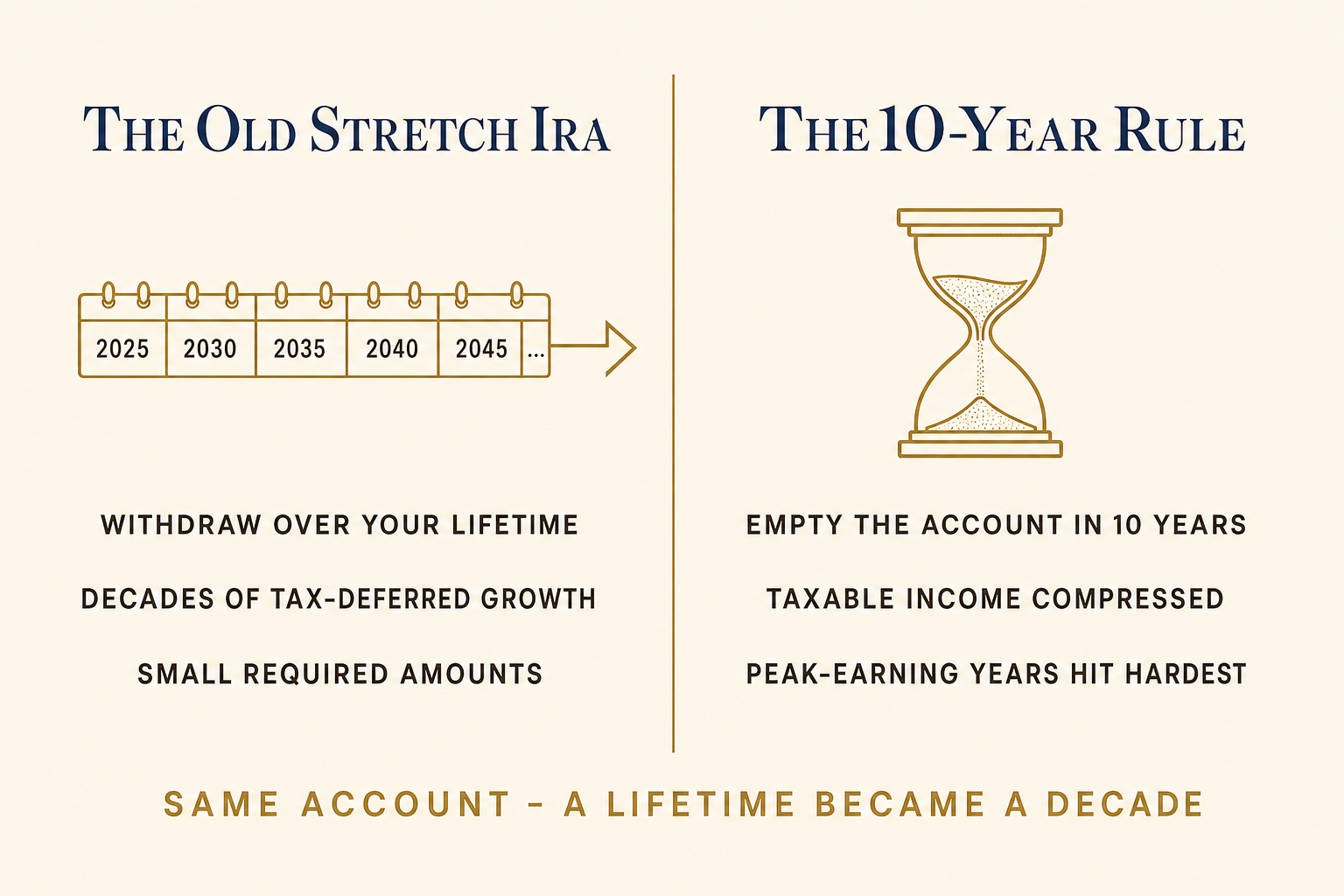
Before 2020, when a non-spouse beneficiary inherited an IRA, they set up an “inherited IRA” and began taking required minimum distributions (RMDs) based on their own age. Because a younger heir has a long life expectancy, those required amounts were tiny in the early years. The account could keep growing, largely untouched, for 30 or 40 years. That’s the “stretch” — it stretched both the tax deferral and the growth across a lifetime.
The SECURE Act, signed at the end of 2019, traded that lifetime stretch for a ten-year sprint. It wasn’t a small tweak. For a large tax-deferred account, compressing decades of withdrawals into one decade can push an heir into much higher tax brackets during the exact years they can least afford it.
The 10-year rule, in plain English
Here’s the core of it: most non-spouse beneficiaries must now empty an inherited IRA by December 31 of the tenth year following the year the original owner died (the IRS lays out the beneficiary rules here). Not ten years of neat, equal payments — the whole account, gone, by the end of year ten.
Within that window you have flexibility on timing. You could take nothing for nine years and everything in year ten, or spread it evenly, or bunch it into your lower-income years. The rule sets a deadline, not a schedule. That flexibility is the one piece of good news, and it’s also where smart planning lives — an heir who withdraws strategically across ten low-income years pays far less than one who takes a single giant distribution in a peak-earning year.
The trap most people miss: annual RMDs inside the ten years
This is the part that trips up even careful families, and it’s the detail the IRS spent years clarifying. Whether you owe annual withdrawals during the ten-year window depends on one thing: whether the original owner had already started taking their own RMDs.
- If the owner died before their required beginning date (roughly, before they’d started RMDs), there are no required annual withdrawals. You just have to hit zero by year ten. Full flexibility.
- If the owner died on or after their required beginning date (they were already taking RMDs — generally age 73 or older in 2026, once their own required distributions had begun), you must take an annual RMD in years one through nine and still empty the account by year ten.
The IRS waived the penalty for missed annual withdrawals from 2021 through 2024 while it sorted out the regulations (the specifics live in IRS Publication 590-B). That grace period is over. Annual RMDs under this rule are enforced starting in 2025, so an heir who inherited from a parent already in their RMD years can’t just wait until year ten anymore — they have a yearly obligation on top of the final deadline.
Who still gets to stretch
The lifetime stretch didn’t disappear for everyone. A protected group the IRS calls “eligible designated beneficiaries” can still take withdrawals over their own life expectancy. That group is narrower than most people assume:
- A surviving spouse — with the most options of anyone (more on that below).
- A minor child of the account owner — but only until they reach the age of majority (21). At that point the ten-year clock starts. Note the wording: a child of the owner, not a grandchild.
- A disabled individual, as defined by the IRS.
- A chronically ill individual.
- Anyone not more than ten years younger than the owner — often a sibling, a partner, or a close-in-age friend.
Everyone else — adult children, most grandchildren, nieces, nephews, friends — falls under the ten-year rule. For a lot of families, that means the people most likely to inherit the IRA are exactly the people who no longer get to stretch it.
A surviving spouse is the real exception. A spouse can roll the inherited IRA into their own IRA, treat it as if it had always been theirs, name new beneficiaries, and delay withdrawals until their own RMD age. If you and your spouse are each other’s primary beneficiaries, the ten-year rule doesn’t hit until the second death — and then it lands on whoever inherits next, usually the kids.
What this actually means for your own plan
Once you see the mechanics, the planning almost writes itself. A big traditional IRA is no longer a tax-efficient thing to leave a high-earning adult child, because it drops a decade of forced, fully-taxable income onto their already-high salary. But you have levers — and most of them are things you do while you’re alive, not clever moves your heirs make after you’re gone.
Convert to Roth in your low-income years. The stretch of quiet years between retirement and the start of RMDs is prime conversion territory. If you move money from a traditional IRA to a Roth while you’re in a low bracket, you pay the tax at your rate instead of your child’s. Your heirs still face the ten-year rule on the Roth — but Roth accounts carry no annual RMDs during that decade, and every dollar comes out tax-free. A Roth is simply the cleanest asset you can leave. (I’ve written separately about the Roth conversion window hiding in your gap years.)
Conversions aren’t automatically the right move, though. You pay the tax now, it’s irreversible, and a large conversion can nudge up your Medicare premiums two years later or spill into a higher bracket. The point isn’t to convert everything — it’s to convert deliberately, in the years your own rate is genuinely low, and to weigh your bracket against your heirs’.
Match the right account to the right heir. If one child is a high earner and another is between careers or in a lower bracket, the traditional IRA does less damage in the lower-bracket hands. Charitably inclined? A charity pays no income tax on an inherited IRA at all, which makes a tax-deferred account the single best asset to earmark for a charitable gift and your Roth or taxable accounts (which get a step-up in basis) better left to family.
Check your beneficiary forms and any trusts. The IRA passes by beneficiary designation, not your will — so the form on file is what controls, full stop, and it’s a big reason who actually inherits your money follows an order most people never see. This is also worth a hard look if you named a trust as beneficiary: many older “see-through” trusts were written for the stretch era and can now force the entire account out in year ten, sometimes taxed at compressed trust rates. Have an estate attorney review anything drafted before 2020. (More on why your beneficiary designations matter more than your will.)
In the Now/Soon/Later bucket framework, this is Later-bucket work. Your Soon bucket — Social Security, a pension, guaranteed income — covers your bills. The Later bucket holds growth and legacy, and a Roth funded during your low-bracket years is close to the ideal legacy asset: it grows without a tax drag and lands in your children’s hands without one either.
A hypothetical to make it concrete
Consider a hypothetical case. Dale and Marie, both 66, are recently retired near Tucson. Their Social Security and Dale’s small pension cover their essential bills, so their $700,000 traditional IRA is money they don’t need to touch for years — they’re sitting in a low tax bracket in the gap before their required withdrawals begin (age 73 or 75, depending on birth year). They plan to leave the IRA to their daughter Nadia, 40, a hospital administrator in her peak earning years.
Down one path, they leave the account as a traditional IRA. When Nadia eventually inherits it, she must empty it within ten years, stacking roughly $70,000-plus of taxable withdrawals a year on top of an already-high salary — much of it taxed at her top marginal rate, at the worst possible time in her career.
Down the other path, Dale and Marie convert portions of the IRA to a Roth over their low-bracket retirement years, paying tax now in the 12% or 22% neighborhood. Nadia still faces the ten-year rule — but she inherits a Roth. As long as Dale and Marie had held the Roth at least five years, it keeps its tax-free treatment for the full decade, and every dollar Nadia eventually withdraws is tax-free. Same $700,000, wildly different family tax bill. The numbers here are round and illustrative, but the shape of the outcome is real.
Thomas’ Take: The stretch IRA quietly made a traditional IRA a wonderful thing to inherit. The ten-year rule just as quietly made it one of the worst — a large tax bill with a deadline. For most families the fix isn’t an exotic trust. It’s deciding which dollars to convert while you’re in a low bracket, and which heir gets which account. Those two decisions, made in your sixties, can be worth more to your kids than any investment you pick.
This is worth modeling with your real numbers before you commit to a conversion strategy. A planning tool like ProjectionLab lets you map out your income year by year, test how much you can convert before jumping a bracket, and see what a decade of forced withdrawals would actually do to an heir’s tax picture. (ProjectionLab is a paid tool; the link is an affiliate link, which means I may earn a small commission at no extra cost to you. I only recommend tools I’d use myself.)
Key takeaways
- The stretch IRA is gone for most heirs. Non-spouse beneficiaries must now empty an inherited IRA within ten years of the owner’s death.
- If the original owner had already started RMDs, the heir also owes an annual withdrawal in years one through nine — enforced starting 2025 — not just a year-ten deadline.
- Surviving spouses, minor children of the owner, disabled and chronically ill individuals, and anyone within ten years of the owner’s age can still stretch over their lifetime. Most adult children cannot.
- Roth conversions during your low-income “gap years” move the tax to your bracket and hand heirs a tax-free asset that still grows through the ten-year window.
- Match assets to heirs, keep beneficiary forms current, and have any pre-2020 trust reviewed.
Frequently asked questions
Does the ten-year rule apply to Roth IRAs too? Yes — non-spouse heirs must still empty an inherited Roth within ten years. But because Roth owners never had lifetime RMDs, there are no required annual withdrawals during the decade — and as long as the original owner had held the Roth for at least five years, the distributions come out completely tax-free. (If the account was opened within five years of death, an heir who withdraws earnings before that five-year clock runs out can owe tax on those earnings.) That’s exactly what makes a Roth the gentler asset to inherit.
My kids are the beneficiaries. Is there anything they can do to soften it? Timing is their main lever. Because the rule sets a deadline rather than a fixed schedule (unless annual RMDs apply), an heir can spread withdrawals across their own lower-income years, or take more in a year they have unusual deductions. A single lump-sum withdrawal in a high-earning year is usually the most expensive way to do it.
Do I need a special trust to handle this? Usually no. For most families the highest-value moves are Roth conversions in low-bracket years and thoughtful beneficiary choices. Trusts still have a place for minor children, spendthrift concerns, or special-needs heirs — but a trust written for the stretch era should be reviewed, because it may now force a fully-taxable payout in year ten.
The stretch IRA rewarded doing nothing — you named a beneficiary and the tax code did the rest. The ten-year rule rewards doing something, and it rewards doing it early. If you have a large traditional IRA you don’t expect to spend, the years between retiring and the day your required withdrawals begin — age 73 or 75, depending on your birth year — are the most valuable planning window you’ll ever get. Spend them deciding what you leave behind — and in what form — before the countdown ever starts.
This article is published by Confluence Media Group LLC, an independent publisher of educational financial content. Thomas Clark is a Series 65 Investment Advisor Representative. The information provided is for educational and informational purposes only and is not personalized financial, tax, or legal advice. Past performance does not guarantee future results. All investing involves risk, including potential loss of principal. Consult a qualified professional before making financial decisions.
Confluence Media Group LLC is a separate entity from Confluence Capital Management, the investment advisory practice through which Thomas Clark provides advisory services. Advisory services are not offered through this publishing platform.
About Thomas Clark
Thomas Clark is the founder of Confluence Media Group LLC and a Series 65 Investment Advisor Representative. He has spent nearly two decades working with families on retirement planning, with a focus on Social Security optimization, retirement income coordination, and the bucket planning approach to building a guaranteed income floor.
Thomas writes and publishes at thomasclarkadvisor.com and is the author of The Just in Case Binder — a 148-page printable family financial organizer for households who want to make sure the people they love know where everything is.
He lives in North Carolina with his family.
Subscribe to the weekly newsletter · Get the Just in Case Binder

Thomas Clark is a Series 65 licensed investment advisor and experienced trader. He specializes in investing, retirement planning, and market analysis, helping individuals build wealth and make informed financial decisions.
