
The 59½ Rule Has Two Doors Most People Miss
The 59½ early-withdrawal rule has two legal doors most people never learn about. Here's how the Rule of 55 and 72(t)/SEPP let you reach retirement money early without the 10% penalty — and why the real reason to know them is to protect your Social Security decision.

You leave your job at 56. If you have a pension, it doesn’t start for years. Social Security is a decision you’re deliberately putting off. And the largest pile of money you own — your 401(k) — is sitting behind what feels like a locked door marked “59½.”
Most people treat that age like a wall. They assume touching retirement money before then means eating a 10% penalty on top of income tax, so they either white-knuckle it on cash savings or, worse, flip on Social Security at 62 just to make the mortgage.
Here’s what most people miss: the 59½ rule has two legal doors built into it. One is the Rule of 55. The other is a mouthful — a 72(t) distribution, or “substantially equal periodic payments.” Used correctly, either one lets you reach your retirement money early without the 10% penalty.
And the reason to know them isn’t to raid your 401(k) the day you retire. It’s that a legal bridge removes the pressure that pushes people into one of the worst money decisions in retirement: claiming Social Security early out of cash-flow panic. Let me walk you through both doors, then the more important question of when to use them.
The penalty you’re planning around
The IRS charges a 10% additional tax on most money you pull from a 401(k), 403(b), or IRA before age 59½ — on top of the ordinary income tax you already owe on every pre-tax dollar. Pull $40,000 at 56 in the 22% bracket, and roughly $8,800 in income tax plus a $4,000 penalty leaves you about $27,000 of spendable cash, per the IRS rules on early distributions.
That penalty exists to keep retirement money in retirement accounts. But the tax code also carves out legal exceptions — and two are wide enough to bridge the gap years between leaving work and turning on your other income sources.
Door #1 — The Rule of 55
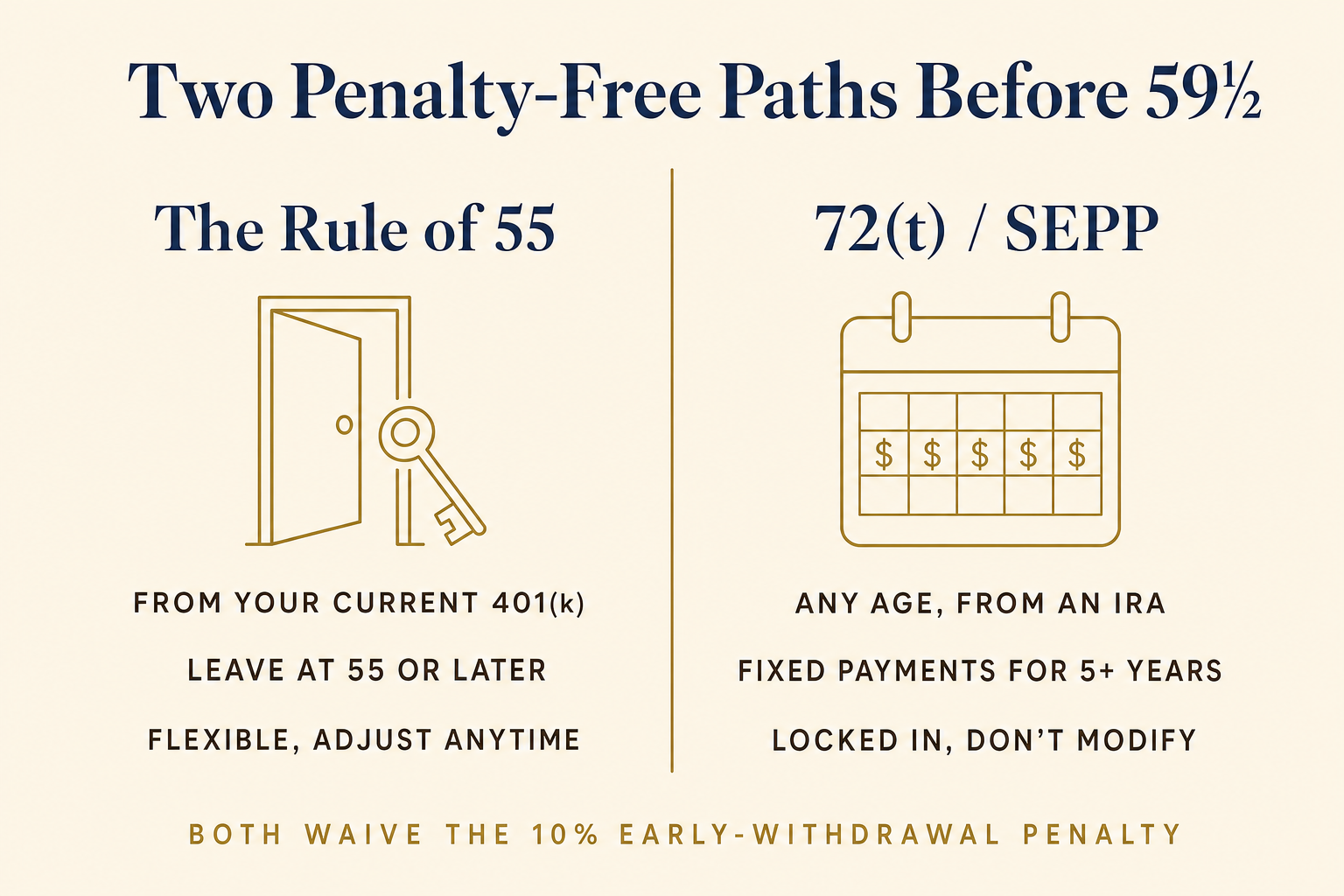
The Rule of 55 is the simpler of the two, and if you qualify, it’s usually the better one. The mechanic: if you leave your employer — quit, get laid off, retire, it doesn’t matter — in or after the calendar year you turn 55, you can take penalty-free withdrawals from that employer’s 401(k) or 403(b). You still owe ordinary income tax. The 10% penalty simply doesn’t apply.
Three details decide whether this works for you, and each one trips someone up.
First, it’s the year you turn 55, not the day. Leave in January of the year you’ll turn 55 in November, and you still qualify. Leave the December before, and you don’t — even if you wait until you’re 57 to take a dollar.
Second, it only applies to the plan at the job you just left. Not your IRA. Not the 401(k) from an employer you left at 48. Just the current one. That leads to the trap that quietly disqualifies the most people.
Third, and this is the one I see wreck the strategy: rolling your 401(k) into an IRA kills Rule of 55 access on every dollar you move. The standard advice at retirement is to roll the old 401(k) into an IRA for more investment options and cleaner management. That advice is often right, but if you’re retiring in your mid-50s and might need bridge income, rolling first slams this door shut. It’s one of the things a rollover can’t undo, which I walked through in my piece on whether to roll your 401(k) into an IRA at retirement.
Two more notes. For certain public-safety workers — police, firefighters, EMS, air traffic controllers — the qualifying age is 50 rather than 55. And the Rule of 55 is an IRS permission, not a plan requirement: your employer’s plan has to actually allow partial withdrawals after you separate. Some plans only offer a single lump-sum payout, which qualifies for the penalty exception but hands you a giant taxable event in one year. Read your plan’s summary description before you count on this.
Thomas’s Take: The Rule of 55 is the most underused tool in early retirement planning, and it’s usually killed by good intentions. Someone retires at 55, a well-meaning advisor rolls the 401(k) to an IRA that afternoon, and a penalty-free bridge worth years of flexibility disappears before lunch. If early retirement is even on the table, ask about the Rule of 55 before you sign a single rollover form.
Door #2 — 72(t), or substantially equal periodic payments
If you left work before 55, or your money is already in an IRA, the second door is the 72(t) — named for the section of the tax code that defines it. Officially it’s a series of “substantially equal periodic payments,” or SEPP: you commit to a fixed schedule of withdrawals, calculated by an IRS-approved formula, and the 10% penalty is waived on all of them. The appeal is that it works at any age, from an IRA, without timing your exit from a job. The catch is that it’s rigid, and the rigidity has teeth.
You choose one of three IRS methods to calculate the payment — required minimum distribution, fixed amortization, or fixed annuitization, all defined in the IRS guidance on substantially equal periodic payments. The RMD method recalculates each year and produces the smallest, most variable payment; the two fixed methods lock in a single level payment and generally pay out more.
How much more depends on an interest rate, and here recent rules help. Under IRS Notice 2022-6, the fixed methods can use a rate as high as 5% (or 120% of the mid-term federal rate, if that’s higher). In 2026 that federal rate is running below 5%, so the 5% floor applies — and that floor roughly doubles the payment you could take compared with the rock-bottom-rate years a while back.
Now the teeth. Once you start a 72(t), you must continue it for the longer of five years or until you reach 59½. Start at 52, and you’re locked in until 59½; start at 58, and you’re locked in until 63. During that window you cannot change the payment, skip a year, take extra, or roll money in or out of the account. Break any of those rules — the IRS calls it “modifying” the plan — and the 10% penalty comes roaring back on every distribution you’ve taken, plus interest.
The defensive move: don’t run a 72(t) on your whole IRA. Split off a separate IRA sized so the required payment matches exactly what you need, and leave the rest untouched — so a market drop or a change of plans doesn’t detonate the penalty on your entire nest egg. You’re also allowed a one-time switch to the RMD method if your balance falls, but that’s a repair, not a plan.
What this looks like in real life
Consider a hypothetical case: Marcus, 56, just took an early retirement package from a manufacturing job outside Columbus. He has $700,000 in his current 401(k), a paid-off house, and about $50,000 in cash. His full Social Security benefit at 67 would be around $2,700 a month, and he’s determined to wait, ideally to 70, because delaying is worth about 8% more in guaranteed, inflation-adjusted income for each year past his full retirement age.
Marcus needs about $45,000 a year to live. His problem is the gap: eleven years between now and 67, and he doesn’t want to burn through cash or claim Social Security early to cover it — the exact trap I wrote about in why the break-even age is the wrong way to decide when to claim.
Because he left in the year he turned 56, the Rule of 55 is open to him, and his plan allows partial withdrawals. He can pull what he needs each year straight from the 401(k), penalty-free, paying only ordinary income tax. With no wages and no Social Security yet, he sits in a low bracket, which makes those withdrawals cheap and even opens room for partial Roth conversions — the same low-income runway I covered in the Roth conversion window in the gap years and the 0% capital gains bracket.
In bucket-planning terms, Marcus is funding his Now bucket from his 401(k) during the bridge, precisely so he can let his other assets, and above all his Social Security, keep growing. The early-access door isn’t the strategy. It’s what makes the real strategy possible.
Which door, and when
When you qualify for both, the Rule of 55 usually wins on flexibility — you can turn withdrawals up or down as life changes, with no five-year handcuffs. Reserve the 72(t) for when the Rule of 55 isn’t available: you retired before 55, or your money already sits in an IRA.
Either way, run the numbers before you commit — especially for a 72(t), where the payment is fixed for years. A planning tool like ProjectionLab lets you test a bridge plan against your tax brackets, your future required distributions, and your Social Security timing before you lock anything in. (ProjectionLab is a paid tool; the link is an affiliate link, which means I may earn a small commission at no extra cost to you. I only recommend tools I’d use myself.) And decide whether you’re bridging before you touch a rollover form — the order you do things in can quietly open or close the better door.
Key takeaways
- The 10% penalty has legal exceptions. The Rule of 55 and 72(t)/SEPP are both broad enough to fund years of spending before 59½.
- The Rule of 55 is tied to one plan. It covers only the 401(k) of the employer you leave in or after the year you turn 55; rolling that money to an IRA forfeits the access.
- A 72(t) is powerful but rigid. It works at any age and from an IRA, but locks in fixed payments for the longer of five years or until 59½ — one misstep restores the penalty retroactively.
- The 5% floor helps. Under Notice 2022-6, it roughly doubles the payment a 72(t) can produce versus a few years ago.
- The real value is defensive. These doors let you avoid claiming Social Security early just to cover the bills.
Frequently asked questions
Do I still pay taxes on a Rule of 55 or 72(t) withdrawal?
Yes. Both waive only the 10% penalty. Every pre-tax dollar you withdraw is still ordinary income in the year you take it. Roth dollars follow their own rules.
Can I use the Rule of 55 on an old 401(k) from a job I left years ago?
No. It applies only to the plan at the employer you separate from in or after the year you turn 55. One workaround some plans allow: rolling old 401(k)s into your current employer’s plan before you retire, so more of your money sits in the one plan the rule covers.
What happens if I break a 72(t) plan?
The IRS treats it as a “modification.” The 10% penalty is applied retroactively to every distribution you’ve taken under the plan, plus interest. That’s why sizing a separate IRA to the payment — and leaving the rest alone — matters so much.
The line isn’t a wall
The 59½ line isn’t a wall. It’s a door with two keys most people never learn they’re holding. But the reason to keep them on your ring isn’t to spend early — it’s to buy yourself the freedom to wait. When you know you can reach your own money without a penalty, you stop making the panicked decisions that come from feeling trapped. You delay Social Security because you can. You convert to Roth in the low-income years because you have room. The bridge isn’t the destination. It’s what lets you get there on your own terms.
This article is published by Confluence Media Group LLC, an independent publisher of educational financial content. Thomas Clark is a Series 65 Investment Advisor Representative. The information provided is for educational and informational purposes only and is not personalized financial, tax, or legal advice. Past performance does not guarantee future results. All investing involves risk, including potential loss of principal. Consult a qualified professional before making financial decisions.
Confluence Media Group LLC is a separate entity from Confluence Capital Management, the investment advisory practice through which Thomas Clark provides advisory services. Advisory services are not offered through this publishing platform.
About Thomas Clark
Thomas Clark is the founder of Confluence Media Group LLC and a Series 65 Investment Advisor Representative. He has spent nearly two decades working with families on retirement planning, with a focus on Social Security optimization, retirement income coordination, and the bucket planning approach to building a guaranteed income floor.
Thomas writes and publishes at thomasclarkadvisor.com and is the author of The Just in Case Binder — a 148-page printable family financial organizer for households who want to make sure the people they love know where everything is.
He lives in North Carolina with his family.
Subscribe to the weekly newsletter · Get the Just in Case Binder

Thomas Clark is a Series 65 licensed investment advisor and experienced trader. He specializes in investing, retirement planning, and market analysis, helping individuals build wealth and make informed financial decisions.
