
Retirement Spending Guardrails: A Smarter Withdrawal Rule
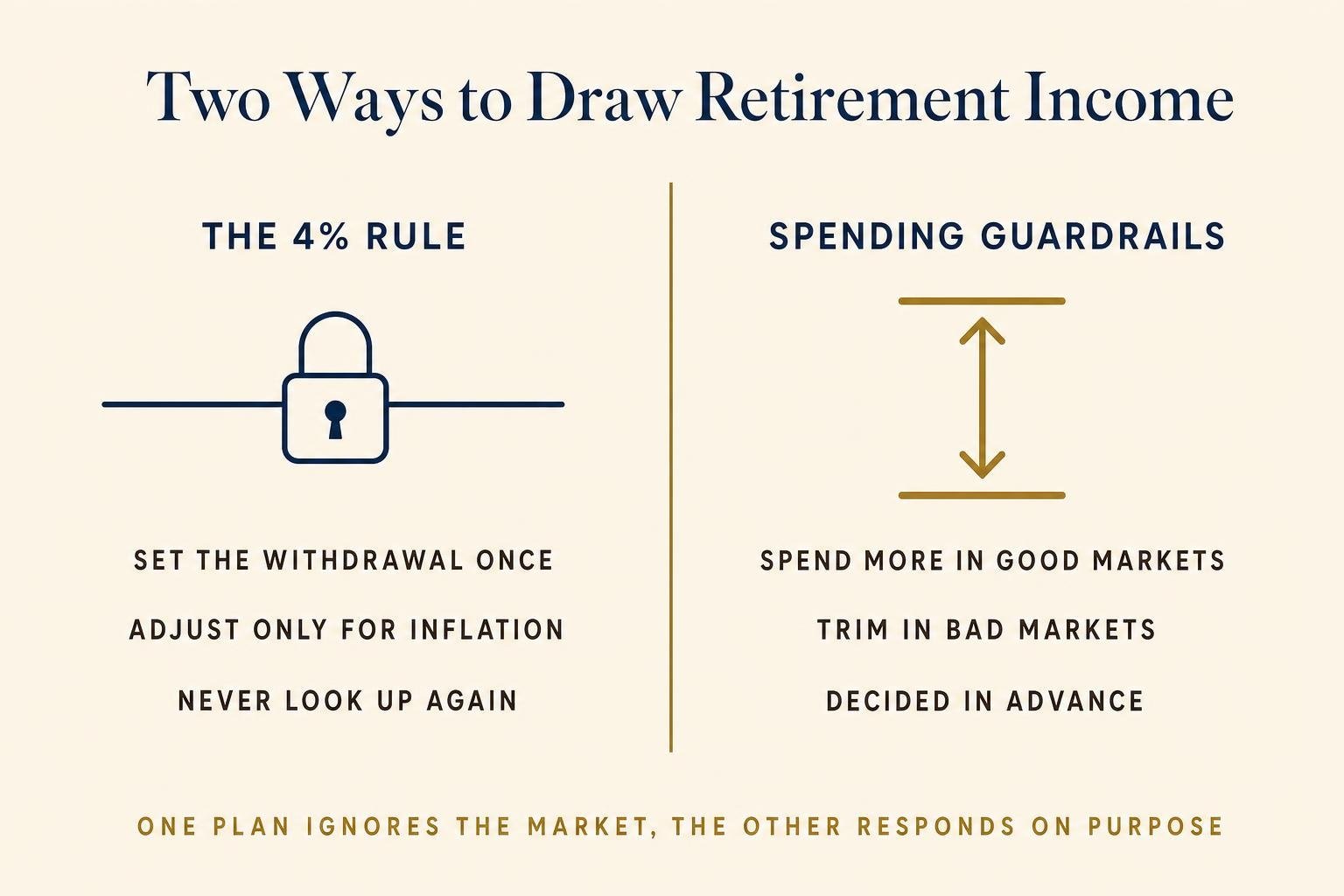
The 4% rule was never meant to be a plan you'd actually follow. Spending guardrails let you adjust your withdrawals on purpose — more in good markets, less in bad ones — so you never run out, and never leave the retirement you saved for unlived.

Consider a hypothetical couple named Ed and Mara. They did everything right — saved for three decades, retired at 66 with a paid-off house and a comfortable portfolio, and built a guaranteed income floor that covers their essentials. Three years in, they still haven’t booked the trip to see their grandkids in Oregon. Every time the market dips, they trim a little more. They are not going to run out of money. They are going to run out of years first.
This is the failure almost nobody plans for. We spend the whole accumulation phase afraid of running out, then carry that same fear into retirement, where it quietly does the opposite kind of damage. The fix for both problems — spending too much in a bad market and too little in a good one — is a set of retirement spending guardrails. It’s the single most useful upgrade you can make to the old 4% rule, and most retirees have never heard of it.
The 4% rule was never meant to be an operating plan
The 4% rule comes from research the financial planner Bill Bengen published in 1994. He looked at the worst market stretches in modern U.S. history and asked what starting withdrawal rate would have survived even the ugliest of them. The answer was about 4%: withdraw 4% of your portfolio the first year, adjust that dollar amount for inflation each year after, and history says the money lasts roughly 30 years.
Give the rule its due — it’s a clean, honest piece of research that replaced guesswork with a defensible number. The problem is what happens when you try to live on it. Nobody keeps writing the same inflation-adjusted check, unchanged, while their portfolio falls 30% — and nobody should. And because the rule is calibrated to survive the worst market ever recorded, most of the time it leaves an enormous balance unspent. You endure a smaller retirement than you could have afforded, to insure against a scenario that usually never arrives.
You can see the cost of that rigidity in the current numbers. Morningstar’s annual retirement-income research put the highest “safe” starting withdrawal rate at about 3.9% for a retiree who wants perfectly steady, inflation-adjusted spending for 30 years — but found that a retiree willing to tolerate some flexibility could start closer to 6%. The gap between 3.9% and 6% isn’t a market forecast; it’s the price of refusing to adjust. FINRA makes the same point, noting that expert opinion on sustainable withdrawals clusters in the 3-to-5% range and that retirees should start conservatively because portfolios swing year to year. (I dig into the rule’s mechanics and blind spots in this closer look at the 4% rule.)
What a spending guardrail actually is
A spending guardrail is a rule you set in advance that tells you when to change your withdrawals — up or down — based on how your portfolio is actually doing. Think of the guardrails on a mountain road. They don’t steer the car for you; they just keep you from going over the edge, which is exactly what lets you drive the road with confidence instead of white knuckles.
The best-known version was introduced by the financial planners Jonathan Guyton and William Klinger in 2006. Stripped of the jargon, it works like this. You set an initial withdrawal rate — say 5% in your first year. From then on you watch your current rate, which moves as your balance moves. If a strong market pushes your current rate well below where you started (you’re drawing a smaller slice of a bigger pile), you give yourself a raise. If a bad market pushes it well above where you started, you take a trim. In one widely-used version, the “rails” sit about 20% above and below your starting rate, and each adjustment is roughly 10%. That’s the whole idea: a lower rail that grants permission to spend more, and an upper rail that says ease off before a downturn does real damage.
How the guardrails work in practice
Back to our hypothetical couple. Ed and Mara are both 66. Their essentials — housing, food, insurance, utilities — run about $4,500 a month, and that entire amount is covered by their guaranteed income floor of Social Security plus a small pension. On top of that floor sits their Later bucket of $800,000, which funds travel, gifts, and the rest of the good life. They decide to draw an initial 5% from it, or $40,000 a year. Their upper rail sits at 6% (20% above 5%), the lower rail at 4% (20% below), and each adjustment is 10%.
Now suppose a rough couple of years drags the portfolio down to $600,000. Their $40,000 draw is suddenly 6.7% of the balance, past the upper rail, so the guardrail tells them to trim spending by 10%, to $36,000. In practice that means two trips this year instead of three. It does not mean skimping on groceries or medication, because those are covered by the floor, not the portfolio. A few years later, suppose a strong market lifts the balance to $1.05 million. Now $40,000 is just 3.8% of the balance, below the lower rail, so they give themselves a 10% raise to $44,000, and finally book Oregon.
The magic isn’t in the exact percentages. It’s that both moves were decided in calm weather, ahead of time. The cut isn’t a panic; it’s a plan executing. The raise isn’t reckless; it’s permission you granted yourself in advance. That distinction is everything, because the real enemy of a withdrawal plan is never the market — it’s the emotional decision you make in the middle of a bad one.
Guardrails only work if you build the floor first
Here is the part the withdrawal-rate debates usually skip. A spending cut is only survivable if it lands on discretionary spending, never on the essentials. That is the entire job of the Soon bucket in the Now, Soon, Later framework — a guaranteed income floor, built from Social Security, a pension, or an income-focused Fixed Index Annuity, that covers the bills that don’t stop no matter what stocks do.
When that floor is in place, a guardrail trim is a manageable lifestyle adjustment — one fewer trip, a smaller remodel, a leaner gift year. Without it, the same 10% cut can force a choice between the pharmacy and the grocery store, and no one follows a rule that painful. This is why sizing that floor correctly matters so much, and why delaying Social Security to enlarge it is one of the highest-leverage moves a pre-retiree can make — the SSA’s figures show the benefit growing roughly 8% for each year you wait past full retirement age, up to 70. The bigger your floor, the more freely your portfolio can flex.
Thomas’ Take: The guardrail is the throttle — it lets you speed up when the road is clear and ease off when it isn’t. The income floor is the seatbelt. People love to argue about withdrawal rates, but a rate without a floor underneath it is just a number you’ll abandon the first time you’re scared. Build the seatbelt first.
The failure these guardrails really prevent
Everyone worries about running out of money. It’s the visible risk, and guardrails defend against it directly by trimming spending before a downturn compounds — the same defense that makes sequence-of-returns risk survivable. But the quieter, far more common failure runs the other way: retirees who spend well below what their plan could comfortably support and reach the end with most of their savings untouched.
A growing body of retirement-income research points at this pattern, and Morningstar’s own finding — that a flexible retiree could responsibly start near 6% rather than 3.9% — is really a measure of how much a rigid, fear-driven plan leaves on the table. That’s no rounding error. On an $800,000 portfolio, it’s the difference between roughly $31,000 and $48,000 of income a year, for decades. The under-spender isn’t being prudent; they’re paying a lifelong tax in forgone experiences to insure against a risk their guardrails already handle.
This is the real gift of a guardrail system: it solves the emotional problem, not just the arithmetic one. Because you’ve already decided — in writing, in calm weather — exactly what you’ll do if markets fall, you free yourself to actually spend the money when they don’t. Ed and Mara finally book the trip. Not because the market did anything in particular, but because they finally had a rule that told them they were allowed to.
If you want to see how guardrails would play out against your own numbers, this is exactly the kind of thing worth modeling before you set them. A planning tool like ProjectionLab lets you enter your real spending, your income floor, and different market scenarios, then watch how your withdrawals — and your ending balance — respond as you move the rails. (ProjectionLab is a paid tool; the link is an affiliate link, which means I may earn a small commission at no extra cost to you. I only recommend tools I’d use myself.)
Key takeaways
- The 4% rule is a research finding about worst-case history, not a plan you’d actually follow — and its built-in conservatism usually leaves a large balance unspent.
- Spending guardrails set two rules in advance: spend more when a strong market pushes your withdrawal rate below a lower rail, trim when a weak market pushes it above an upper rail.
- A common version uses rails about 20% above and below your starting rate, with roughly 10% spending adjustments.
- Guardrails only work on top of a guaranteed income floor, so any trim lands on discretionary spending, never essentials.
- The failure guardrails most often prevent isn’t running out — it’s under-spending out of fear and leaving the retirement you saved for unlived.
Frequently asked questions
Is this just the 4% rule with extra steps?
No — it’s a different philosophy. The 4% rule sets your spending once and then ignores the market for 30 years. Guardrails do the opposite: they respond to the market on purpose, with pre-set rules, so you can start with a higher, more livable withdrawal and adjust as you go instead of locking in a worst-case number for life.
How big should the adjustments be?
The widely-cited version uses rails set about 20% above and below the starting withdrawal rate, with adjustments of around 10%. Those aren’t sacred numbers. Wider rails mean fewer, larger changes; narrower rails mean more frequent, gentler ones. What matters is that you choose them in advance and write them down, so a future decision becomes a rule you follow, not a mood you’re in.
What if I don’t have a pension?
Then building the floor is your first job, before you worry about rails. Social Security is a floor most people underuse — delaying it raises your guaranteed base substantially — and an income-focused annuity can fill a remaining gap. The bigger your guaranteed floor, the more room your portfolio has to flex, and the easier every guardrail decision becomes.
Stop treating your withdrawal rate as a number you set once and defend forever. A single fixed rate has to be either too timid for good markets or too aggressive for bad ones — it can’t be right for both. Guardrails let you be right for both by deciding ahead of time how you’ll respond to each. That’s not just better math. It’s the difference between a retirement you carefully preserve and one you actually get to live.
This article is published by Confluence Media Group LLC, an independent publisher of educational financial content. Thomas Clark is a Series 65 Investment Advisor Representative. The information provided is for educational and informational purposes only and is not personalized financial, tax, or legal advice. Past performance does not guarantee future results. All investing involves risk, including potential loss of principal. Consult a qualified professional before making financial decisions.
Confluence Media Group LLC is a separate entity from Confluence Capital Management, the investment advisory practice through which Thomas Clark provides advisory services. Advisory services are not offered through this publishing platform.
About Thomas Clark
Thomas Clark is the founder of Confluence Media Group LLC and a Series 65 Investment Advisor Representative. He has spent nearly two decades working with families on retirement planning, with a focus on Social Security optimization, retirement income coordination, and the bucket planning approach to building a guaranteed income floor.
Thomas writes and publishes at thomasclarkadvisor.com and is the author of The Just in Case Binder — a 148-page printable family financial organizer for households who want to make sure the people they love know where everything is.
He lives in North Carolina with his family.
Subscribe to the weekly newsletter · Get the Just in Case Binder

Thomas Clark is a Series 65 licensed investment advisor and experienced trader. He specializes in investing, retirement planning, and market analysis, helping individuals build wealth and make informed financial decisions.
