
Self-Employed? You Fund Both Halves of Social Security
When you work for yourself, you pay both halves of the Social Security tax, and your benefit is built on the earnings you report, not the tax you pay. Here is how the self-employed earn, fund, and sometimes shortchange their own Social Security.

Most self-employed people I talk to take a quiet pride in how little self-employment tax they pay. They track every mile, expense the home office, time their equipment purchases, and watch their net profit shrink to something the IRS can’t take much of a bite from. What almost none of them realize is that the number they’re working so hard to push down is the same number the Social Security Administration will one day use to calculate their check.
When you work for yourself, you are both the employee and the employer. That changes how you fund Social Security, how you qualify for it, and how much you eventually collect. It also hands you a lever most employees never get to touch. Pulled the wrong way, that lever can cost you real money for the rest of your life.
You pay both halves of the tax
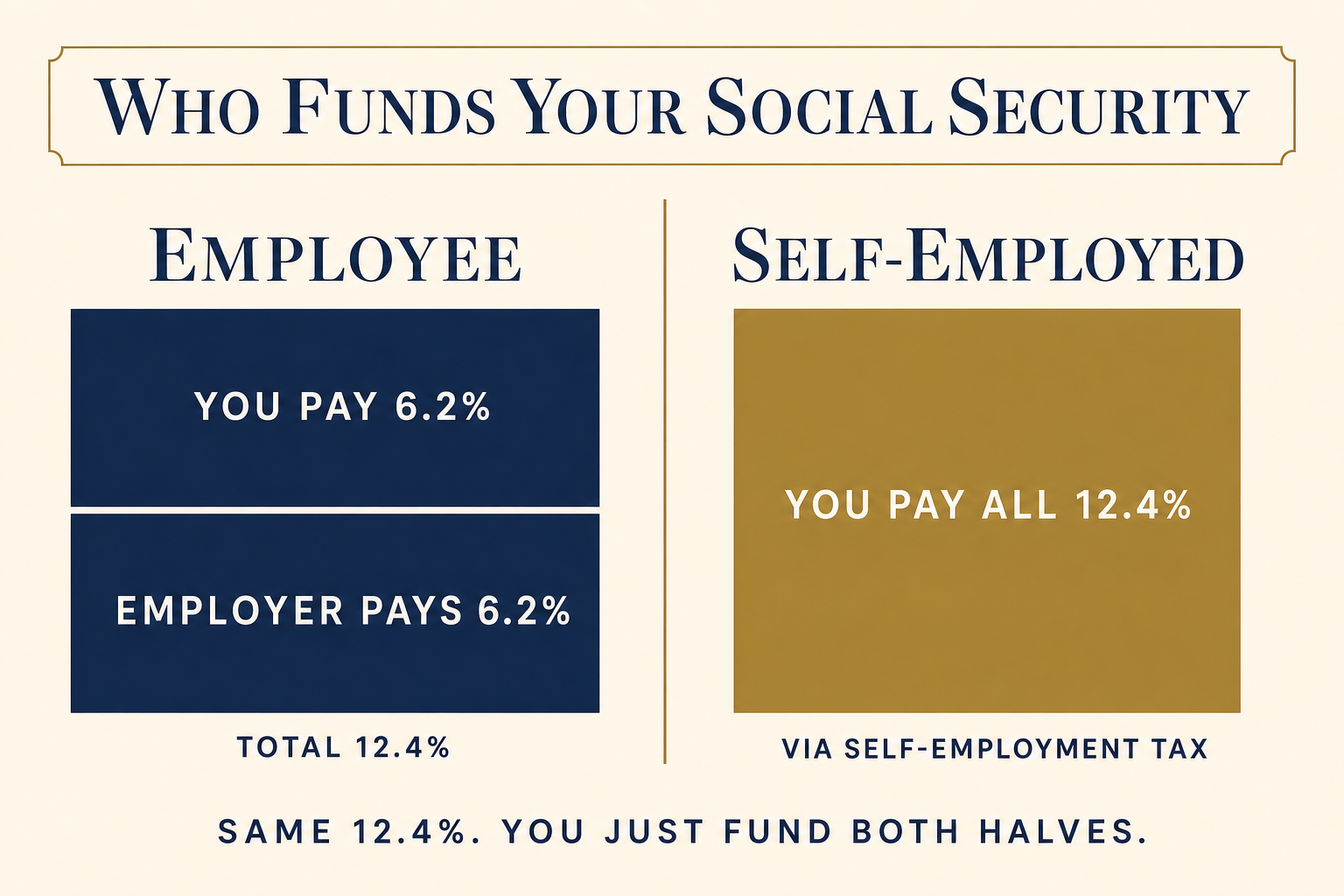
A regular employee splits the Social Security tax with their employer. The worker sees 6.2% come out of each paycheck; the employer quietly matches it with another 6.2%. Together that’s the 12.4% that funds the Social Security side of the system. Most employees never think about the employer’s half because they never see it.
When you’re self-employed, there is no employer to cover that second half. You pay the whole 12.4% yourself, and you pay it through the self-employment tax you settle up on Schedule SE. The full self-employment tax rate is 15.3% — the 12.4% for Social Security plus 2.9% for Medicare. The Social Security portion applies to your net earnings up to the annual wage base, which is $184,500 in 2026. The Medicare portion has no ceiling.
Two details soften the blow, and both are worth knowing. First, you don’t pay the tax on your full net profit — you pay it on 92.35% of it, a factor built in to approximate the employer-side deduction a business would normally take. Second, you get to deduct half of your self-employment tax when you calculate your income tax, which lowers what you owe the IRS even though it doesn’t lower the Social Security credit you’re building. The system is trying to put you roughly on par with someone who works for a company. It only feels like a penalty because you write the check in one lump instead of never seeing it at all.
You earn your way in with credits, not years
Qualifying for a Social Security retirement benefit takes 40 credits, which most people describe as “ten years of work.” That’s close, but the real rule is about earnings, not time. In 2026 you earn one credit for every $1,890 in covered earnings, and you can earn a maximum of four credits a year. Once you’ve reported $7,560 in net self-employment earnings for the year, you’ve locked in all four credits — whether it took you two months or twelve.
This matters for people whose self-employment income is lumpy. A consultant who has one strong quarter and three quiet ones still banks a full year of credits, as long as the reported total clears that threshold. And credits don’t expire. If you spent fifteen years as a W-2 employee before going out on your own, those credits already sit in your record and combine with the ones you’re earning now. You’re rarely starting from zero.
The tradeoff nobody points out
Here’s the part that costs self-employed people the most, precisely because it’s invisible. Your eventual benefit isn’t based on the tax you paid — it’s based on the earnings you reported. Social Security takes your 35 highest-earning years, adjusts them for wage inflation, and averages them into the figure that runs through the benefit formula. I walked through that machinery in detail in how your Social Security benefit is actually calculated, and the takeaway bears repeating here: the average is built from what shows up on your record.
So every dollar you legitimately keep off Schedule SE is a dollar that never enters that 35-year average. Trimming your reported net profit shaves your tax bill today, and it quietly shaves the benefit you’ll draw for the rest of your life. That’s not an argument for overpaying — legitimate deductions are legitimate, and nobody should report income they didn’t earn. It’s an argument for seeing the whole tradeoff instead of half of it.
The tradeoff lands harder on modest earners than on high ones, because the benefit formula is deliberately progressive. The first slice of your averaged earnings is credited at 90 cents on the dollar; the next, much larger slice at 32 cents; the top slice at just 15. If your reported earnings sit in the lower tiers, shrinking them gives up 90-cent and 32-cent dollars. If you’re a high earner already past the top bend point, the same reduction only costs you 15-cent dollars. The lever is real either way — it just has a different price depending on where you stand.
The S-corporation wrinkle
Many self-employed people eventually form an S-corporation and split their income into a W-2 salary plus distributions. Done right, this can save real money, because the distributions aren’t subject to the 15.3% self-employment tax. But the same split that saves you tax also narrows the earnings that count toward Social Security, because your benefit is built only on the W-2 wages you pay yourself — not on the distributions.
The IRS requires that salary to be “reasonable compensation” for the work you actually do, so this isn’t a dial you can turn to zero. It’s a genuine tradeoff between money saved now and benefit built for later, and it deserves to be weighed as one rather than defaulted into for the tax savings alone. The Social Security Administration lays out the basics for business owners in its guide for the self-employed.
Mind the gap in your record
The self-employed have one more exposure employees mostly don’t: income that reaches the IRS but never makes it onto your Social Security record. Filing errors, a mismatched name, or a year that simply gets dropped can leave a hole that pulls down your 35-year average. There’s also a correction deadline — generally about three years to fix an earnings error — after which the record tends to harden in place.
The fix is unglamorous and free. Pull your statement, read it against your own returns, and correct anything that’s wrong while you still can. I laid out the whole procedure in how to audit your Social Security earnings record and covered what the online statement does and doesn’t show you in what your Social Security statement doesn’t tell you. For someone whose income has flowed through a dozen different clients and 1099s, that half-hour is time well spent.
You’re building your own income floor
When you work for yourself, nobody is building a pension for you, and there’s no employer match landing in a 401(k). That makes Social Security more important to you, not less — it’s the one guaranteed, inflation-adjusted income stream you’re already paying into, and for most self-employed people it will be the anchor of their retirement.
In the bucket planning approach I use, that guaranteed income sits in the Soon bucket: the floor that covers your essential bills no matter what markets do. Social Security is the backbone of that floor, which is exactly why the earnings you report and the age you claim deserve real attention. The growth side — the Later bucket — is the part you have to build deliberately, through a SEP-IRA, a solo 401(k), or a similar self-funded account, since no company is doing it for you. If you want the fuller picture, start with the Now, Soon, Later framework and then look at how to size your income floor.
Consider a hypothetical case: Marcus, 54, a self-employed general contractor outside Raleigh. He nets around $90,000 a year and, like a lot of tradespeople, treats aggressive deductions as a point of pride. His accountant could help him report a lower number, and it would trim his tax bill now. But Marcus also plans to lean on Social Security as the base of his retirement income. Every year he pushes his reported earnings down by, say, $10,000, he’s pulling down the 35-year average his benefit will be built on — and because his earnings land in the 90-cent and 32-cent tiers of the formula, he feels that reduction more sharply than a high earner would. There’s no single right answer for Marcus. There’s only the tradeoff, seen clearly, and a decision made on purpose instead of by reflex. (Marcus is a hypothetical illustration, and the figures are round numbers chosen to show the mechanics, not a projection.)
Thomas’ Take: The self-employment tax feels like the government reaching into your pocket twice. Reframe it. You’re buying into a lifetime, inflation-adjusted, government-backed income stream — the closest thing to a guaranteed pension most self-employed people will ever have. That doesn’t mean you should pay a dollar more than you owe. It means you should stop treating the number on Schedule SE as pure cost, and start treating it as what it also is: the record your future paycheck is built from.
Key takeaways
- As a self-employed worker you pay both halves of the 12.4% Social Security tax yourself, through the 15.3% self-employment tax — but you pay it on 92.35% of net profit and deduct half of it against income tax.
- Retirement eligibility takes 40 credits; in 2026 one credit is $1,890 of earnings, and $7,560 for the year earns all four, no matter how the income arrived.
- Your benefit is based on reported earnings, not tax paid, so cutting reported profit quietly cuts the check you’ll draw for life — a bigger price for modest earners than for high ones.
- An S-corp salary-and-distribution split saves self-employment tax but builds your benefit only on the W-2 wages, and the salary still has to be reasonable.
- Check your earnings record for gaps while you still can, and treat Social Security as the anchor of a self-built income floor.
Common questions
Do W-2 jobs and self-employment count toward the same 40 credits?
Yes. Credits from wage jobs and credits from self-employment go into one record and add up together. Years you spent as an employee before going out on your own already count toward the 40 you need.
Does forming an S-corporation help or hurt my Social Security?
It can do either. The distributions escape self-employment tax, which is the appeal — but your benefit is calculated only on the W-2 salary you pay yourself, so a very low salary means a smaller benefit later. It’s a tradeoff to weigh, not a free win, and the salary still has to meet the IRS “reasonable compensation” standard.
What if I under-reported income years ago?
There’s generally a window of about three years to correct an earnings error, after which the record usually locks. Pull your statement, compare it against your old returns, and file a correction for anything that’s genuinely wrong before that window closes.
If you’re self-employed, you already write the biggest check into Social Security that most people never see. That’s not a reason to resent the system — it’s a reason to make sure the system is working as hard for you as you’re working for it. Report your income honestly, watch what an aggressive tax strategy quietly costs on the benefit side, keep your record clean, and treat the eventual check as the guaranteed floor it’s meant to be. When you’re ready to see what your own claiming decision could look like, run the numbers with the free Social Security calculator before you make any move.
This article is published by Confluence Media Group LLC, an independent publisher of educational financial content. Thomas Clark is a Series 65 Investment Advisor Representative. The information provided is for educational and informational purposes only and is not personalized financial, tax, or legal advice. Past performance does not guarantee future results. All investing involves risk, including potential loss of principal. Consult a qualified professional before making financial decisions.
Confluence Media Group LLC is a separate entity from Confluence Capital Management, the investment advisory practice through which Thomas Clark provides advisory services. Advisory services are not offered through this publishing platform.
About Thomas Clark
Thomas Clark is the founder of Confluence Media Group LLC and a Series 65 Investment Advisor Representative. He has spent nearly two decades working with families on retirement planning, with a focus on Social Security optimization, retirement income coordination, and the bucket planning approach to building a guaranteed income floor.
Thomas writes and publishes at thomasclarkadvisor.com and is the author of The Just in Case Binder — a 148-page printable family financial organizer for households who want to make sure the people they love know where everything is.
He lives in North Carolina with his family.
Subscribe to the weekly newsletter · Get the Just in Case Binder

Thomas Clark is a Series 65 licensed investment advisor and experienced trader. He specializes in investing, retirement planning, and market analysis, helping individuals build wealth and make informed financial decisions.
