
Stock Market Seasonality: The Worst Two Months Start Now
August and September are historically the stock market's weakest months, and this year adds a hawkish Fed and a midterm election on top. Here's why that's a fact for traders, not a reason to touch a well-built retirement plan.

The calendar just flipped to August, which means the market has entered the two months investors have spent decades learning to fear. Look at the long record and September is the single worst month for U.S. stocks, with August close behind — the only back-to-back pair that has historically averaged a loss.
Here is the part almost nobody says out loud: the pattern is real. I’m not going to wave it away as superstition. But “real” and “useful to your retirement plan” are two very different things. One is a fact about market history. The other would be an instruction about your money — and the calendar has no business giving you those.
Here’s what the data actually says, why late summer tends to wobble, and why the people who trade around it usually end up worse off than the ones who never looked at a calendar at all.
The seasonality is real — here’s the actual record
Seasonality just means a recurring, calendar-based tendency in returns — a month or stretch that has, on average, behaved a certain way across many years. It is a description of the past, not a schedule for the future. With that caveat doing a lot of work, here is the record that earns August and September their reputation.
Going back roughly 75 years, September has averaged about a 0.7% decline for the S&P 500 — the only month of the year to average a loss, and the only one that has finished higher less than half the time. When September has gone negative, the average drop has been near 3.8%. August isn’t far behind; depending on the start date, it ranks as the second- or third-weakest month of the calendar.
Market historians at the Stock Trader’s Almanac — the people who popularized “sell in May and go away” — note that since 1945, August and September are the only consecutive pair of months to both average negative territory. And the weakness doesn’t stop at Labor Day: the August-through-November window has historically been the market’s most volatile stretch, home to a disproportionate share of the worst single-month declines on record.
So the reputation is earned. The question is what a person actually planning for retirement is supposed to do with it. My answer is going to disappoint anyone hoping for a clever trade.
Why late summer tends to wobble
Some of the seasonal softness is structural. Trading desks thin out in August as much of Wall Street takes vacation, and lighter volume means fewer buyers to absorb any bad news — so a headline that would barely register in March can push prices around more sharply in August. As the third quarter closes in September, institutions rebalance portfolios and harvest tax losses, which adds selling pressure right on schedule.
Then there’s whatever is specific to this year, layered on top of the calendar. The Federal Reserve held its policy rate at 3.50–3.75% on July 29, but three officials dissented in favor of a hike — an unusually hawkish split — and the Fed doesn’t meet again until September, per its published FOMC calendar. That leaves a long, data-dependent gap where markets can talk themselves into and out of a rate move, with inflation still running hot from the year’s energy shock. Add a midterm election in November — a period that has historically carried its own volatility — and you have plenty of kindling for a jumpy couple of months.
I laid out the “watch the Fed do nothing and react accordingly” version of this argument around the July meeting. The seasonal version is the same lesson wearing a different hat: none of this is new information, and none of it tells you what your portfolio should do next.
Why knowing the pattern makes most people poorer
Here’s the trap. The moment you learn that September is historically weak, the obvious move seems to be: sell in late summer, sit in cash, buy back in October. It sounds disciplined. It’s actually one of the reliable ways retail investors underperform.
To profit from a seasonal exit you have to be right twice — right about getting out, and right about getting back in. And the getting-back-in leg is brutal, because market gains cluster: some of the best trading days in history have landed within days of the worst ones. Sit out September to dodge a decline and you’re just as likely to sit out the snap-back rally that follows it. Decades of studies on market timing keep landing in the same place — staying invested beats jumping in and out — which is why regulators like FINRA and the SEC steer ordinary investors toward a durable allocation rather than a calendar.
Then there are the frictions the seasonal story never mentions: every sale in a taxable account can trigger capital gains, and every round trip is a chance to be whipsawed by a market that didn’t read the almanac. “Sell in May and go away” has spent much of the last fifteen years being wrong, because a tendency measured across seventy years says almost nothing about any one September.
From the trader’s seat: a probability tilt is not a plan
I spent years trading, and I want to be fair to the pattern, because there’s a version of this that traders legitimately use. A desk trader might lean slightly into a known seasonal tendency — trim a bit of risk into a historically soft window, size positions a touch smaller, keep a stop in place. That’s a probability tilt applied to risk capital, with a defined amount they’re willing to lose and a plan for being wrong.
That is a completely different activity from funding your grocery bill. The trader is betting a slice of money he can afford to lose on a small statistical edge. A retiree drawing income can’t run the mortgage and the medication on a “tends to.” The whole discipline of trading — position sizing, stop losses, never risking money you need — exists precisely because edges are thin and the future is uncertain. The retirement version of that discipline isn’t a cleverer seasonal trade. It’s building a structure that doesn’t need the trade to work at all.
What actually carries you through a weak season
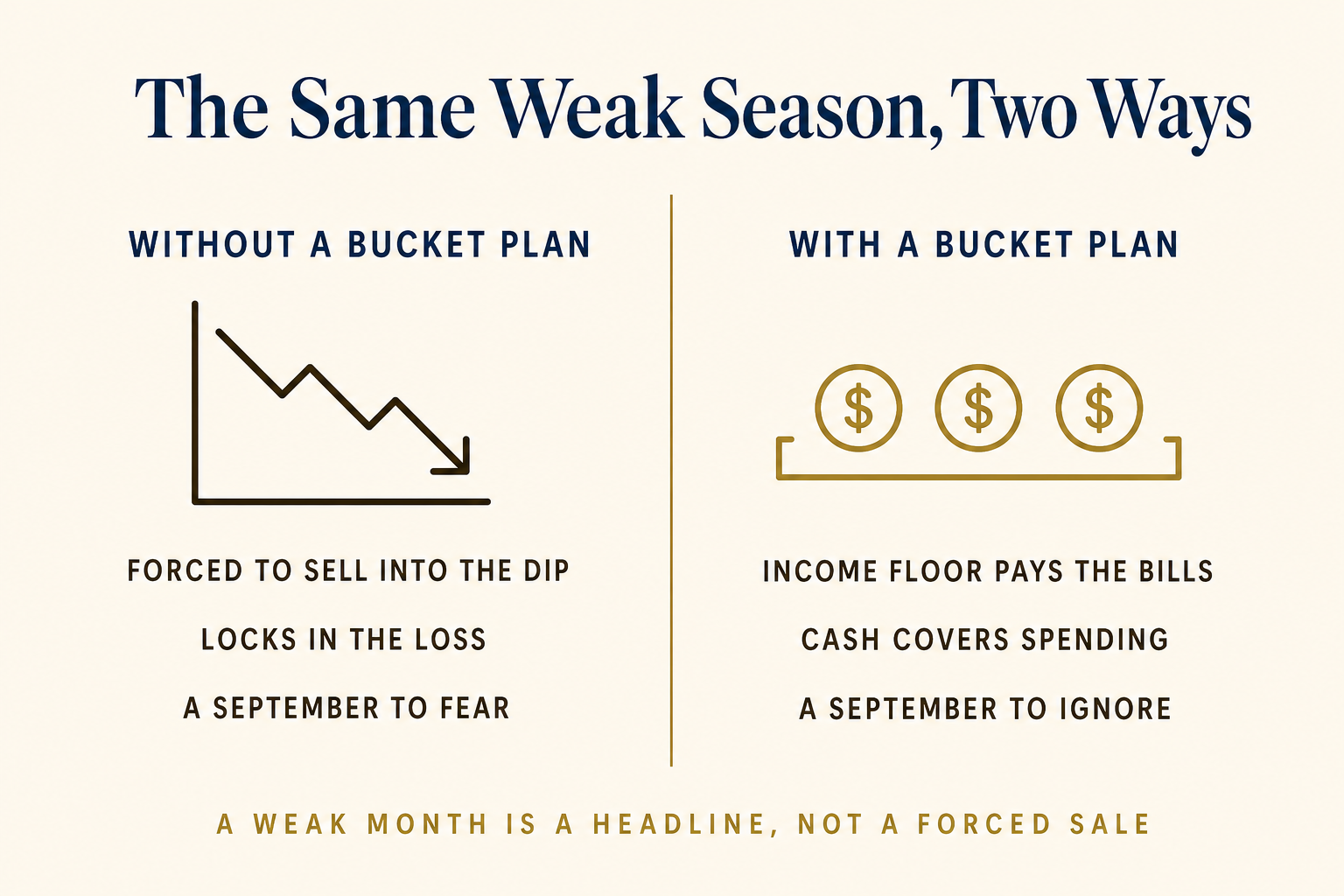
This is where the Now / Soon / Later bucket framework quietly does its job. The reason a September swoon can be a headline instead of an emergency isn’t that you predicted it — it’s that you never gave it the power to force your hand.
The Now bucket — a couple of years of spending in cash and short-term instruments — means the money you’ll actually use in the next stretch isn’t sitting in a market that’s having a bad month. The Soon bucket is your guaranteed income floor: Social Security, any pension, and, for some households, an income-focused annuity built to pay a set amount for life. That floor pays the same in a green September as a red one. And the Later bucket — your growth money — has a horizon measured in a decade or more, which is the only timeframe on which a single weak month means nothing.
Put those together and the seasonal question answers itself before it’s asked. You’re not selling stocks into a September dip to raise cash, because the cash is already set aside and the floor is already covering the bills. That’s the real defense against sequence-of-returns risk — the danger that a bad stretch early in retirement, met with forced selling, does permanent damage. A retiree without that structure experiences August and September as a threat. A retiree with it experiences them as weather.
Consider a hypothetical case. Frank and Sylvia, both 66, just retired near Greenville, South Carolina. Between them, Social Security and Frank’s small pension cover their roughly $5,000 a month of essential expenses — a guaranteed floor they spent years sizing to their actual bills. They keep about two years of spending in cash, and roughly $650,000 in a growth-oriented Later bucket. Frank reads that September is historically the worst month, gets a knot in his stomach, and wants to move the whole Later bucket to cash “just until October.”
Walk it through and the temptation dissolves. Their bills are already covered no matter what stocks do in September, so selling wouldn’t protect a single dollar they’re going to spend this year. What it would do is lock in a tax bill, and stake their long-term growth on guessing both the decline and the recovery — the two-right-answers problem, with real money riding on each. If Frank genuinely can’t shake the worry, the disciplined move isn’t to trade on it — it’s to model it first. A tool like ProjectionLab lets you run your own plan against a bad-season scenario and watch how little your “will I run out” risk actually moves — usually far less than a nervous week makes it feel. (ProjectionLab is an affiliate partner; if you subscribe through that link, Confluence Media Group may earn a commission at no additional cost to you. I only point readers toward tools I’d actually use.)
The calendar belongs to traders. Your plan runs on a floor.
August and September have earned their spot as the market’s weakest months, and they may well live down to the reputation this year — a hawkish Fed, a hot inflation print, and an election can do that. None of it changes what you should do, because the honest answer was decided long before the calendar turned: build a floor under your spending, hold enough cash that no month can force your hand, and let your growth money keep its long horizon.
Do that, and market seasonality becomes a piece of trivia you can appreciate the way you appreciate the tides — interesting, predictable enough, and completely beside the point of whether your bills get paid. The traders can have the calendar. You’ve got a plan.
Key takeaways
- September has historically been the S&P 500’s weakest month and August its runner-up — the only back-to-back pair to average a loss since 1945. It’s a real pattern, and it’s a description of the past, not a forecast.
- Trying to sell before a weak season requires being right twice — exit and re-entry — and market gains cluster so tightly that sitting out the bad days often means missing the best ones.
- A trader may lean lightly on a seasonal tilt with risk capital and a stop loss. A retiree living off a portfolio needs a structure, not a tendency.
- A guaranteed income floor plus a couple of years of cash turns a weak season from a forced-selling emergency into a passing headline.
Frequently asked questions
Should I move to cash for September and buy back in October?
For a long-term retirement portfolio, almost certainly not. You’d need to be right about both the exit and the re-entry, you’d likely owe taxes on the sale in a taxable account, and you’d risk missing the recovery, which often arrives fast and without warning. Holding enough cash and guaranteed income that you’re never forced to sell is the far more reliable defense than trying to time the calendar.
If September is usually weak, isn’t a September dip a buying opportunity?
Sometimes it is, in hindsight — but “usually weak” is an average, and plenty of Septembers finish higher. Rather than trying to call the bottom, a steadier approach is to keep investing on your normal schedule and let a routine rebalance, not the calendar, decide when you’re adding to stocks.
Does market seasonality even still work?
As a rough historical tendency, the pattern still shows up in the long-run averages. As a tradable edge, it’s unreliable — “sell in May” has been wrong for much of the last fifteen years. A tendency measured across seven decades tells you very little about what any single month will do, which is exactly why it’s poor grounds for a real-money decision.
This article is published by Confluence Media Group LLC, an independent publisher of educational financial content. Thomas Clark is a Series 65 Investment Advisor Representative. The information provided is for educational and informational purposes only and is not personalized financial, tax, or legal advice. Past performance does not guarantee future results. All investing involves risk, including potential loss of principal. Consult a qualified professional before making financial decisions.
Confluence Media Group LLC is a separate entity from Confluence Capital Management, the investment advisory practice through which Thomas Clark provides advisory services. Advisory services are not offered through this publishing platform.
About Thomas Clark
Thomas Clark is the founder of Confluence Media Group LLC and a Series 65 Investment Advisor Representative. He has spent nearly two decades working with families on retirement planning, with a focus on Social Security optimization, retirement income coordination, and the bucket planning approach to building a guaranteed income floor.
Thomas writes and publishes at thomasclarkadvisor.com and is the author of The Just in Case Binder — a 148-page printable family financial organizer for households who want to make sure the people they love know where everything is.
He lives in North Carolina with his family.
Subscribe to the weekly newsletter · Get the Just in Case Binder

Thomas Clark is a Series 65 licensed investment advisor and experienced trader. He specializes in investing, retirement planning, and market analysis, helping individuals build wealth and make informed financial decisions.
