
Survivor Benefits: The Switch Most Widows Never Make
After a spouse dies, your own Social Security and your survivor benefit are two separate checks — and you can claim one now and switch to the bigger one later. It's the one sequential-claiming move the 2015 rules left intact, and most survivors never use it.

In 2015, Congress quietly closed the door on the Social Security claiming tricks that financial planners had spent a decade teaching. “File and suspend” was gone. The “restricted application” that let you take a spousal benefit while your own grew to 70 was phased out for almost everyone. The era of claiming one Social Security check now and switching to a bigger one later was, for most people, over.
Except in one situation. If you are widowed, that door is still wide open.
Survivor benefits were never subject to the rules that shut down everyone else’s switching strategies. That makes being a widow or widower the one remaining case where you can deliberately claim a smaller benefit first, let a larger one keep growing, and switch when the timing is right. Most survivors never do it — because no one tells them it’s allowed, and Social Security’s own system will often quietly pick the wrong one for them.
You have two checks, not one
Here’s the part that catches people off guard. After your spouse dies, you don’t have a single Social Security benefit. You have two separate benefits sitting side by side: your own retirement benefit, built on your own earnings record, and a survivor benefit, built on your late spouse’s record.
You can only collect one at a time — Social Security pays you the one you’ve claimed, not both stacked together. But the two are independent. You can claim one now and leave the other untouched, still growing, and come back for it later. That single fact is the entire strategy.
The survivor benefit can start as early as age 60 (or 50 if you’re disabled, or any age if you’re caring for your late spouse’s child who is under 16). Your own retirement benefit can start as early as 62. Because they open on different clocks and grow at different rates, the order you take them in can be worth tens of thousands of dollars over a long retirement.
Why the switch still works when every other one died
The 2015 Bipartisan Budget Act killed sequential claiming by introducing “deemed filing.” Under that rule, when you file for your own retirement benefit, you’re automatically deemed to have filed for any spousal benefit you qualify for too — so you can’t take one and save the other. That’s what ended the restricted-application strategy.
Deemed filing applies to retirement and spousal benefits. It has never applied to survivor benefits. The Social Security Administration treats a survivor benefit as a completely separate entitlement, and filing for one does not force you to file for the other. That’s the whole reason the widow’s switch survived a law that was written specifically to stop this kind of move.
So the flexibility that was taken away from married couples still exists for survivors. It’s not a loophole or a gray area. It’s how the rules are written.
The two ways to run it
There are only two patterns, and which one fits you comes down to a single question: which benefit will eventually be larger, yours or your late spouse’s?
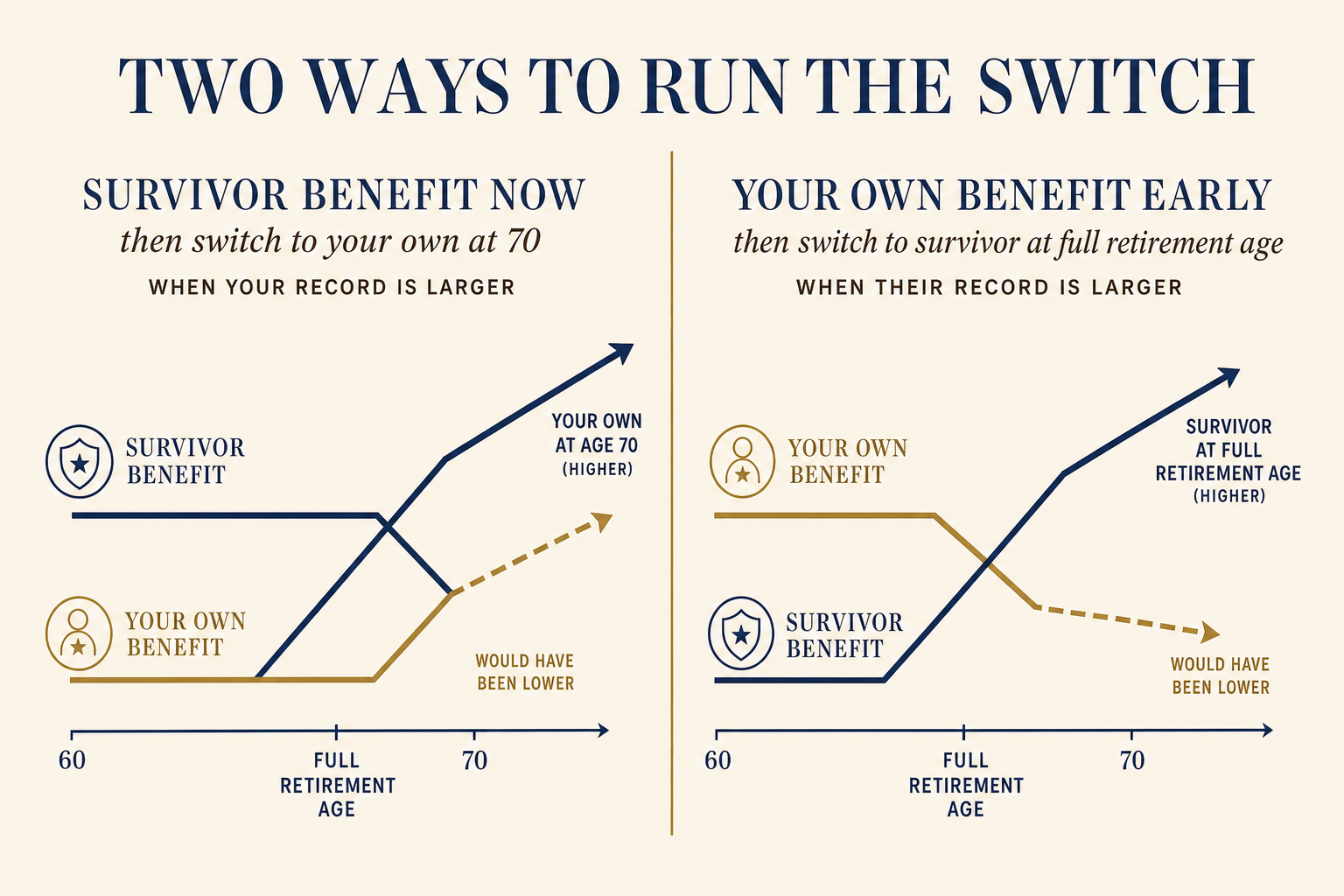
Pattern one — take the survivor benefit now, let your own grow to 70. This is the move when your own earnings record is strong. You claim the survivor benefit (reduced if you’re before full retirement age, full once you reach it), live on it, and let your own retirement benefit collect delayed retirement credits of about 8% per year until it maxes out at 70. Then you switch to your own, now permanently larger. You’ve essentially let Social Security pay you for the years you were waiting.
Pattern two — take your own benefit early, switch to the survivor benefit at full retirement age. This is the move when your late spouse’s benefit will be the bigger one. You claim your own reduced retirement benefit as early as 62, take the smaller check for a few years, and switch to the full survivor benefit once you reach your survivor full retirement age. Claiming your own benefit early does not reduce the survivor benefit — again, they’re separate — so the early reduction only ever applies to the check you’re leaving behind.
The detail that drives the whole decision
Your own retirement benefit and a survivor benefit do not stop growing at the same age, and that asymmetry is where most of the money is won or lost.
Your own retirement benefit keeps earning delayed credits all the way to age 70. A survivor benefit does not. It reaches its maximum at your survivor full retirement age and grows no further — waiting past that point earns you nothing extra. There is no reason on earth to delay a survivor benefit past your full retirement age.
Thomas’ Take: This is the piece almost everyone gets backwards. People assume both checks reward patience equally, so they sit on whichever one they’ve claimed and wait. But the survivor benefit tops out years earlier than your own. If you’re going to let one benefit ripen to 70, it has to be your own retirement benefit — never the survivor benefit, which was already done growing at full retirement age.
A hypothetical: Elena, 63
Consider a hypothetical case. Elena is 63 and recently widowed. She spent her career as a hospital nurse and has a solid earnings record of her own. Her own retirement benefit would be about $2,000 a month at her full retirement age of 67 — and if she delayed it to 70, delayed credits would push it to roughly $2,480. Her late husband Marco was the lower earner late in his career; his benefit, which becomes her survivor benefit, is about $2,300 a month. (These are illustrative, round numbers, not a quote or a projection.)
Elena’s instinct is to call Social Security, claim “her benefits,” and be done. If she does that at 63, the system is likely to put her on a reduced version of the larger benefit available right now and stop there. She’d be leaving the switch unused.
Run it deliberately instead. Elena claims the survivor benefit now. It’s reduced somewhat because she’s before full retirement age, but it gives her an income floor to live on. Meanwhile her own retirement benefit sits untouched, climbing toward that $2,480 figure at 70. At 70, she switches to her own benefit — now the larger of the two, and locked in for life, with every future cost-of-living adjustment compounding on the bigger number. The years she spent on the survivor benefit were years her own check was being paid to wait.
Change one fact — say Elena’s own benefit would only ever reach $1,600 — and you flip to pattern two: she takes her modest own benefit early and switches to the $2,300 survivor benefit at her full retirement age. Same tool, mirror image.
The traps that quietly cost survivors money
The strategy is simple. The ways it gets wrecked are specific, and worth knowing before you ever pick up the phone. (And maximizing the check is only half the survivor’s financial picture — the year a spouse dies also brings a quiet tax jump worth planning for separately.)
Letting Social Security choose for you. When you apply, the representative is not required to map out your optimal switching strategy. If you ask to “file for benefits,” you may be filed for whichever one pays more today — which can silently forfeit the larger lifetime path. You have to tell them explicitly that you want to restrict your application to one benefit and claim the other later. Say it plainly, and say which one.
The RIB-LIM cap. If your spouse claimed their own benefit early, before their full retirement age, the survivor benefit you inherit can be limited — generally to the greater of what they were actually receiving or 82.5% of their full benefit amount. It doesn’t erase the strategy, but it changes the numbers, so don’t assume the survivor benefit equals your spouse’s full retirement-age figure if they claimed at 62.
The earnings test. If you claim either benefit before your full retirement age and you’re still working, the earnings test can temporarily withhold part of your check once your wages pass the annual limit. For a survivor who’s bridging with a part-time job, this matters — it may push you toward claiming the survivor benefit later, or toward pattern two.
None of this requires a professional to execute. It requires knowing the two benefits are separate, knowing which one will be bigger, and telling Social Security exactly what you want instead of letting the default run.
If you want to see how the two patterns play out against your own numbers before you call, you can run different claiming ages through our free Social Security calculator and compare the lifetime paths side by side.
Key takeaways
- As a survivor, your own retirement benefit and your survivor benefit are two separate checks — you can claim one now and switch to the other later.
- Deemed filing, which ended switching for everyone else in 2015, never applied to survivor benefits. That’s why the move still works.
- Your own benefit grows until 70; a survivor benefit maxes out at your full retirement age. Only your own benefit is ever worth delaying past full retirement age.
- Take the survivor benefit first when your own record is stronger; take your own first when your late spouse’s benefit will be larger.
- Tell Social Security explicitly that you’re claiming one benefit and restricting the other — the system won’t optimize this for you.
Frequently asked questions
Can I really collect a survivor benefit and still let my own grow?
Yes. You claim the survivor benefit, and your own retirement benefit keeps earning delayed credits until you choose to switch, up to age 70. The two don’t interfere with each other.
Does claiming my own benefit early reduce my survivor benefit?
No. The early-claiming reduction applies only to the benefit you actually claim early. Your survivor benefit is calculated separately and isn’t cut because you took your own retirement benefit at 62.
What if I remarry?
If you remarry before age 60, you generally lose eligibility for survivor benefits on your late spouse’s record. Remarrying at 60 or later does not affect them. The rules around remarriage are their own subject, and worth checking carefully before you make a decision that’s hard to undo.
Losing a spouse is not the moment anyone wants to think about Social Security paperwork. But the first claiming decision a survivor makes often becomes permanent, and the default the system reaches for is rarely the one that pays the most over a long life. Knowing you have two checks instead of one — and that you get to choose the order — is the difference between taking what’s handed to you and claiming what you’re actually owed.
This article is published by Confluence Media Group LLC, an independent publisher of educational financial content. Thomas Clark is a Series 65 Investment Advisor Representative. The information provided is for educational and informational purposes only and is not personalized financial, tax, or legal advice. Past performance does not guarantee future results. All investing involves risk, including potential loss of principal. Consult a qualified professional before making financial decisions.
Confluence Media Group LLC is a separate entity from Confluence Capital Management, the investment advisory practice through which Thomas Clark provides advisory services. Advisory services are not offered through this publishing platform.
About Thomas Clark
Thomas Clark is the founder of Confluence Media Group LLC and a Series 65 Investment Advisor Representative. He has spent nearly two decades working with families on retirement planning, with a focus on Social Security optimization, retirement income coordination, and the bucket planning approach to building a guaranteed income floor.
Thomas writes and publishes at thomasclarkadvisor.com and is the author of The Just in Case Binder — a 148-page printable family financial organizer for households who want to make sure the people they love know where everything is.
He lives in North Carolina with his family.
Subscribe to the weekly newsletter · Get the Just in Case Binder

Thomas Clark is a Series 65 licensed investment advisor and experienced trader. He specializes in investing, retirement planning, and market analysis, helping individuals build wealth and make informed financial decisions.
