
The First $100,000 Is the Hardest. Here’s the Math.
For the first several years, investing feels broken - because at low balances your contributions do almost all the work and the market barely shows up. Here's the compounding math behind why the first $100,000 is the hardest, and why quitting early is the costly mistake.

Charlie Munger put it about as bluntly as anyone ever has: the first $100,000 is the hardest part of building wealth. Get past it, he said, and you can “ease off the gas a little.” People love the quote because it sounds like encouragement. It isn’t. It’s arithmetic.
Here’s the part nobody warns you about: for the first several years of investing, it genuinely feels like nothing is working. You put money in, the balance barely moves, the market does something dramatic on the news, and your account yawns. So a lot of people conclude investing “doesn’t really work for someone like me” and quit — right before the only part that matters kicks in. Let me show you why the early stretch feels broken, why it isn’t, and what actually gets you through it.
Why the first $100,000 feels like it’s not working
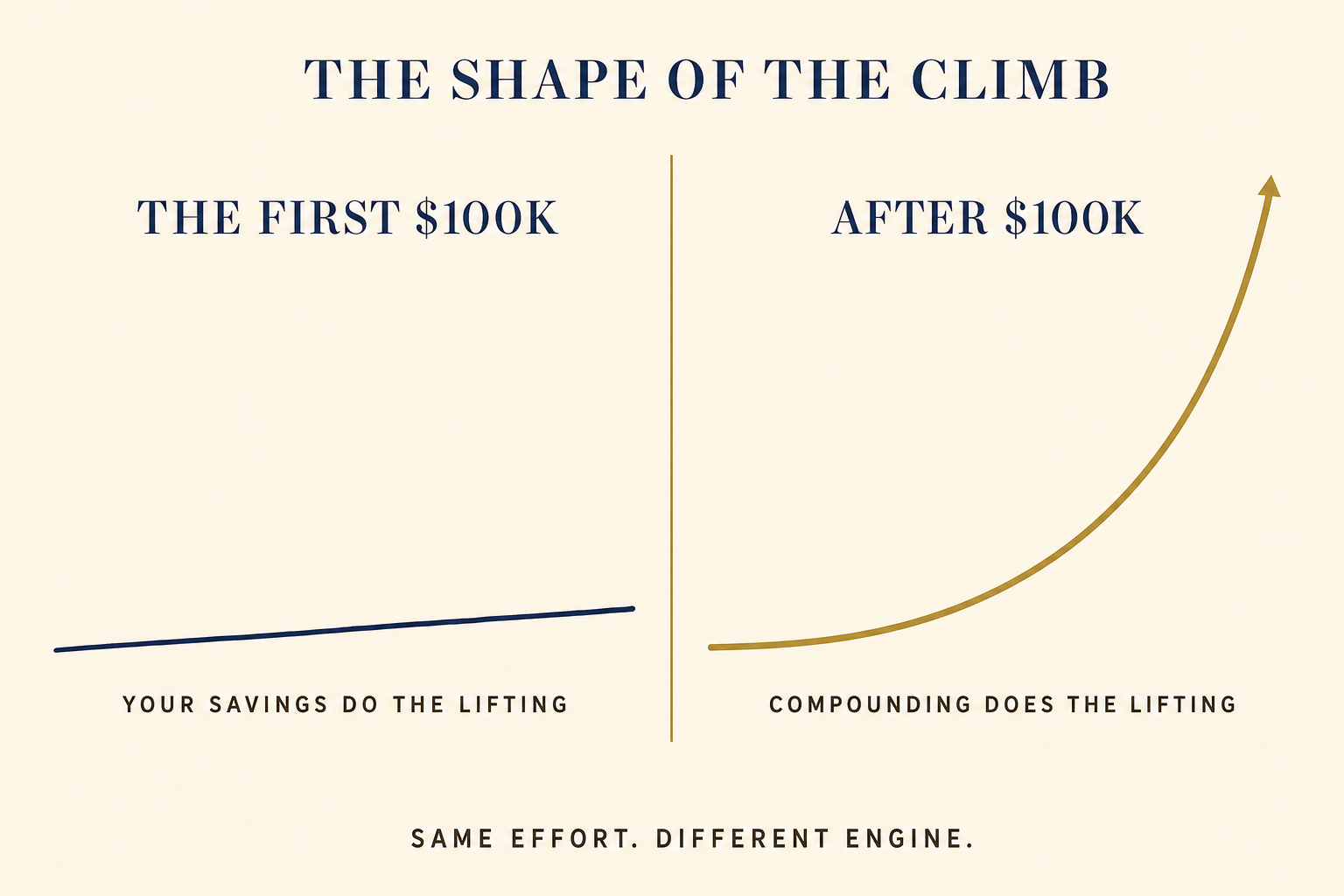
Early on, your contributions do almost all the work, and the market does almost none. That’s not a failure of your investments. It’s math.
Say you’re putting away $500 a month — $6,000 a year. When your balance is $10,000, a strong 7% year adds about $700. Your own savings added $6,000. You are doing roughly 90% of the lifting; the market is a rounding error. No wonder it feels like the market doesn’t matter — at that balance, it basically doesn’t.
This is the trap. You’ve been told compounding is magic, you signed up for the magic, and for years the magic is nowhere to be seen. The problem isn’t the strategy. The problem is that you’re judging a long-run engine by its first few laps.
(For context, U.S. stocks have historically averaged something like 10% a year before inflation and closer to 7% after, over long periods — but that’s a smoothed long-run average, not a promise, and certainly not what any single year looks like. Real markets zigzag. I’m using 7% below purely as a round illustration.)
The crossover: where the market starts outworking you
Now watch what happens as the balance grows, with your contribution held steady at $6,000 a year:
- At $10,000, a 7% year adds about $700. You add $6,000. You’re the engine.
- At $100,000, a 7% year adds about $7,000 — now the market is contributing more than you are.
- At $500,000, a 7% year adds about $35,000 — nearly six times your own contributions.
Somewhere around $100,000, the balance quietly crosses a line. Below it, you are carrying the account. Above it, the account starts carrying you. The machine you spent years building finally switches on — and from that point, your job shifts from pushing to mostly not getting in the way.
That’s the real reason the first $100,000 is the hardest. It isn’t harder because the dollars are bigger. It’s harder because it’s the only stretch where you have to supply almost all the force yourself, with almost no visible help, on faith that the help is coming. If you’re skeptical of my arithmetic, you don’t have to take my word for it — the SEC’s free compound interest calculator will run the same math on your own numbers.
A hypothetical worth sitting with
Consider a hypothetical case: Maya, 26, just started her first real job and decides to invest $500 a month into a low-cost, broadly diversified index fund inside a Roth IRA. She’s not picking stocks, not timing anything — just automating the same $500, month after month. (The figures below are illustrative and rounded, assume a smoothed 7% a year, and are not a projection — her real results would bounce around a lot more.)
For the first decade, it’s a slog. Around age 38 — roughly 12 years in — she finally crosses $100,000. And here’s the thing that should stop you: of that first $100,000, she personally contributed about $72,000. Twelve years of discipline, and the market only chipped in about $28,000. If she were grading the market on those twelve years alone, she’d be unimpressed.
Then the curve bends. The second $100,000 takes about five years instead of twelve. By her mid-60s, that steady $500 a month has illustratively grown to something north of $1 million — of which only about $240,000 was money she put in. The other roughly three-quarters is growth she didn’t lift a finger for. Same contribution the whole way. Completely different engine doing the work on each end.
Maya didn’t get rich because she was brilliant. She got there because she didn’t quit during the twelve boring years when it looked like it wasn’t working.
The behavioral trap hiding in the flat part
This is where most wealth-building actually dies — not in a market crash, but in the quiet stretch where nothing seems to be happening. The early flat part is emotionally brutal precisely because it’s uneventful. There’s no payoff to point to, no dopamine, nothing to post about. Meanwhile someone you know just doubled their money on something and won’t stop talking about it.
So people do the thing that feels smart and is actually expensive: they stop. Or they go looking for a shortcut — a hot stock, a crypto moonshot, a “strategy” — because slow-and-boring clearly “isn’t working.” They abandon the one approach that was about to pay off, in favor of the one that usually doesn’t.
The uncomfortable truth is that the boring stretch is the strategy. The persistence isn’t a nice-to-have alongside the math — it’s the input the math requires. Compounding only rewards the money that stays.
Thomas’ Take: I spent years in active trading, and here’s what it taught me about this: the hardest skill in markets isn’t finding the big winner. It’s sitting still long enough for an ordinary plan to become an extraordinary result. The flashy move is almost always the enemy of the first $100,000.
What actually gets you to $100,000 faster
If the market barely moves the needle early on, then the levers that do matter are the ones you control. Three of them do nearly all the work:
Your savings rate, not your returns. When your balance is small, how much you feed it dwarfs how it performs. Chasing an extra percentage point of return on $15,000 is a rounding error; raising your monthly contribution is not. Early on, you don’t have a returns problem — you have a contributions opportunity. (The SEC’s savings goal calculator is a quick way to see how much a higher monthly amount changes your timeline.) I made the fuller case for this in why your savings rate matters more than your returns.
Automation beats willpower. The reason Maya’s plan worked isn’t that she was disciplined every month — it’s that she only had to decide once. Automating a fixed amount on a schedule (plain dollar-cost averaging) takes the monthly “should I?” off the table, which is exactly the decision people get wrong when markets are scary. I looked at whether that steady approach costs you anything versus investing all at once in dollar-cost averaging vs. lump sum.
Don’t over-engineer a small account. People will spend three weekends optimizing a fund lineup for a $9,000 balance. The optimization barely matters at that size; the contributions matter enormously. Get the money going in automatically first, into something broad and low-cost, and refine the details once there’s a real balance to refine. If you want a sane sequence for which dollar goes where — emergency fund, match, high-interest debt, and so on — I laid one out in the financial order of operations.
And once that first $100,000 is built and compounding takes over, this money has a job later in life too: it becomes the growth engine of your Later bucket — the long-horizon money that doesn’t need to be touched for decades, which is exactly the money that benefits most from being left alone.
The payoff nobody tells you about
Here’s what the first $100,000 actually buys you, and it isn’t just the balance. It buys proof. For the first time, you’ve watched the market contribute more in a year than you did, and you understand — not as a slogan, but as something you’ve personally seen — that the machine works. After that, wealth-building stops being an act of faith and becomes an act of patience. Those are very different, and the second one is much easier to sustain.
Munger’s “ease off the gas” line is really a promise: the effort is front-loaded. The hardest, least rewarding, most faith-dependent part of your entire investing life is the beginning — the exact part you’re in right now if you’re just starting. That’s not a reason to quit. It’s the reason not to.
If you want to see what your own version of Maya’s curve looks like — your contribution, your timeline, a few bad markets in a row thrown in — it’s worth modeling rather than guessing. A planning tool like ProjectionLab lets you run your own numbers and watch where your crossover point actually lands.
Disclosure: the ProjectionLab link above is an affiliate link. If you subscribe through it, I may earn a commission at no additional cost to you. I only point to tools I’d actually sit down and use.
Key takeaways
- Early on, your contributions do almost all the work and the market does almost none — so investing feels broken when it’s simply young.
- Around $100,000, annual growth starts to exceed your annual contributions. That crossover is when compounding takes over the lifting.
- Most people quit in the flat early stretch — the persistence through it is the strategy, because compounding only rewards money that stays invested.
- The levers you control — savings rate, automation, and not over-tinkering a small account — matter far more than returns before you hit six figures.
- The first $100,000 buys proof the machine works; after that, wealth-building shifts from faith to patience.
This article is published by Confluence Media Group LLC, an independent publisher of educational financial content. Thomas Clark is a Series 65 Investment Advisor Representative. The information provided is for educational and informational purposes only and is not personalized financial, tax, or legal advice. Past performance does not guarantee future results. All investing involves risk, including potential loss of principal. Consult a qualified professional before making financial decisions.
Confluence Media Group LLC is a separate entity from Confluence Capital Management, the investment advisory practice through which Thomas Clark provides advisory services. Advisory services are not offered through this publishing platform.
About Thomas Clark
Thomas Clark is the founder of Confluence Media Group LLC and a Series 65 Investment Advisor Representative. He has spent nearly two decades working with families on retirement planning, with a focus on Social Security optimization, retirement income coordination, and the bucket planning approach to building a guaranteed income floor.
Thomas writes and publishes at thomasclarkadvisor.com and is the author of The Just in Case Binder — a 148-page printable family financial organizer for households who want to make sure the people they love know where everything is.
He lives in North Carolina with his family.
Subscribe to the weekly newsletter · Get the Just in Case Binder

Thomas Clark is a Series 65 licensed investment advisor and experienced trader. He specializes in investing, retirement planning, and market analysis, helping individuals build wealth and make informed financial decisions.
