
Will Social Security Be There? What 2033 Really Means
The Social Security trust fund is projected to run short in 2033 - but that's a potential benefit reduction, not a shutdown. Here's what the 2033 date really means, and why claiming early out of fear usually backfires.

Almost every week, someone in their early sixties tells me a version of the same thing: “I’m going to claim Social Security the moment I’m eligible, because I don’t think it’ll be there much longer.” I understand the worry. Headlines have warned that the trust fund is “running out” for as long as most of us have been paying into it.
But claiming early because you’re afraid the program is vanishing is one of the most expensive money mistakes a pre-retiree can make. And it’s built on a misreading of what the widely quoted 2033 date actually means. So let’s separate the fear from the facts, because the facts are less frightening than the headlines, and the fear itself is what does the real financial damage.
What the 2033 date actually means
Social Security isn’t a personal savings account with your name on it. It’s a pay-as-you-go system: the payroll taxes coming out of today’s workers’ paychecks fund today’s retirees’ checks. For decades those taxes brought in more than the program paid out, and the surplus piled up in a reserve called the trust fund.
That reserve is now being drawn down as the Baby Boomers retire in force. According to the 2025 Social Security Trustees Report, the retirement trust fund — technically the Old-Age and Survivors Insurance (OASI) fund — is projected to be depleted in 2033. Combine it with the disability fund and the projected date is 2034.
Here’s the part the scary headlines leave out. “Depleted” does not mean “zero.” Even after the reserve runs dry, payroll taxes keep flowing in from every working American — and those taxes are projected to cover about 77% of scheduled benefits. So the honest worst case, if Congress does absolutely nothing between now and then, is not that Social Security disappears. It’s roughly a 23% reduction. That’s a serious problem that deserves a real fix. It is not the same problem as “the checks stop coming.”
Why 77% is the number that should calm you down
A 23% cut would hurt, and I’m not waving it away. But notice how different that is from what most people are picturing when they rush to file at 62 to “get theirs while they still can.”
Two more things are worth knowing. First, this is a projection, not a schedule. It assumes zero legislative change for the better part of a decade, which has never once happened in the program’s history. In 1983, with the trust fund only months from insolvency, a divided Congress passed a bipartisan rescue — gradually raising the full retirement age, taxing a portion of benefits, and adjusting the payroll tax. Social Security has been patched before, under worse near-term pressure than it faces today.
Second — and this is the part I want you to sit with — even if benefits were trimmed, the cut would not reward you for claiming early. It would be a percentage of whatever you’re owed. Taking a smaller check now doesn’t let you dodge a future haircut. It just locks in a smaller base for the haircut to cut from.
Thomas’ Take: The 2033 date is a reason to pay attention to what Congress does, not a reason to blow up your own claiming strategy. You cannot fix the trust fund by filing early. You can only shrink your own check — for the rest of your life, and your spouse’s.
The expensive mistake the fear causes
Here’s where the anxiety turns into real dollars. Your benefit is built from your full retirement age amount — what the SSA calls your “primary insurance amount.” File at 62 and you accept a permanent reduction of about 30% (for anyone whose full retirement age is 67, which is everyone born in 1960 or later). That figure comes straight from the SSA’s early-retirement rules. Wait past full retirement age instead and you earn delayed retirement credits worth 8% a year up to age 70, which lifts your check to 124% of that base.
That is not a small spread. Between 62 and 70, the same worker’s monthly benefit nearly doubles — and every future cost-of-living adjustment compounds on the larger number, permanently.
Now put the two ideas together. Suppose you’re so worried about the 2033 cut that you claim at 62 to beat it. You’ve just volunteered for a roughly 30% reduction in order to sidestep a possible 23% one — and if that cut does arrive, it lands on your already-shrunken check anyway. You didn’t outrun the system. You cut yourself twice.
What the numbers look like
Consider a hypothetical case. Karen is 62, recently retired from a school-district job in suburban Charlotte, and her full retirement age benefit at 67 would be about $2,400 a month. She’s healthy, has longevity on both sides of her family, and doesn’t strictly need the income yet — but the trust fund headlines have her spooked.
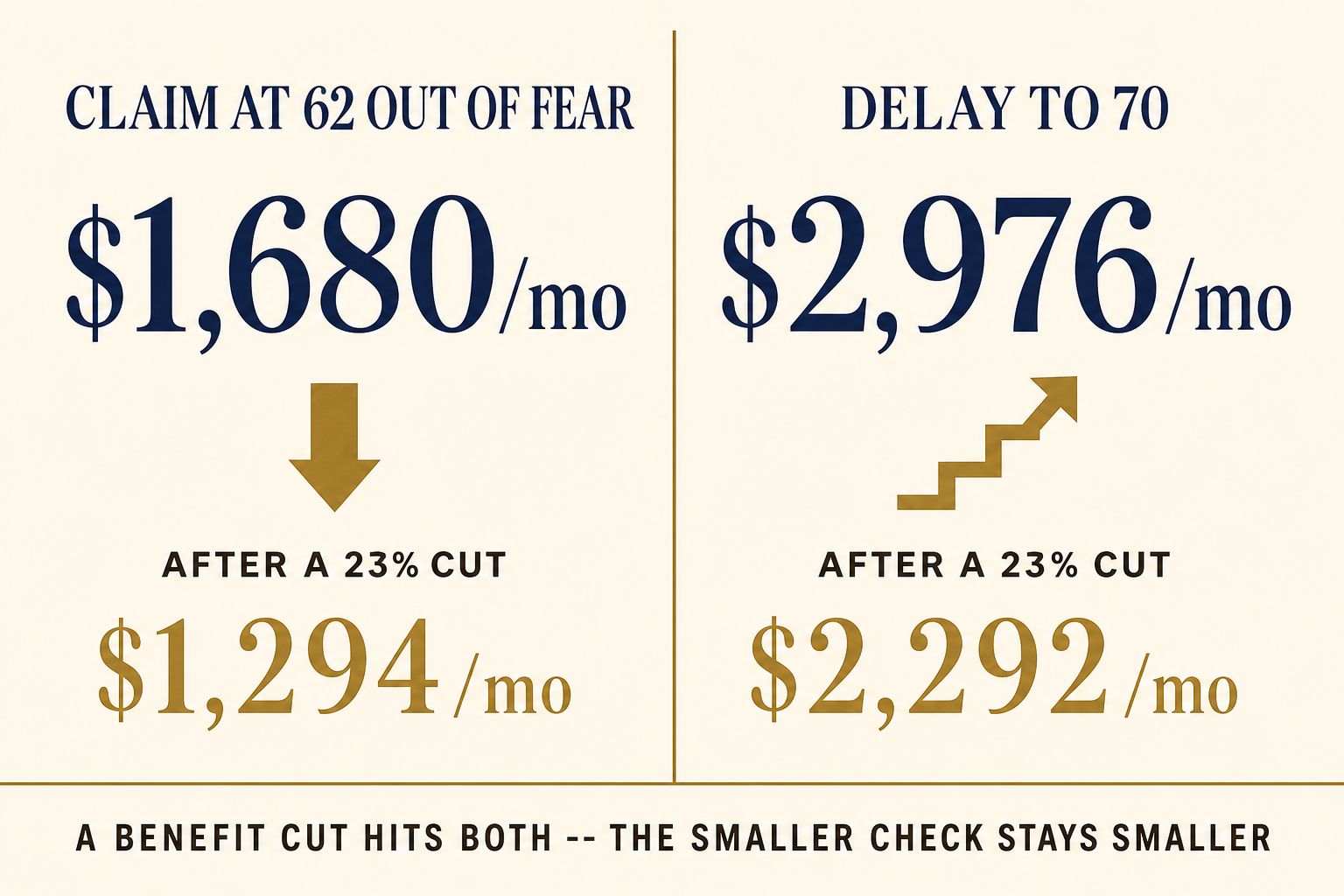
If Karen files now at 62, her benefit is roughly $1,680 a month. If she waits until 70, it’s about $2,976. Now suppose the worst case actually happens and scheduled benefits are reduced 23% across the board starting in 2033. Karen’s early check would fall to about $1,294; her delayed check would fall to about $2,292. The reduction lands on both — but the larger check stays larger by nearly a thousand dollars a month, for the rest of her life, and for her surviving spouse’s life after that.
The fear told Karen to grab the money early. The math says that fear-driven move is precisely the one that leaves her most exposed. This is the same conclusion I reached when I argued that the break-even age is the wrong way to decide when to claim — Social Security is longevity insurance, and the fear-driven early claim quietly throws that insurance away.
None of this means claiming at 62 is always wrong. If you’re in poor health, if you’re single with no survivor to protect, or if you genuinely need the income to keep from selling investments at a loss in a down market, an early claim can be exactly the right call — those are real, individual reasons that deserve their own math. The point here is narrower: a general fear that the program will disappear is not one of those good reasons, and it’s the one that most often pushes people into a decision that works against them.
What you can actually control
You cannot personally fix Social Security’s financing. What you can do is build a retirement plan that doesn’t hinge on a headline.
This is exactly what the Now, Soon, and Later bucket framework is for. Social Security lives in the Soon bucket — the guaranteed income floor that covers your essential bills. The stronger and more inflation-protected that floor is, the less any single market scare or policy headline can shake the rest of your plan. Delaying the higher earner’s benefit is usually the cheapest way to buy more of that floor, because a bigger Social Security check is a bigger, COLA-adjusted, government-backed stream of lifetime income — and it protects a surviving spouse, too, since the survivor keeps the larger of the two checks.
If you’re genuinely worried about future benefit levels, the productive response isn’t to grab a reduced check out of anxiety. It’s to size your Soon bucket honestly, coordinate the claiming decision with your spouse, and stress-test your plan against a lower-benefit scenario so you know you’d be fine either way.
Before you lock in a claiming age out of fear, run your own numbers. Our free Social Security calculator lets you compare claiming ages side by side — and because you can apply your own reduction to the results, you can see for yourself how your plan holds up even in a trimmed-benefit world.
The bottom line
Social Security is facing a real financing gap, and it deserves a real legislative fix. But “the trust fund is projected to run short in 2033” and “Social Security won’t be there” are two very different sentences, and the space between them is where a lot of retirees quietly cost themselves money. Plan for the program as it actually works — a 77%-funded worst case, a long track record of fixes, and a benefit that grows the longer you wait. Don’t let a headline make the single most valuable claiming decision of your life on your behalf.
Key takeaways
- The 2025 Trustees Report projects the retirement trust fund is depleted in 2033, after which payroll taxes would still cover about 77% of scheduled benefits — a potential ~23% cut, not a shutdown.
- The projection assumes no law changes for years; Congress has fixed the program before, most notably in 1983.
- Claiming early to “beat the cut” backfires: a future reduction would apply to your smaller check too, so you’d cut your benefit twice.
- Waiting from 62 to 70 nearly doubles the monthly benefit and compounds every future COLA on the larger number.
- You can’t control Social Security’s financing, but you can build a guaranteed income floor that makes your plan resilient either way.
Frequently asked questions
Will Social Security really run out of money in 2033?
No. The Trustees project the retirement trust fund’s reserves are depleted around 2033, but incoming payroll taxes would still fund roughly 77% of scheduled benefits after that. “Reserves depleted” is not the same as “program bankrupt,” and it assumes Congress makes no changes in the meantime.
Should I claim early to lock in my benefits before a possible cut?
For most people, no. A future across-the-board reduction would apply to early claimers as well, so filing early doesn’t shield you — it just permanently reduces the base that any reduction would be measured against. Claiming early trades a certain, permanent cut for the chance to avoid an uncertain one.
Would a shortfall affect people who are already collecting?
A reduction at trust fund depletion would apply to scheduled benefits generally, but history strongly favors a legislative fix before that point. That’s a reason to follow the policy debate — not a reason to distort your own claiming decision today.
This article is published by Confluence Media Group LLC, an independent publisher of educational financial content. Thomas Clark is a Series 65 Investment Advisor Representative. The information provided is for educational and informational purposes only and is not personalized financial, tax, or legal advice. Past performance does not guarantee future results. All investing involves risk, including potential loss of principal. Consult a qualified professional before making financial decisions.
Confluence Media Group LLC is a separate entity from Confluence Capital Management, the investment advisory practice through which Thomas Clark provides advisory services. Advisory services are not offered through this publishing platform.
About Thomas Clark
Thomas Clark is the founder of Confluence Media Group LLC and a Series 65 Investment Advisor Representative. He has spent nearly two decades working with families on retirement planning, with a focus on Social Security optimization, retirement income coordination, and the bucket planning approach to building a guaranteed income floor.
Thomas writes and publishes at thomasclarkadvisor.com and is the author of The Just in Case Binder — a 148-page printable family financial organizer for households who want to make sure the people they love know where everything is.
He lives in North Carolina with his family.
Subscribe to the weekly newsletter · Get the Just in Case Binder

Thomas Clark is a Series 65 licensed investment advisor and experienced trader. He specializes in investing, retirement planning, and market analysis, helping individuals build wealth and make informed financial decisions.
