
A Falling Market, a Hawkish Fed, and Your Safe Money
The market just had its worst week since 2020 — and this time the Fed isn't cutting to the rescue. For retirees, the same high rates pressuring stocks are quietly paying safe money the most in years.

In the week that just ended, the stock market had its worst five days since the spring of 2020. The S&P 500 fell roughly 8.6%, the Nasdaq dropped about 10% and slipped into what Wall Street calls a correction — erasing its gains for the entire year. The Dow posted its worst week since March 2020.
Here is what makes this one different from the usual scary headline: the Federal Reserve is not riding to the rescue. In past selloffs, investors could count on the Fed to start cutting interest rates to cushion the fall. This time, the Fed’s own meeting minutes read hawkish, and the futures market is now pricing in a near-certain rate hike at the December meeting — not a cut.
That sounds like bad news stacked on bad news. And if you are decades from retirement with everything in stocks, a rough week is just a rough week — keep investing. But if you are retired or close to it, there is a second story buried inside this one that almost nobody is telling: the same high interest rates pressuring stocks are quietly paying your safe money the most it has earned in more than a decade. Let’s walk through what actually happened, why it breaks the usual script, and what it means for how you are positioned.
What actually happened this week
Two forces hit at once. The first was the unwinding of the “AI trade” — the handful of giant technology and AI-related stocks that had powered the market all year. A closely watched artificial-intelligence company’s stock-market debut turned into a reason to take profits rather than the start of a new leg up, and the megacap names that had carried the indexes sold off hard. When a few large stocks pull an index up, they can pull it down just as fast. That is concentration risk in plain sight, and it is exactly why diversification matters.
The second force was the Fed. The minutes from its last meeting showed that almost all officials expect further rate increases, and the market now puts the odds of a quarter-point hike at the December Federal Reserve meeting somewhere in the mid-90s to near-100%. The Fed’s target range already sits at 3.75%–4.00%. For a market that had been leaning on the hope of rate cuts, a Fed signaling the opposite was a cold shower.
Why this selloff breaks the usual script
For years, investors relied on something traders nicknamed the “Fed put” — the belief that if a market decline got bad enough, the Fed would step in and cut rates to stop it. That belief was a safety net under every dip.
This week, that net is not showing up. With inflation still a live concern, the Fed is signaling higher-for-longer, even into market weakness. For an investor who is all-in on stocks and counting on a rescue, that is a genuine loss of a familiar cushion.
But here is the thing: a retirement plan was never supposed to depend on the Fed catching anything. If your plan is built on guaranteed income and a cash cushion rather than on the Fed’s next move, this week changes far less than the headlines suggest. And in one specific way, it actually helps.
The part nobody is celebrating: your safe money just got a raise
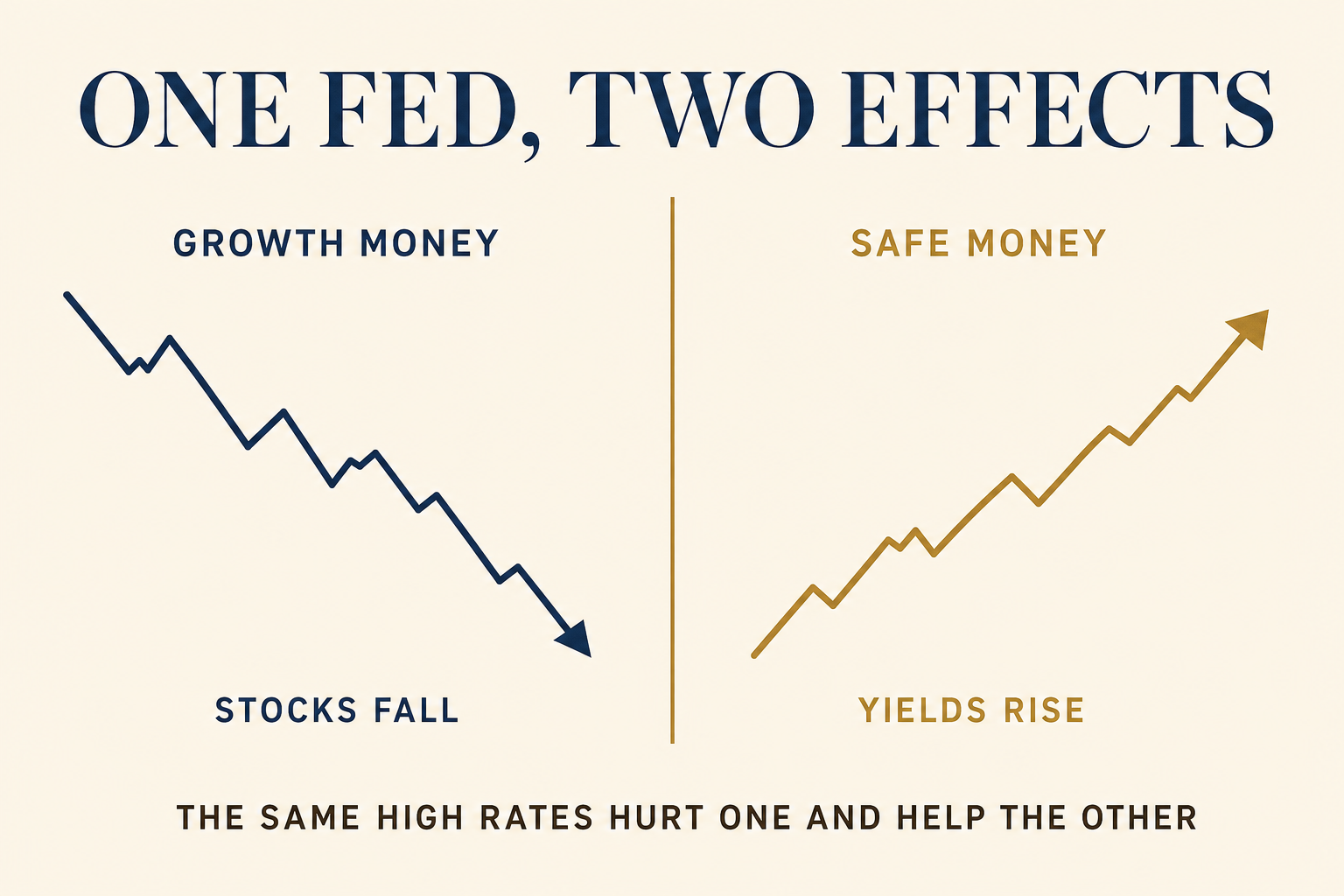
Higher rates are brutal for the growth side of a portfolio. But they are a gift to the cash-and-bonds side. The same interest-rate environment works in opposite directions depending on which money you are talking about.
As of mid-November, the 10-year Treasury yield sat near 5%. Short-term Treasuries and the most competitive certificates of deposit were paying in the neighborhood of 4.5%–5%, and money market funds were yielding in the high-3s to around 4%. A quick jargon check: a Treasury is a loan to the U.S. government; a certificate of deposit (CD) is a time deposit at a bank that is FDIC-insured; a money market fund is an investment fund that holds very short-term, high-quality debt (and, unlike a bank account, is not FDIC-insured). These rates move, so treat the numbers as a snapshot, not a promise.
Now connect that to how a retirement plan is actually built. The money you keep safe — your near-term spending cash and the stable layer behind it — is earning real yield for the first time since before the 2010s. The exact force dragging the growth side down is lifting the return on everything you are deliberately keeping out of the market.
Thomas’ Take: For most of the 2010s, holding two or three years of spending in cash felt expensive, because it paid almost nothing. Today, that same safety is paying you to hold it. I don’t love watching the growth side of anyone’s accounts take a hit — but a world where your safe money finally earns its keep is a genuinely better one to retire into, not a worse one.
What a bucket plan does in a week like this
If you have read much of what I write, you know the structure I come back to: the Now, Soon, and Later buckets. A week like this one is exactly what that structure is designed to absorb.
Your Now bucket — one to two years of spending held in cash and money market funds — did not fall this week. It is sitting in the one corner of your plan that rising rates reward, and it is now earning more than it has in years.
Your Soon bucket — the guaranteed income floor built from Social Security, a pension if you have one, and income-focused tools like Fixed Index Annuities — is untouched by the market entirely. The stock market does not get a vote on the size of your Social Security check or your pension payment. Those arrive on schedule no matter what the Nasdaq did on Friday. (If you have never sized that floor deliberately, start with how big your income floor should be.)
Your Later bucket — the growth money, the part invested in stocks — is the piece that fell this week. But it is also the money you will not touch for years. That time horizon is the whole point: a correction only becomes a permanent loss if it forces you to sell. When your spending is covered by the Now and Soon buckets, you don’t have to sell the Later bucket into a down market. You let it recover on its own schedule, the way markets historically have. This is the same lesson a Nasdaq correction taught two weeks ago, and the reason volatility isn’t the same thing as risk.
One move worth considering while rates are high
Rates this high don’t last forever. Whenever the Fed eventually turns — and someday it will — the yield on overnight cash and money market funds falls quickly, because those reprice almost immediately. Multi-year CDs and Treasuries work differently: they let you lock in today’s rate for a set number of years.
That is the idea behind a ladder — splitting your safe money across several maturities, say one, two, and three years, so a portion matures each year to refill your Now bucket while the rest keeps earning a locked-in rate. It is a way to hold onto today’s higher yields a little longer instead of watching them evaporate the moment the Fed changes course. For the guaranteed-income layer, higher rates can also mean more attractive income terms on tools like Fixed Index Annuities, since insurers can often offer better income features when rates are elevated — these are income instruments for the Soon bucket, not growth plays.
One caution, because it cuts both ways: don’t let a scary week chase your growth money into the wrong bucket. Your long-horizon Later money still belongs in the market, where it has years to recover. Locking it into a CD to escape one bad week is how people quietly turn a temporary decline into a permanent case of under-earning. The safe-money opportunity is for safe money — not an excuse to abandon the growth you’ll need in your 80s.
If you want to see how your own plan holds up against both a down year in stocks and a higher-for-longer rate environment, that is worth modeling before you ever need the answer. A planning tool like ProjectionLab lets you run your real spending, your cash buffer, and your income floor against bad-sequence scenarios and watch what holds up. Seeing it on your own numbers lands differently than reading someone else’s example.
Disclosure: the ProjectionLab link above is an affiliate link. If you subscribe through it, I may earn a commission at no additional cost to you. I only point to tools I’d actually sit down and use.
A hypothetical to make it concrete
Consider a hypothetical couple — Omar and Leila, both 66, who retired last year near Charlotte. The numbers here are illustrative and rounded, not a projection. They hold about $650,000 in a Later bucket of stock funds, roughly $80,000 in a Now bucket money market account, and a Soon bucket built on about $4,500 a month in combined Social Security that covers most of their essential bills.
This week, their Later bucket fell about 9% on paper — call it a $58,000 decline. A year ago that might have ruined their month. But look at what actually changed in their life: nothing. Their Social Security checks are identical. Their Now bucket didn’t drop a dollar, and it is earning around 4% — more than their cash has paid them in their entire adult lives. They will not draw on the Later bucket for years, so they are under no pressure to sell anything at this week’s prices. The scary headline is real; its effect on their plan this month is close to zero. That is not luck. That is structure.
Key takeaways
- The market had its worst week since 2020, and this time the Fed is signaling higher rates rather than cuts — the usual “rescue” isn’t coming.
- The same high rates that pressure stocks are repricing safe money upward: as of mid-November, short Treasuries and top CDs were paying roughly 4.5%–5% and money market funds near 4%.
- In a bucket plan, the week hits only the Later bucket — the money you won’t touch for years — while the Now and Soon buckets are untouched and, for cash, now better paid.
- Consider laddering safe money to lock in today’s yields before they eventually fall, but don’t let a bad week chase your long-horizon growth money into the wrong bucket.
The headline this week is that the Fed won’t catch the market. For a stock-only investor, that is a real loss. But your retirement was never supposed to hang on the Fed catching anything. If your spending money is safe, your income floor is guaranteed, and your growth money has years to recover, a brutal week in the market is a headline — not an emergency. And for once, the money you are keeping safe is being paid well to sit there. That isn’t a consolation prize. That’s the plan doing its job.
This article is published by Confluence Media Group LLC, an independent publisher of educational financial content. Thomas Clark is a Series 65 Investment Advisor Representative. The information provided is for educational and informational purposes only and is not personalized financial, tax, or legal advice. Past performance does not guarantee future results. All investing involves risk, including potential loss of principal. Consult a qualified professional before making financial decisions.
Confluence Media Group LLC is a separate entity from Confluence Capital Management, the investment advisory practice through which Thomas Clark provides advisory services. Advisory services are not offered through this publishing platform.
About Thomas Clark
Thomas Clark is the founder of Confluence Media Group LLC and a Series 65 Investment Advisor Representative. He has spent nearly two decades working with families on retirement planning, with a focus on Social Security optimization, retirement income coordination, and the bucket planning approach to building a guaranteed income floor.
Thomas writes and publishes at thomasclarkadvisor.com and is the author of The Just in Case Binder — a 148-page printable family financial organizer for households who want to make sure the people they love know where everything is.
He lives in North Carolina with his family.
Subscribe to the weekly newsletter · Get the Just in Case Binder

Thomas Clark is a Series 65 licensed investment advisor and experienced trader. He specializes in investing, retirement planning, and market analysis, helping individuals build wealth and make informed financial decisions.
