
The 5 Mistakes That Quietly Break a Bucket Plan
Bucket planning rarely fails because the idea is wrong — it fails in the execution. Here are the five mistakes that quietly break a retirement bucket plan, and how to fix each one.

The bucket strategy is one of the most durable retirement plans I know of. Split your money into three jobs — a Now bucket for near-term spending, a Soon bucket for guaranteed income, and a Later bucket for long-term growth — and you get a plan that survives bad markets without forcing you to sell at the worst possible time.
So when a bucket plan fails, it almost never fails because the idea was wrong. It fails in the execution. And after years of watching people build these plans, I’ve noticed the mistakes rhyme. Nearly every one comes down to the same root error: treating a bucket like a jar — a pile of money — instead of a job — a rule for what that money is supposed to do.
Here are the five that quietly break the plan, and how to fix each one before a down market finds it for you.
Mistake 1: Sizing the buckets by formula instead of by your actual numbers
The first mistake happens before the plan even starts running. Someone reads that they should hold “two years in cash and the rest invested,” or splits the portfolio into a tidy 50/30/20, and calls it a bucket plan. It looks like one. It isn’t.
A bucket isn’t a percentage — it’s a job sized to a specific number. The Now bucket holds a defined stretch of your actual spending gap. The Soon bucket is sized to cover your essential expenses for life. The Later bucket is simply everything left over. Start from a formula and you can end up with a Now bucket that’s far too small for your spending, or a Soon bucket that quietly assumes income you never locked in.
The fix is unglamorous: write down your annual essential expenses (housing, food, insurance, healthcare, utilities — the bills that don’t stop) separately from your discretionary spending. Everything else flows from that one number. If you haven’t done it, you don’t have a bucket plan yet — you have a portfolio wearing a bucket costume. I walk through the sizing math in sizing the Soon bucket.
Mistake 2: Faking the floor with market-risk money
This is the most common — and most expensive — mistake, and it’s subtle because the plan still looks complete.
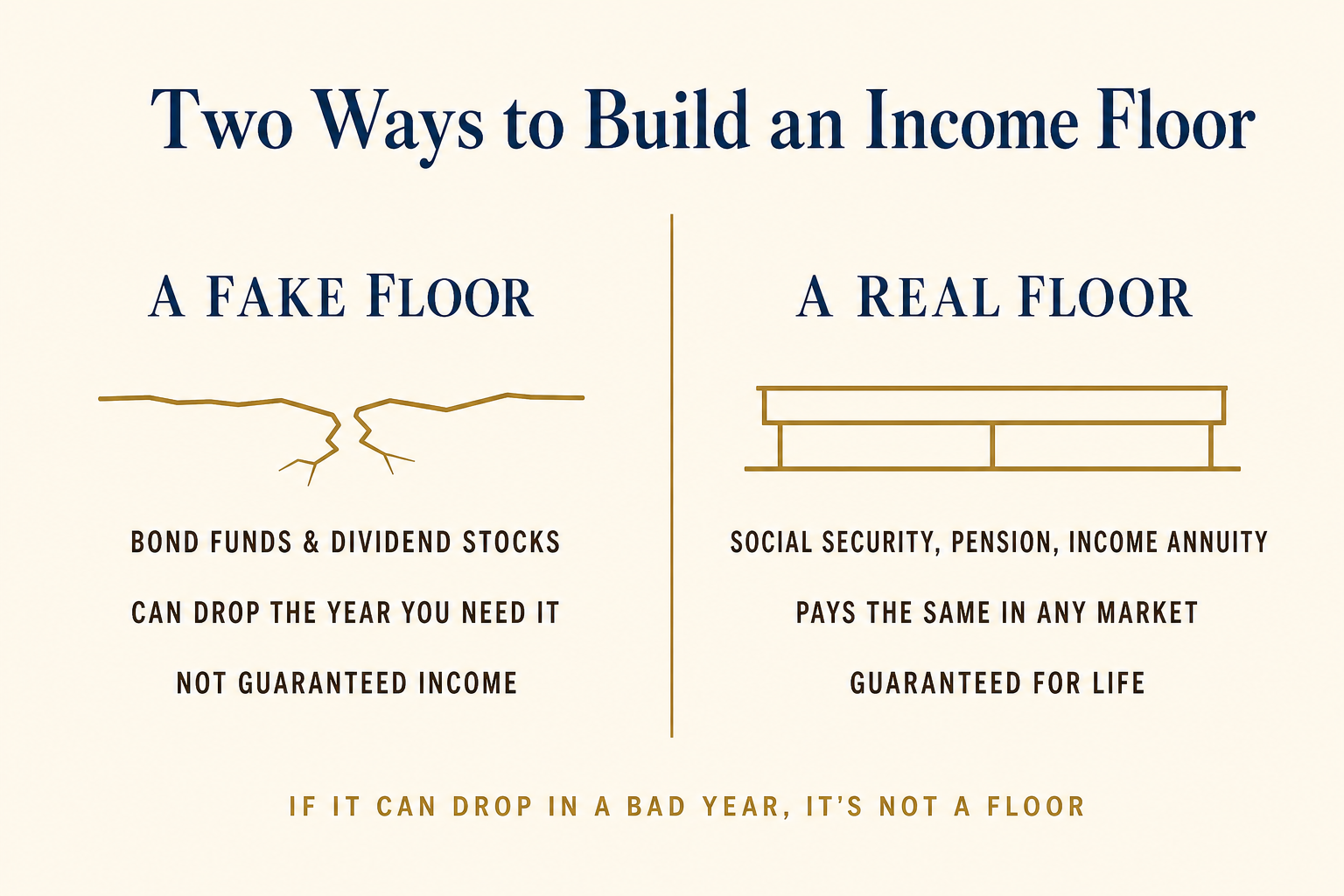
The whole point of the Soon bucket is a guaranteed income floor: money that arrives no matter what the stock market does that year. Genuinely guaranteed income has a short list of sources — Social Security, a pension, and income-focused annuities like a fixed index annuity with an income rider, which belong in this bucket precisely because their job is income, not growth. What doesn’t belong here is anything whose value moves with the market.
But a bond fund pays interest, and dividend stocks pay dividends, so it’s tempting to drop them into the Soon bucket and call it an income floor. It isn’t one. A bond fund can fall when interest rates rise. Dividends can be cut in exactly the year a company is struggling. When you build your “floor” out of things that can drop in value the same year you need them, you haven’t built a floor — you’ve built a second Later bucket and mislabeled it.
Thomas’ Take: A floor you can stand on doesn’t move when the market does. If the income can shrink in a bad year, it belongs in the Later bucket, where you’re not counting on it for groceries.
The fix is to be honest about what’s actually guaranteed. Build the floor from income that’s contractually or statutorily guaranteed, and let the market-linked money do its real job in the Later bucket, where a bad year is survivable because you’re not spending from it yet.
Mistake 3: Refilling the Now bucket on the calendar
Most people set up a refill rule that sounds disciplined: “Every January, I’ll top the Now bucket back up from the Later bucket.” In a normal year, that’s fine. In a down year, it’s a machine for doing the one thing bucket planning exists to prevent.
If you refill on a fixed date regardless of what markets are doing, then a January that follows a 20% drop forces you to sell growth shares at a discount to buy cash you don’t urgently need. You’ve converted a temporary paper loss into a permanent one — the exact failure mode the buckets were supposed to insulate you from.
The better rule is “refill from strength, not from the calendar.” When the Later bucket is up, top off the Now bucket. When it’s down, you let the Now bucket draw down further and lean on your guaranteed floor — which is why Mistake 2 matters so much. A real floor is what lets you not sell in a downturn. I go deeper on this in when not to refill your Now bucket.
Mistake 4: Letting the Later bucket get too safe
The first three mistakes leave the plan too exposed. This one is the opposite — and it’s the mistake careful, conservative people make.
Once you’ve built a cash cushion and a guaranteed floor, the natural instinct is to make the Later bucket “safe” too. But the Later bucket’s job is growth over a decade or more — outrunning inflation and longevity, the risk that you live a lot longer than planned and your purchasing power quietly erodes. Shift it heavily into cash because a market drop scared you, and you’ve traded a risk you can see (a temporary decline) for one you can’t (running low twenty years from now).
The structure is what earns you the right to keep the Later bucket invested. You have cash in the Now bucket and income from the Soon bucket, so you don’t have to sell Later-bucket holdings in a bad year. Getting scared out of the market anyway wastes the very protection you built. FINRA’s investor education makes the same underlying point about matching your allocation to your time horizon — and the Later bucket’s horizon is long. I cover how to think about that growth allocation in the Later bucket and risk tolerance.
Mistake 5: Building the plan, then overriding it
The last mistake undoes all the others, and it has nothing to do with math. A bucket plan is a set of decisions you make while you’re calm so you don’t have to make them while you’re scared. Its entire value is that the hard calls — what to sell, when to refill, how much to spend — were settled in advance.
Then the market drops 25%, a headline screams recession, and the temptation arrives to “just move some of the Later bucket to safety until things settle down.” That’s not running the plan. That’s overriding it at the exact moment it was designed for. The refill rule, the floor, the allocation — they only work if you let them work when it’s uncomfortable.
This is also why simpler wins. The more buckets and rules you pile on, the more dials there are to second-guess at 2 a.m. Three buckets, each with a clear job, is a plan you can actually stick to — which is the point I make in how many buckets you actually need.
What it looks like when two mistakes stack
Consider a hypothetical case. Dennis and Anita, both 66, retired last year outside Durham, North Carolina. They have about $850,000 across their accounts, a paid-off house, and roughly $5,200 a month in essential expenses. They did the responsible thing and built three buckets — but they made Mistakes 2 and 3 without realizing it.
For their Soon bucket, they used a bond fund and a basket of high-dividend stocks, figuring the interest and dividends were their “income floor.” And they set a rule to refill the Now bucket every January from the Later bucket. Both choices felt prudent.
Then, suppose, a rough year arrives. The Later bucket falls with the broad market, rising rates knock down the bond fund, and a couple of the dividend payers trim their payouts. Their “floor” drops in the one year they were counting on it — and come January, their calendar rule forces them to sell Later-bucket shares at a low to top off the Now bucket. The plan built to protect them did the opposite, twice.
The fix doesn’t require more money — it requires fixing the jobs. Dennis delays his Social Security so his benefit grows through delayed retirement credits, so Social Security plus Anita’s small pension covers most of their essentials as a genuinely guaranteed floor. The bond fund and dividend stocks move back to the Later bucket, where they belong. And the refill rule changes to “refill from strength.” Same portfolio, same house, same expenses — but now a down year touches nothing they spend.
If you want to see where your own plan is exposed before a bad market shows you, it helps to model it. A retirement planning tool like ProjectionLab lets you test different withdrawal orders, Social Security claiming ages, and a deliberately awful market year, so you can watch which of these five mistakes your plan is quietly carrying.
Disclosure: The ProjectionLab link above is an affiliate link. If you start a paid plan through it, Confluence Media Group may earn a commission at no additional cost to you. I only point readers to tools I’d be comfortable using myself.
Key takeaways
- Size each bucket to a real number — your essential expenses — not to a tidy formula or percentage.
- A guaranteed income floor has to be genuinely guaranteed. Bond funds and dividend stocks aren’t a floor.
- Refill the Now bucket from strength, never on a fixed calendar date that can force a sale in a downturn.
- Keep the Later bucket invested for growth — that’s the risk the structure was built to let you take.
- The plan only works if you don’t override it the moment it gets uncomfortable.
Frequently asked questions
Does a bucket plan mean I need to hold years of cash doing nothing? The Now bucket is a defined stretch of your spending gap — often two to three years — not a giant cash hoard, and with short-term rates where they’ve been, that cash can earn a real yield while it waits. The mistake is holding far more, or far less, than the job requires.
How do I know if my Soon bucket is a real floor? Ask one question of every dollar in it: can this drop in value in a bad market year? If the answer is yes, it’s Later-bucket money in disguise. A real floor comes from Social Security, pensions, and income-focused annuities — sources that pay the same whether the market is up or down.
What if I’ve already made one of these mistakes? Most of them are fixable without starting over. You’re usually relabeling jobs — moving market money out of the floor, changing a refill rule, or sizing a bucket to your real expenses — not liquidating your whole portfolio. Start with the floor, since Mistakes 2 and 3 tend to travel together.
The framework isn’t fragile. Now, Soon, Later has held up through every kind of market because it separates the money you spend from the money you invest. But a good framework run badly is still a bad plan. Get the jobs right — a real floor, a disciplined refill, a Later bucket left alone to grow — and the plan does what it promised: it lets you stop watching the market and start living off it. If you’re still building yours, start with the Now, Soon, Later framework and the build sequence.
This article is published by Confluence Media Group LLC, an independent publisher of educational financial content. Thomas Clark is a Series 65 Investment Advisor Representative. The information provided is for educational and informational purposes only and is not personalized financial, tax, or legal advice. Past performance does not guarantee future results. All investing involves risk, including potential loss of principal. Consult a qualified professional before making financial decisions.
Confluence Media Group LLC is a separate entity from Confluence Capital Management, the investment advisory practice through which Thomas Clark provides advisory services. Advisory services are not offered through this publishing platform.
About Thomas Clark
Thomas Clark is the founder of Confluence Media Group LLC and a Series 65 Investment Advisor Representative. He has spent nearly two decades working with families on retirement planning, with a focus on Social Security optimization, retirement income coordination, and the bucket planning approach to building a guaranteed income floor.
Thomas writes and publishes at thomasclarkadvisor.com and is the author of The Just in Case Binder — a 148-page printable family financial organizer for households who want to make sure the people they love know where everything is.
He lives in North Carolina with his family.
Subscribe to the weekly newsletter · Get the Just in Case Binder

Thomas Clark is a Series 65 licensed investment advisor and experienced trader. He specializes in investing, retirement planning, and market analysis, helping individuals build wealth and make informed financial decisions.
