
Retirement or College Savings? Fund Retirement First
When the tuition bill arrives, the instinct is to pause retirement and fund college first. Here is the asymmetry that makes the opposite order the more generous choice — and the sequence that still lets you do both.

The tuition bill lands in August, and something in a parent’s brain flips a switch. Suddenly the 401(k) contribution feels optional and the college fund feels urgent. I understand the instinct completely. I just think it’s backward.
Here is the rule I’d put on the refrigerator of every 50-something parent staring down a first-semester invoice: fund your own retirement before you fund your child’s college. Not instead of. Before. It sounds cold the first time you hear it, and it is actually the most generous financial decision most parents will ever make. Here’s why.
The one asymmetry that settles the argument
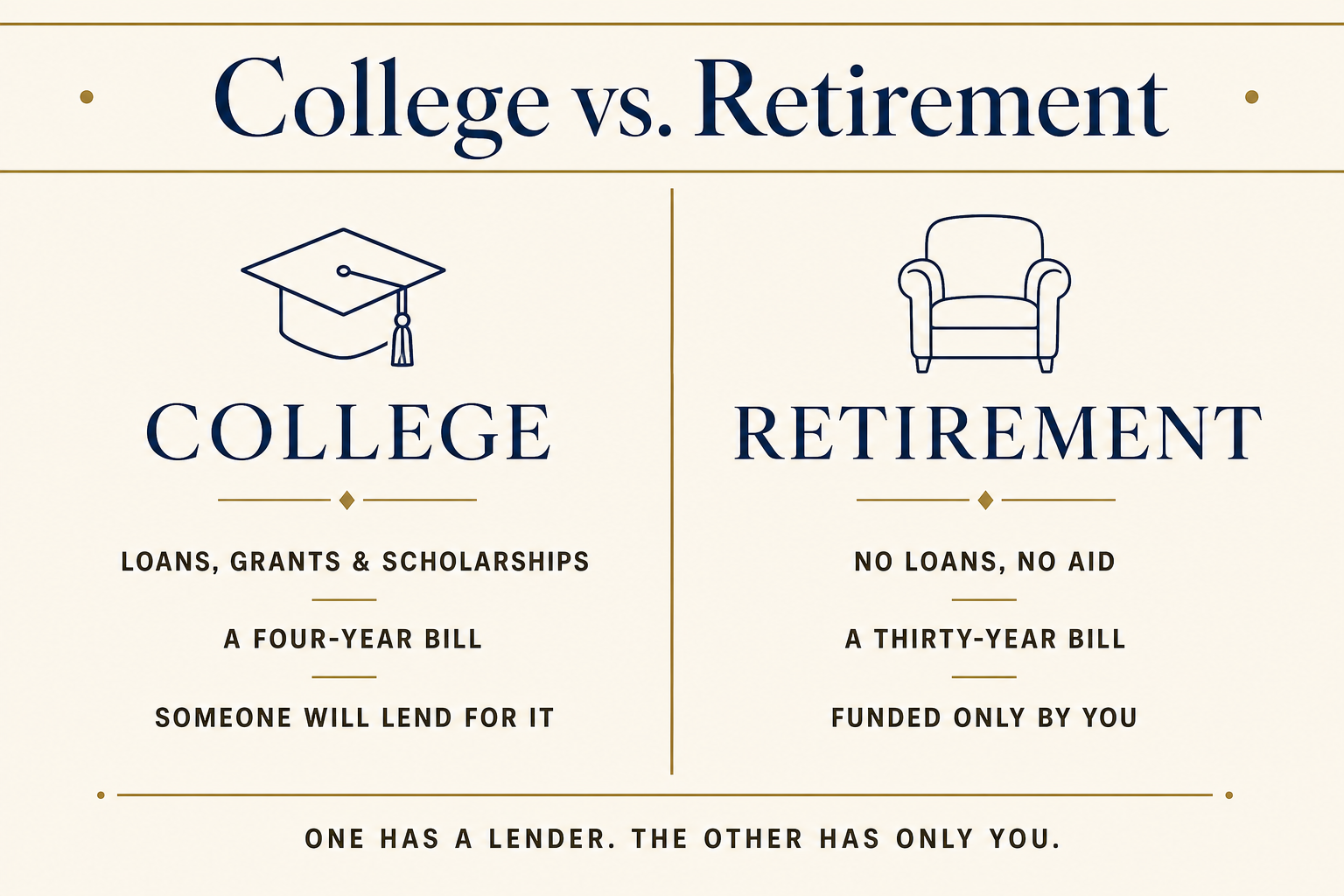
Your child can borrow for college. You cannot borrow for retirement. That single sentence does more work than any spreadsheet.
An 18-year-old headed to school has an entire aid ecosystem built around them: federal Direct Loans, Pell Grants, work-study, merit scholarships, and income-driven repayment plans that cap payments as a share of what they eventually earn. You can see the full menu at the Department of Education’s Federal Student Aid site. It isn’t free money and I’m not pretending student debt is painless. But options exist.
Now picture a 78-year-old who ran short. There is no aid office for retirement. No grant, no scholarship, no lender writing a loan against a fixed income and three decades of no paychecks. The catch-up mechanism your kid has at 18 simply does not exist at 78. When you drain the retirement account to spare your child some loan interest, you are trading a debt they can repay over a career for a shortfall you may never be able to close.
The number most parents haven’t actually run
College feels infinite when the bill is in your hand, but it is a finite, bounded expense. According to the College Board’s Trends in College Pricing, the average total cost of attendance for the 2025–2026 year runs about $29,910 at a public four-year school for in-state students and about $62,570 at a private nonprofit. Those are sticker prices. After grants and aid, the average net price at a public in-state school is closer to $14,000 a year. It’s a real number, but it’s a four-year number with a finish line.
Retirement has no finish line and no aid. And the gap there is not hypothetical. Vanguard’s 2025 retirement outlook estimated that the typical 61-to-65-year-old is heading toward roughly a $9,000 annual shortfall in retirement — about a 24% gap between what they’ll have and what they’ll need. That shortfall runs not for four years but for the twenty-five or thirty that a modern retirement can last.
Line those two problems up next to each other and the priority almost picks itself. One is bounded, shareable, and financeable. The other is open-ended, yours alone, and un-financeable — and if you’ve never mapped it, figuring out how much you actually need to retire is the honest first step before a dollar goes anywhere else.
Why “I’ll just catch up later” usually doesn’t
The quiet cost of prioritizing college isn’t the dollars you hand the bursar. It’s the years you stop feeding your own accounts — and for most parents, those years are the worst possible ones to skip.
A parent writing tuition checks is often in their late 40s to late 50s: peak earning years, and the exact window when retirement savings are supposed to compound hardest and when the tax code finally lets you accelerate. Once you turn 50, the IRS allows additional catch-up contributions to a 401(k) each year, with an even larger catch-up available in your early 60s under the SECURE 2.0 rules. Those are the highest-leverage contributions of your life. Redirect them to college for four or five years and you don’t just lose the deposits — you lose everything they would have become over the next two decades. As I’ve written before, your savings rate does more work than your returns, and the savings you skip in your 50s is the most expensive savings to skip.
The damage is invisible in the moment. Nobody sends you a statement showing the retirement you gave up. That’s exactly why it’s so easy to do.
The order that actually works
None of this means you ignore college. It means you sequence, and the sequence matters more than the intensity. In practice, the order I’d run is straightforward.
First, capture your full employer match. A dollar-for-dollar or fifty-cents-on-the-dollar match is the closest thing to found money in all of personal finance — a boost on your contribution before a single dollar is even invested. Skipping the match to fund a 529 is the one move that’s almost never worth it.
Second, fund your retirement to your actual target rate, catch-up contributions included. This is the step families collapse under tuition pressure, and it’s the one to protect.
Third, with whatever is left, help with college — ideally through a tax-advantaged vehicle like a 529 plan, which now carries far more flexibility than it used to. If the “what if they don’t go” worry is what’s held you back, I walked through why the two biggest objections to 529s have basically disappeared. This is the same sequencing logic behind deciding whether to pay off debt or invest first: get the order right and you usually get to do meaningful amounts of both.
Consider a hypothetical couple, Miguel and Rosa, both 53, with a 16-year-old two years from campus. They can afford to put about $2,000 a month toward the future. The instinct is to pour all of it into a college fund for the next six years to cover as much tuition as possible. The sequenced version looks different: they keep funding retirement to their target first — match, plus catch-up contributions that only get more valuable at their age — and steer the remainder, say $700 a month, into a 529. Their child covers the rest with a manageable mix of savings, a modest federal loan, and a campus job. Miguel and Rosa arrive at retirement intact. Their child arrives at graduation with a degree and a loan they can retire in a few years on an entry-level salary. Both problems got solved — in the right order. (Miguel and Rosa are hypothetical, and the figures are round numbers for illustration.)
The most generous thing you can do
The objection I hear is always some version of “but I want to give my kids more than I had.” Here is the reframe I’d offer. The parent who quietly secures their own retirement is not being selfish. They are removing the single largest financial risk their adult children will ever face: having to support Mom and Dad.
A financially independent 80-year-old is a gift to their kids. A debt-free 22-year-old whose parents are now short on retirement income is a bill waiting to arrive — usually in that same child’s prime saving and child-rearing years, when they can least afford it. Fund your retirement first and you protect your children twice: once by staying off their balance sheet, and again by modeling the exact discipline you want them to carry into their own financial lives. This is also why the retirement side belongs on a real foundation — a Now, Soon, and Later bucket structure that covers your essentials from guaranteed income — so that helping with college is something you do from strength, not from the account that’s supposed to feed you for thirty years.
This is exactly the moment to run your own numbers rather than react to a tuition bill. A planning tool like ProjectionLab lets you model what redirecting, say, $1,500 a month to college for four years actually does to your retirement plan — whether your plan absorbs it comfortably or whether it quietly pushes your own finish line out by years. (ProjectionLab is a paid tool; the link is an affiliate link, which means I may earn a small commission at no extra cost to you. I only recommend tools I’d use myself.) Seeing the tradeoff on one screen tends to end the argument faster than any rule of thumb.
Key takeaways
- Your child can borrow, work, and win aid for college. There is no loan, grant, or scholarship for your retirement — which is why it comes first.
- College is a bounded, four-year expense with a net price often near half the sticker. Retirement is an open-ended, twenty-five-plus-year expense with a documented shortfall for the typical near-retiree.
- The tuition years are usually your peak-earning, catch-up-eligible years — the most expensive savings you can skip.
- Sequence, don’t choose: full employer match, then your retirement target, then college with what’s left, ideally in a 529.
- The most generous thing you can do for your kids is to never become their financial burden.
Frequently asked questions
Isn’t it selfish to prioritize my retirement over my child’s education?
It feels that way and it’s the opposite. The alternative to funding your retirement isn’t your child having a slightly better-funded college account — it’s your child eventually helping cover your living expenses, usually during their own peak family years. Securing your retirement is how you make sure the help only ever flows one direction.
What if my child truly has no other way to pay for college?
Almost every student has some combination of federal aid, work income, in-state or community-college options, and merit awards available — a genuinely no-options situation is rarer than it feels the week the bill arrives. Before you tap a retirement account, exhaust the aid your child can access that you cannot: that’s the whole point of the borrowing asymmetry.
Should I stop contributing to a 529 entirely?
No. The point is order, not abstinence. Once your employer match is captured and your retirement is funded to your target, a 529 is an excellent place for the remainder — tax-advantaged, more flexible than it used to be, and squarely useful. It just sits third in line, not first.
The bottom line
Flight attendants tell you to secure your own oxygen mask before helping the person next to you, and nobody thinks that’s a selfish instruction. It’s the only version that actually saves both of you. Retirement funding works the same way. Take care of the future that has no lender, no aid office, and no do-over first — and you’ll be in a far stronger position to help with the one that does. Your kids don’t need a debt-free start nearly as much as they need parents who never become a bill.
This article is published by Confluence Media Group LLC, an independent publisher of educational financial content. Thomas Clark is a Series 65 Investment Advisor Representative. The information provided is for educational and informational purposes only and is not personalized financial, tax, or legal advice. Past performance does not guarantee future results. All investing involves risk, including potential loss of principal. Consult a qualified professional before making financial decisions.
Confluence Media Group LLC is a separate entity from Confluence Capital Management, the investment advisory practice through which Thomas Clark provides advisory services. Advisory services are not offered through this publishing platform.
About Thomas Clark
Thomas Clark is the founder of Confluence Media Group LLC and a Series 65 Investment Advisor Representative. He has spent nearly two decades working with families on retirement planning, with a focus on Social Security optimization, retirement income coordination, and the bucket planning approach to building a guaranteed income floor.
Thomas writes and publishes at thomasclarkadvisor.com and is the author of The Just in Case Binder — a 148-page printable family financial organizer for households who want to make sure the people they love know where everything is.
He lives in North Carolina with his family.
Subscribe to the weekly newsletter · Get the Just in Case Binder

Thomas Clark is a Series 65 licensed investment advisor and experienced trader. He specializes in investing, retirement planning, and market analysis, helping individuals build wealth and make informed financial decisions.
