
Revenge Trading: Why the Dangerous Trade Is the Next One
The loss everyone remembers is rarely what blows up a trading account; the revenge trade that follows it is. Here is what drives that reflex, how to catch yourself on tilt, and the simple protocol experienced traders use to make the next trade nearly impossible to take.
In almost every blown-up trading account I have watched up close, the fatal damage did not come from the loss everyone remembers. It came from the trade right after it: the one taken to win the money back.
The market did not ruin those traders. The need to get even did. A single planned loss is survivable. It is a line item, the cost of doing business, the thing you budgeted for when you decided how much to risk. What is not survivable is the decision to double the size, widen the stop, and press a bad position because sitting with a red number felt intolerable. That decision has a name among traders. It is called revenge trading, and it destroys more accounts than any bad forecast ever has.
If you have ever taken a trade purely because you were down and wanted it back by the close, this is a mirror. Here is what is actually happening when you do it, how to catch yourself mid-spiral, and the specific protocol experienced traders use to make the next trade nearly impossible to take.
What revenge trading actually is
Revenge trading is any trade whose real reason is the loss you just took, not the opportunity in front of you. The setup stopped mattering. The dollar figure on the screen is now driving the car.
The tell is almost embarrassingly simple. When the reason you are entering a position is the number you are down rather than a setup you would have taken yesterday on a flat day, you are revenge trading, even if you would never use that phrase for it. Poker players call the same state “tilt”: a run of bad luck knocks you out of your disciplined game and into an emotional one, and the emotional player always pays for it eventually.
This matters most in fast, self-directed trading, which is exactly where the regulators point their warnings. Both the SEC’s investor education office and FINRA flag day trading as a high-risk activity precisely because the pace leaves so little room between the emotion and the click. The faster the game, the more a single bad reaction can compound before you have caught your breath.
Why your brain reaches for the next trade
Three forces push you toward that trade, and understanding them is most of the defense.
The first is loss aversion. The behavioral researchers Daniel Kahneman and Amos Tversky found that losses tend to feel roughly twice as powerful as equivalent gains. A $1,000 loss generates an urge to act that is about twice as strong as the satisfaction a $1,000 gain would bring. Your nervous system treats the red number as an open wound, and the obvious way to close a wound is to act now.
The second is an arbitrary deadline. We anchor to wherever we started the day, so being “down on the day” feels like a deficit that has to be erased by the closing bell. The market does not know or care what your account looked like at 9:30 this morning. That reference point is one you invented, but it drives real decisions.
The third is identity. If you quietly tie your self-worth to being right, a loss does not feel like a cost. It feels like being wrong, and the fastest way to stop feeling wrong is to be right again immediately. That is a psychological need, not a trading plan, and the market does not pay out on psychological needs.
The data on where this leads is not subtle. In a landmark study titled “Trading Is Hazardous to Your Wealth,” finance professors Brad Barber and Terrance Odean found that the most active individual traders earned the lowest net returns. Overtrading is one of the most reliable ways to underperform, and the revenge trade is overtrading in its most concentrated, most emotional form. It is the same mistake that shows up among the structural reasons most traders lose money, compressed into a single afternoon.
How to know you are on tilt
The spiral is easier to stop if you can name it while it is happening. A handful of tells show up almost every time.
Your size creeps. The position is suddenly two or three times what you would normally take, because a normal size “won’t make it back fast enough.” Your stop gets generous or disappears entirely, since a tight stop would just “lock in” the loss you are trying to undo. You find yourself watching the profit-and-loss number instead of the chart. You skip your own checklist “just this once.” And the self-talk turns to fairness: the market owes you that money back.
Notice the common thread. Every one of those moves increases your risk at the exact moment your judgment is at its worst. That is the opposite of how sound position sizing is supposed to work, and it is why the revenge trade is so dangerous: the worse you feel, the bigger you bet.
A hypothetical spiral
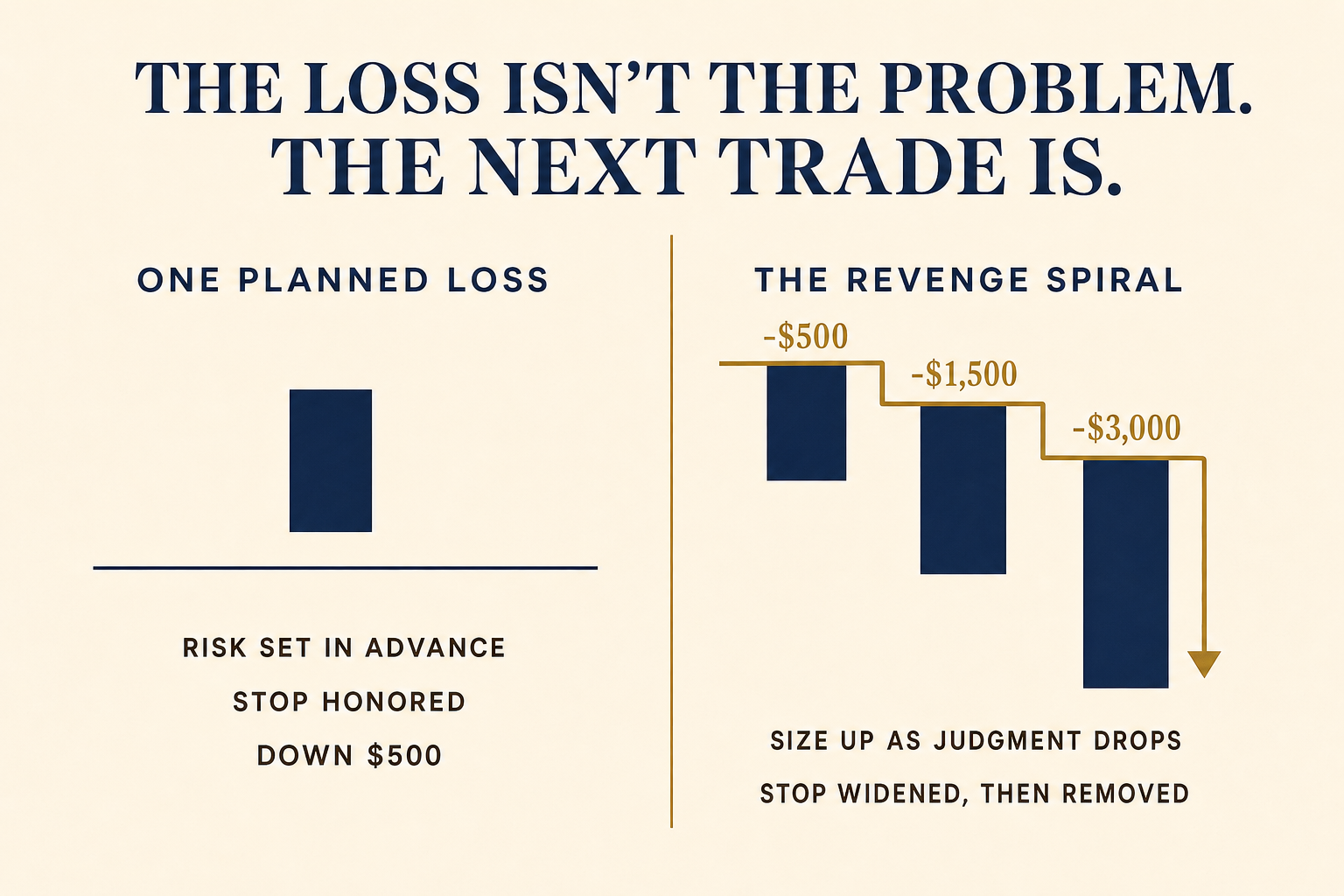
Consider a hypothetical case. Danny, 41, trades part-time around his job and risks about $500 per trade on a $50,000 account, a disciplined 1% of capital. On Monday he takes a clean setup. It fails, and he is down $500. Nothing has gone wrong yet. That is a normal, planned loss, exactly the kind he budgeted for.
But the red number nags at him all afternoon. So he takes a second trade he has not fully vetted, sized at $1,500, to “make it back faster.” It also loses. Now he is down $2,000 and genuinely angry. The third trade is $3,000 with no stop at all, because a stop would just confirm the damage. You can write the ending yourself.
In three trades, Danny turned a routine $500 cost into a $5,000 hole. His analysis did not get six times worse. His sizing got six times bigger exactly as his thinking got cloudier. The loss did not do that. The reaction to the loss did. (These figures are illustrative and rounded, not a projection of any real result.)
How experienced traders break the loop
The professionals I respect are not calmer than everyone else by temperament. They have simply built rules that fire before emotion can get its hands on the keyboard. Three of those rules do most of the work.
The first is a daily loss limit, the circuit breaker. You decide in advance the dollar or percentage loss that ends your trading day. When you hit it, you are done, full stop, no “just one more to get it back.” The limit is set in the morning when you are calm, so it can protect you in the afternoon when you are not.
The second is a position size that does not flex. The size of a trade is determined by your account and the setup, never by how you feel or how much you are down. Since the revenge trade is almost always an oversized trade, fixing your size in advance defuses most of the bomb before it is ever lit.
The third is a mandatory pause after a loss. Step away from the screen, even for ten minutes. The urge to get even has a short half-life. It fades noticeably if you simply let a little time pass before the next click, which is why “walk around the block” is more useful trading advice than it sounds.
There is a quieter fourth habit worth adding: the trading journal. Writing down the revenge trade, what you felt and what you actually did, turns an invisible reflex into a visible, countable pattern. You cannot manage a habit you refuse to look at.
Thomas’ Take
In my own trading, the single most profitable habit I ever built had nothing to do with picking better trades. It was a hard daily stop. On the days I did not need it, it cost me nothing. On the handful of days I did, it saved me from myself, and those are the days that decide whether you are still trading a year from now.
The same reflex shows up far from a trading screen
This is not only a day-trader problem. The long-term investor who watches a market drop, panic-sells near the bottom, and then cannot stand being out while prices recover, so buys back in higher, is running the identical loop: an emotional reaction to a loss, acted on at the worst possible moment.
It is why I keep arguing that volatility is not the same thing as risk. The real risk is being forced, or forcing yourself, to act on someone else’s timetable. It is also the quiet case for a guaranteed income floor in retirement: when your grocery money does not depend on this week’s market, the urge to “do something” about a drawdown loses most of its grip. The same bias sits behind the tendency to sell your winners and hold your losers. Different account, same nervous system.
The reframe worth keeping
The edge in trading was never really about predicting the next move. Nobody does that reliably for long. The edge is in surviving your own reaction to the moves you got wrong. A loss is information and a cost. A revenge trade is a decision to let one bad moment write several more.
Protect the account from the second decision, and the first one stops mattering very much. So the next time you are staring at a red number and feeling the pull to make it back right now, treat that feeling as the signal. Not a signal to trade. A signal to stand up. The trade that can actually hurt you is the one you have not taken yet.
Key takeaways
- The dangerous trade is usually the one after a loss, not the loss itself. The first loss is a budgeted cost; the revenge trade is the account-killer.
- The urge is driven by loss aversion (losses feel about twice as strong as equal gains) plus a self-imposed “even by the close” deadline the market does not share.
- The reliable tells are size creep, a widening or vanishing stop, and trading to a dollar target instead of a setup.
- The fixes are mechanical, not emotional: a hard daily loss limit, a position size that never flexes, and a mandatory pause after a loss.
- The same panic-sell-then-chase loop shows up in long-term investors. A guaranteed income floor is one way to quiet it.
This article is published by Confluence Media Group LLC, an independent publisher of educational financial content. Thomas Clark is a Series 65 Investment Advisor Representative. The information provided is for educational and informational purposes only and is not personalized financial, tax, or legal advice. Past performance does not guarantee future results. All investing involves risk, including potential loss of principal. Consult a qualified professional before making financial decisions.
Confluence Media Group LLC is a separate entity from Confluence Capital Management, the investment advisory practice through which Thomas Clark provides advisory services. Advisory services are not offered through this publishing platform.
About Thomas Clark
Thomas Clark is the founder of Confluence Media Group LLC and a Series 65 Investment Advisor Representative. He has spent nearly two decades working with families on retirement planning, with a focus on Social Security optimization, retirement income coordination, and the bucket planning approach to building a guaranteed income floor.
Thomas writes and publishes at thomasclarkadvisor.com and is the author of The Just in Case Binder — a 148-page printable family financial organizer for households who want to make sure the people they love know where everything is.
He lives in North Carolina with his family.
Subscribe to the weekly newsletter · Get the Just in Case Binder

Thomas Clark is a Series 65 licensed investment advisor and experienced trader. He specializes in investing, retirement planning, and market analysis, helping individuals build wealth and make informed financial decisions.
