
Why You Sell Your Winners and Keep Your Losers
You lock in gains fast and give your losers room to recover. That instinct — the disposition effect — is one of the costliest habits in investing. Here is the one question that fixes it.

Here is a pattern I watched play out for years on the trading desk, and I still see it every time I look at a retirement account. Someone holds two positions. One is up 40%. The other is down 35%. Ask which one they are tempted to sell, and almost everyone points to the winner. “Lock in the gain,” they say. “The other one will come back.”
That instinct feels like discipline. It is actually one of the most expensive habits an investor can have, and it is so common that researchers gave it a name: the disposition effect. Once you see it in yourself, you can start to undo it — and the fix comes down to a single question.
The instinct that feels like discipline
Consider a hypothetical investor named Ellen, 58, who manages her own brokerage account. Two years ago she bought two stocks with roughly the same amount of money. One is now up about 40%. The other is down about 35%.
Ellen needs to raise some cash, so she has to sell one. She sells the winner. It feels responsible — she is “taking profits,” “not being greedy,” “locking it in.” The loser she keeps, because selling it would mean accepting the loss, and besides, it only counts as a loss if she sells, right? It will probably come back.
Every piece of that reasoning is backwards, and Ellen is not unusual. She is doing exactly what most investors do, for exactly the reasons most investors do it. The problem is that she made both decisions by looking at the one number that should have had no vote: what she originally paid.
What the research actually found
In 1998, finance professor Terrance Odean published a study in the Journal of Finance that looked at the trading records of roughly 10,000 accounts at a discount brokerage. He found that investors sold their winning positions at a meaningfully higher rate than their losing ones — they were far quicker to realize a gain than to realize a loss.
The part that should stop you is what happened next. The winners people sold went on, on average, to outperform the losers they held onto over the following year. The behavior that felt like prudence was, in that data, working against the people doing it. It was not explained by rebalancing or by trying to avoid trading costs, and later portfolio results did not justify it. You can read Odean’s original paper if you want the full breakdown.
This is not a quirk of one brokerage in the 1990s. A 2007 follow-up study on Taiwan’s market found that 84% of investors there sold winners faster than losers. It now shows up on the standard list of behavioral biases that investor-education groups warn about — FINRA’s investor insights cover a whole family of them. The one consistent exception in the data was December, when tax-loss selling finally gave people a reason to let go of their losers — more on that in a moment, because it is the one time the red number actually matters.
Why your brain insists on it
Three forces push in the same direction here, and understanding them is most of the battle. None of them are about the market — they are about you, which is exactly why the SEC’s investor-education resources put so much weight on managing your own reactions rather than chasing the next pick.
The first is loss aversion. Research on how people weigh gains and losses suggests that a loss feels roughly twice as painful as an equivalent gain feels good. Selling a loser forces you to actually feel that pain, so you avoid it. Selling a winner lets you feel good, so you reach for it.
The second is mental accounting. We treat each position as its own little scoreboard that has to be closed out as a “win.” Selling a stock below what you paid closes that account as a loss — a permanent admission that the purchase was a mistake. Holding it keeps the verdict pending.
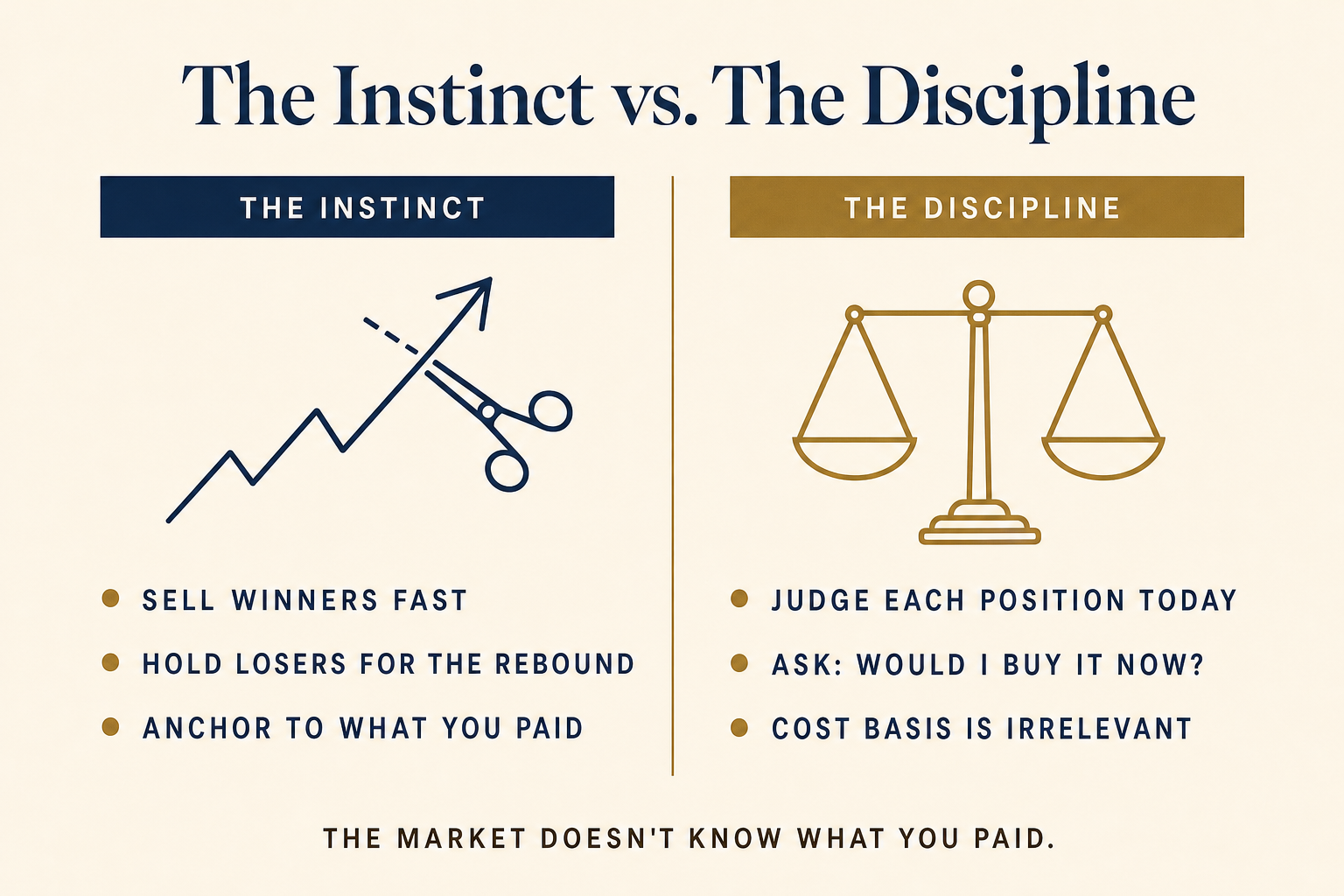
The third is anchoring. Your cost basis — the price you paid — becomes a reference point your brain treats as meaningful. But the market has no idea what you paid, and it would not care if it did. Your purchase price is a fact about your history, not a fact about the investment’s future. I wrote more about these patterns in five behavioral finance traps that derail retirement plans, and this one is the quietest and most costly of the set.
The one question that fixes it
Here is the question I learned to ask at the desk, and it dissolves the whole problem: Would I buy this today, at today’s price, in this size?
If the answer is yes, you hold — whether the position is green or red is irrelevant. If the answer is no, you sell — again, whether it is green or red is irrelevant. The decision is about the investment’s future, and the only honest way to judge that is to ignore what you paid. A position that is up 40% might still be the best thing you own at today’s price. A position that is down 35% might be dead money you are keeping alive out of stubbornness.
Thomas’ Take: The market doesn’t know what you paid, and it is never going to reward you for your loyalty to a losing position. Judge every holding by whether you would buy it again today. If you wouldn’t, the fact that it is “almost back to even” is not a reason to keep it — it is the story you tell yourself to avoid the sale.
There is exactly one time the red number earns a real vote, and it is a tax rule, not a feeling. In a taxable account, selling a loser lets you harvest the loss to offset gains and a limited amount of ordinary income. That is the legitimate version of “the December effect” from the research — a deliberate strategy, not an excuse. I covered when it helps and when it is overrated in this piece on tax-loss harvesting. Outside of that specific, intentional move, your cost basis does not belong in the decision.
And if the honest answer to “would I buy this today?” is “yes, but not this much of it,” that is a sizing problem, not a hold-or-sell problem. Trimming a position back to a size you can live with is one of the most underrated moves there is — something I get into in position sizing, the most underrated skill in trading.
Where this shows up in retirement
You do not have to be an active trader for this to cost you. It shows up constantly in ordinary retirement portfolios, just in slower motion.
It is the retiree sitting on a single stock that has grown into 40% of the portfolio, refusing to trim it because selling would trigger a tax bill and feel like “quitting a winner” — while that one position quietly becomes the biggest risk they own. It is the old fund that has lagged for a decade, held because selling would lock in the disappointment. It is the inherited position nobody will touch because of what it meant to someone.
In every case the fix is the same question, asked without reference to the cost basis. A disciplined seller is not someone who refuses to take losses or who dumps winners to feel safe. A disciplined seller is someone who owns what they would buy today and nothing else. That is also the difference between reacting to price and managing risk — the theme underneath why volatility isn’t risk, but being a forced seller is, and part of why trading and investing are two different jobs.
Being right about a stock and making money from it are not the same thing, as I argued in this related post. The disposition effect is one of the main reasons the gap exists: people are right often enough, but they sell the proof too soon and hold the mistakes too long. If you want the fuller picture of why self-directed investors underperform, most of it is structural and behavioral, not a matter of picking better.
The scoreboard that actually counts
Your cost basis is the most emotionally loaded number in your account and the least useful one for deciding what to do next. The scoreboard that counts is the one you would build from scratch today: if you had the cash and a blank account, which of your current holdings would you actually buy, and in what size?
Everything you would buy, you keep. Everything you would not, you have your answer — regardless of how it looks in green or red. That is not cold-blooded. It is the one move that quietly separates the investors who compound from the ones who stay busy and go nowhere.
Key Takeaways
- The disposition effect is the tendency to sell winners too soon and hold losers too long — and research has found it works against the people doing it.
- It is driven by loss aversion, mental accounting, and anchoring to the price you paid. The market does not know or care what you paid.
- The fix is one question: would I buy this today, at today’s price, in this size? If yes, hold; if no, sell — green or red is irrelevant.
- The lone exception is deliberate tax-loss harvesting in a taxable account, which is a strategy, not an emotional escape hatch.
Frequently Asked Questions
Isn’t “let your winners run” the opposite of this advice?
It is actually the same advice. Cutting winners early is the disposition effect; letting winners run is the cure — as long as you would still buy the position today. The point is never “always hold winners” or “always sell losers.” It is to judge each position on its future, not its history.
Does this mean I should never sell at a loss?
The opposite. You should sell at a loss any time you would not buy the position today. Refusing to ever sell below your cost basis is the exact trap the research describes. And in a taxable account, harvesting a loss on purpose can be a genuinely smart move.
How is this different from panic selling?
Panic selling is the mirror-image error — dumping good positions in fear during a drop. Both come from reacting to how a price feels rather than to whether you would own the investment today. The same question fixes both: would I buy this now?
This article is published by Confluence Media Group LLC, an independent publisher of educational financial content. Thomas Clark is a Series 65 Investment Advisor Representative. The information provided is for educational and informational purposes only and is not personalized financial, tax, or legal advice. Past performance does not guarantee future results. All investing involves risk, including potential loss of principal. Consult a qualified professional before making financial decisions.
Confluence Media Group LLC is a separate entity from Confluence Capital Management, the investment advisory practice through which Thomas Clark provides advisory services. Advisory services are not offered through this publishing platform.
About Thomas Clark
Thomas Clark is the founder of Confluence Media Group LLC and a Series 65 Investment Advisor Representative. He has spent nearly two decades working with families on retirement planning, with a focus on Social Security optimization, retirement income coordination, and the bucket planning approach to building a guaranteed income floor.
Thomas writes and publishes at thomasclarkadvisor.com and is the author of The Just in Case Binder — a 148-page printable family financial organizer for households who want to make sure the people they love know where everything is.
He lives in North Carolina with his family.
Subscribe to the weekly newsletter · Get the Just in Case Binder

Thomas Clark is a Series 65 licensed investment advisor and experienced trader. He specializes in investing, retirement planning, and market analysis, helping individuals build wealth and make informed financial decisions.
