
Stocks Set a Record. The 10-Year Treasury Matters More.
The S&P 500 set another record this week, but the number that matters more for anyone near retirement is the 10-year Treasury near 5%. Here's what a high risk-free yield means for your income floor.
The S&P 500 closed at a fresh record on Friday, finishing the week up about 1.2%. If you only read the headline, it was a good week for your portfolio. The financial press cheered.
But if you are within a few years of retirement, the record wasn’t the most important number of the week. This one was: the yield on the 10-year Treasury note climbed to a 52-week high near 5.3% before settling back around 5.24%. That is the number worth your attention — and almost nobody is talking to you about why.
Two numbers, two very different stories
Here’s what actually happened in markets the week of October 6. The S&P 500 and the Dow both touched new highs midweek before a bout of selling trimmed the gains; the index still finished up 1.2%, the Dow up 0.9%, the Nasdaq up a more modest 0.6%. Market breadth — the share of stocks actually participating — improved to roughly 35% of the S&P trading above their 50-day average, up from depressed levels near 20% earlier in the month. So the rally broadened a little, which is healthy, but it is still a market carried by a handful of large names.
The bond market told the louder story. The 10-year Treasury yield pushed to a 52-week high, driven by heavy government debt issuance and a jump in oil prices. And on October 7, the minutes from the Federal Reserve’s latest meeting showed officials expect to raise interest rates again before year-end to lean against inflation that has run above their 2% target for more than five years. The Fed’s target range currently sits at 3.50%–3.75%, and the next policy meeting lands on October 27–28.
Translate that out of market-speak: short-term rates may be nudged higher, and longer-term rates — the ones that set the price of a 10-year bond, a CD, or an annuity income rider — are already at their highest level in well over a decade.
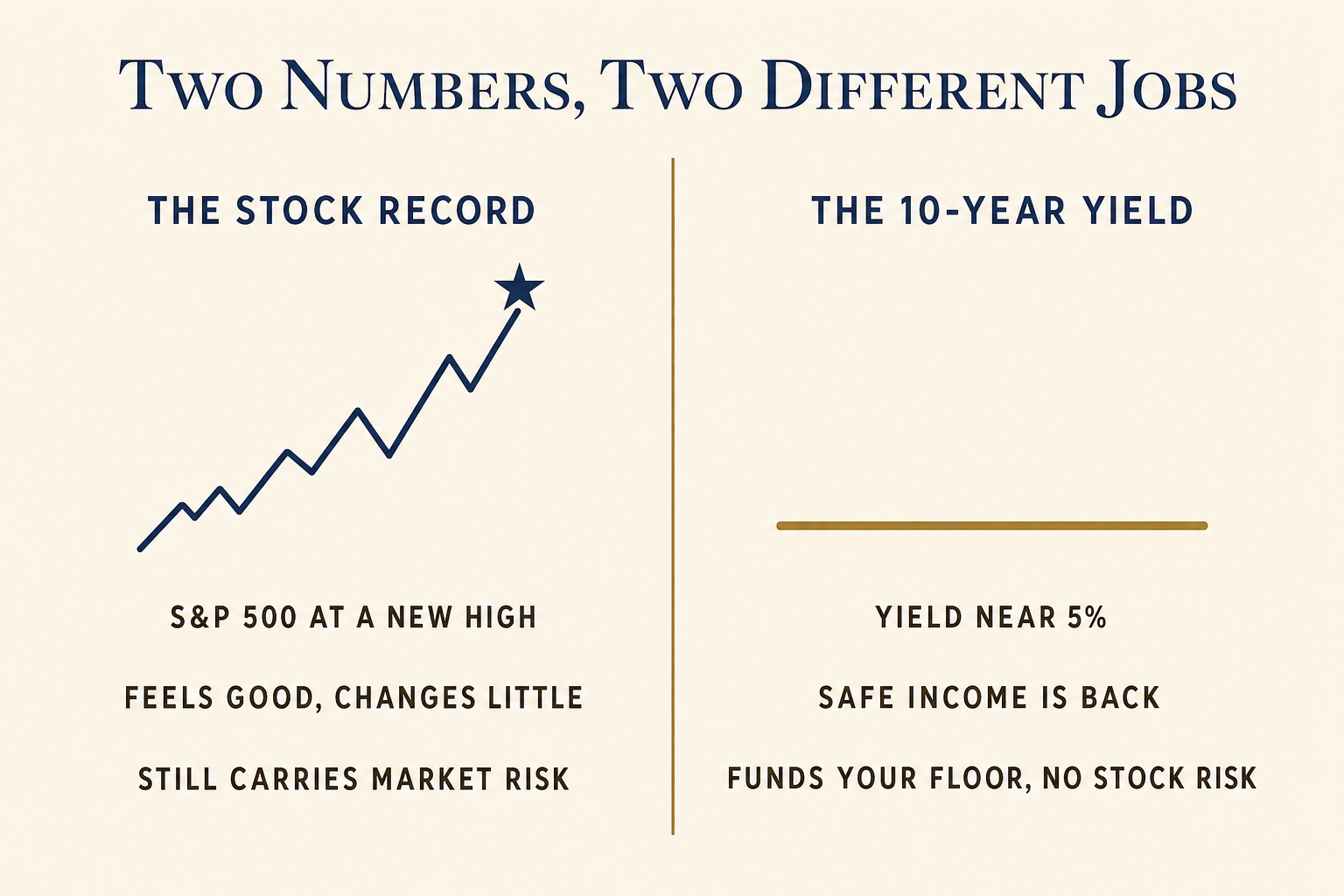
Stocks at a record is a story about optimism. A 5% 10-year is a story about the price of safety. And for someone building a retirement income plan, the price of safety is the number that actually moves your life.
Why the bond market matters more to you than the stock record
For most of the 2010s, “safe” money paid you almost nothing. A 10-year Treasury yielded 2% or less for years; savings accounts paid a rounding error. That era quietly punished retirees. If you wanted income, you were pushed out on the risk spectrum — into dividend stocks, into longer-duration bonds, into products you may not have fully understood — because the safe stuff didn’t pay enough to live on.
That math has flipped. When the “risk-free” rate — the yield on a Treasury the government is contractually obligated to pay — sits near 5%, you can fund a meaningful chunk of your retirement income without reaching for equity risk to do it. That is the single biggest change in the retirement-planning landscape in fifteen years, and it happened while everyone was watching the stock ticker.
It is worth saying plainly, because the headlines won’t: this is the best environment to build a guaranteed or near-guaranteed income floor that pre-retirees have had in a generation. Not because of where stocks are. Because of where yields are.
What this does to your buckets
Regular readers know I think about retirement money in three buckets, and today’s rates change the job each one can do. (If the framework is new to you, I’ve written about why bucket planning isn’t just mental accounting.)
Your Now bucket — the cash and short-term money you live on in the next year or two — finally earns something. Money market funds and short Treasury bills are paying in the neighborhood of 4–5%. For the first time in a long time, holding cash isn’t a penalty.
Your Soon bucket — the guaranteed income floor that covers your essential bills — is where high yields matter most. A Treasury, a CD, or the income rider on a fixed index annuity that you lock in while rates are elevated keeps paying that rate even after the Fed eventually changes course. You are not chasing a yield; you are buying a contractual stream at a price that hasn’t been this attractive since before the financial crisis.
Your Later bucket — the growth money, the equities at record highs — is the one the headlines are screaming about. And here is where I’ll plant my flag.
Thomas’ Take: When stocks are at records and safe bonds pay 5%, the instinct a lot of people feel — to pile more money into stocks because they’re “winning” — is exactly backwards for anyone near retirement. The gift this week isn’t the record. It’s that you can now take less risk and still fund the life you planned. Most advisors won’t frame it that way because “buy more stocks, they’re going up” is an easier sentence to say. It’s also how people end up as forced sellers in the next downturn — a trap I’ve described as the real difference between volatility and risk.
What higher rates give, and what they take
I won’t pretend rising rates are a free lunch, because they aren’t. Higher yields are good for new money and for savers, but they come with tradeoffs you should see clearly.
When rates rise, the price of bonds you already own falls — that’s how bond math works, and it’s why some retirement portfolios saw their “safe” bond funds drop in value over the past few years. Longer-maturity bonds fall the most; that sensitivity is called duration. Higher rates also keep borrowing expensive: mortgages, car loans, and any variable-rate debt stay costly. And a government issuing a lot of debt at 5% is a reason yields are high in the first place — not a sign that all is calm.
So the move isn’t “dump everything into long bonds.” It’s to recognize that safe, contractual yield is back on the menu, and to use it deliberately in the part of your plan that’s supposed to be boring.
A hypothetical to make it concrete
Consider a hypothetical case: Dan and Linda, both 61, live outside Columbus and plan to retire at 65. They’ve mapped their essential bills — housing, food, insurance, utilities — at roughly $4,000 a month. Between them, Social Security at full retirement age is expected to cover about $3,000 of that, leaving a $1,000 monthly gap they want filled by something that doesn’t depend on the stock market cooperating.
A few years ago, generating $12,000 a year of safe income took a lot of principal, because safe instruments paid so little. With high-quality bonds and CDs yielding in the 4.5%–5% range today, the amount of principal it takes to throw off that same income is meaningfully smaller. (These are round, illustrative figures to show the direction of the math, not a quote, a projection, or a recommendation — your own numbers and the rates available when you act will differ.)
The point isn’t the exact figure. It’s that the same income floor is cheaper to build today than it was for most of the last fifteen years. Dan and Linda didn’t get that gift from the stock market’s record. They got it from the bond market almost nobody put on the front page.
What to actually do with this
A few educational takeaways, not instructions for your specific situation:
First, don’t try to trade the Fed. Whether the next move is in October or December, and whether the 10-year sits at 5.0% or 5.4% next month, is noise you can’t reliably predict — and I’ve argued before that you don’t have to watch the Fed to run a good plan.
Second, start from the income your Soon bucket needs to produce, not from a yield you’re trying to grab. Decide the job first, then fill it.
Third, recognize that elevated rates let you lock in that job for years, and that laddering maturities — staggering when your bonds or CDs come due — spreads out your reinvestment risk if rates eventually fall again. (That reinvestment risk is the flip side of the coin I wrote about when the story ran the other way — back when I explained how falling rates can quietly give your cash a pay cut.)
The honest way to know what this means for you is to put it on your own numbers. Map your real essential spending, your expected Social Security, and the income your floor needs to cover, then see how today’s rates change how much principal that actually takes. A planning tool like ProjectionLab lets you build that scenario with your actual figures and watch how a higher safe yield changes the picture — seeing it on your own plan lands differently than reading someone else’s example.
Disclosure: the ProjectionLab link above is an affiliate link. If you subscribe through it, I may earn a commission at no additional cost to you. I only point to tools I’d actually sit down and use.
Key takeaways
- The S&P 500 set another record this week, but the more consequential move for pre-retirees was the 10-year Treasury yield touching a 52-week high near 5.3%.
- The Fed’s latest minutes signal another possible rate increase before year-end to counter above-target inflation; the next meeting is October 27–28.
- A near-5% “risk-free” yield means you can fund a retirement income floor without reaching for equity risk — the biggest shift in the planning landscape in fifteen years.
- Higher rates help new savings and income but lower the price of bonds you already hold; duration and borrowing costs are the tradeoffs.
- Start from the income your Soon bucket needs, lock in today’s rates deliberately, and ladder maturities rather than trying to time the Fed.
The record will lead tomorrow’s headlines and be forgotten by next week. A 5% yield locked into your income floor will still be working for you in 2031. Watch the number that compounds into your retirement — not the one that compounds into cocktail-party conversation.
This article is published by Confluence Media Group LLC, an independent publisher of educational financial content. Thomas Clark is a Series 65 Investment Advisor Representative. The information provided is for educational and informational purposes only and is not personalized financial, tax, or legal advice. Past performance does not guarantee future results. All investing involves risk, including potential loss of principal. Consult a qualified professional before making financial decisions.
Confluence Media Group LLC is a separate entity from Confluence Capital Management, the investment advisory practice through which Thomas Clark provides advisory services. Advisory services are not offered through this publishing platform.
About Thomas Clark
Thomas Clark is the founder of Confluence Media Group LLC and a Series 65 Investment Advisor Representative. He has spent nearly two decades working with families on retirement planning, with a focus on Social Security optimization, retirement income coordination, and the bucket planning approach to building a guaranteed income floor.
Thomas writes and publishes at thomasclarkadvisor.com and is the author of The Just in Case Binder — a 148-page printable family financial organizer for households who want to make sure the people they love know where everything is.
He lives in North Carolina with his family.
Subscribe to the weekly newsletter · Get the Just in Case Binder

Thomas Clark is a Series 65 licensed investment advisor and experienced trader. He specializes in investing, retirement planning, and market analysis, helping individuals build wealth and make informed financial decisions.
