
The Market Hit a Record. Most of It Didn’t.
One index set a record last week while the Dow fell and most stocks lagged behind. Here's what narrow market breadth actually means when you're living off your portfolio.

Last week gave us one of those headlines that sounds like great news and tells you almost nothing: the Nasdaq closed at a record high. What the headline left out is that the Dow fell more than 1% over the same five days, and the broad market barely moved. One index set a record while another dropped. That gap is the story.
When the indexes disagree like that, it usually means one thing: a handful of stocks are doing the heavy lifting while most of the market sits still or slips. That’s called narrow breadth, and if you’re drawing income from a portfolio, it matters more than the record itself. Here’s why.
What “breadth” actually measures
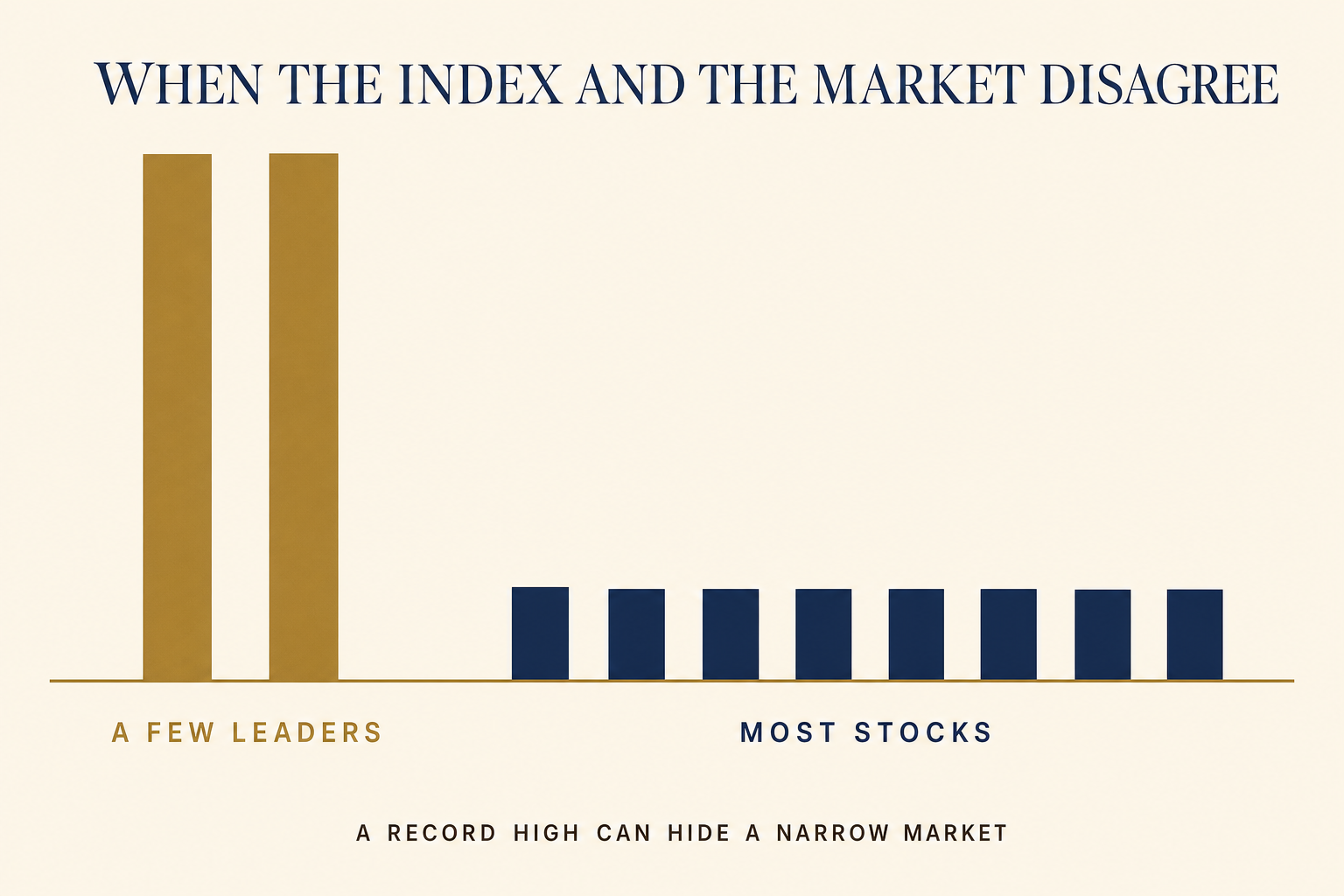
Breadth is simply how many stocks are participating in a move. A healthy rally is broad — most sectors rise together, and the average stock looks a lot like the index. A narrow rally is the opposite: the index climbs because a few very large companies climb, and their size drags the whole average up with them, even as the typical stock goes nowhere.
Last week was a textbook narrow tape. The gains were concentrated in AI and semiconductor names — Micron’s strong earnings were a big part of the lift — while rate-sensitive corners like consumer staples, health care, and financials pulled back under the weight of high borrowing costs. The index you read about went up. The stocks most retirees actually own, spread across those lagging sectors, mostly didn’t.
This isn’t a doom signal. Narrow markets can stay narrow for a long time, and the leaders can keep leading. But it does mean the record high you heard about is describing a smaller slice of the market than the word “record” implies.
Why a record high can be the most misleading number you’ll hear
Most major stock indexes are market-cap weighted. The bigger a company, the more of the index it represents. When the largest few companies are also the ones rising, they can push the whole index to a record even if the other several hundred names are flat or down.
That’s the quiet problem hiding inside “the market is at an all-time high.” It can be true and irrelevant to your portfolio at the same time. If your money is spread across the whole market — which, for most people, is the point — your experience last week looked a lot more like the Dow than the Nasdaq. This is the same cap-weighting quirk I wrote about in why your index fund isn’t as diversified as you think: the headline number and the thing you own are not always the same number.
Here’s where I’ll take a clear position. For someone living off their portfolio, the record-high headline is close to useless. It tells you how a few giant companies did. It tells you nothing about whether your plan still works. Those are completely different questions, and only one of them should affect what you do next.
The real risk narrow markets create
The danger of a narrow market isn’t that it crashes tomorrow. It’s what it does to your behavior. When a small group of stocks is making all the headlines, the pull to chase them gets strong — to sell the boring, lagging parts of your portfolio and pile into whatever’s working. That instinct peaks right when the leaders are most expensive, and it’s one of the most reliable ways people turn a record high into a personal loss.
There’s also a concentration trap. If you’ve held broad funds for years and a few names have grown into an outsized share of the market, those same names now make up an outsized share of your money too — whether you chose that or not. A narrow market quietly increases how much of your outcome rides on a short list of companies. That’s a valuation-and-concentration question worth checking in your growth holdings, calmly, not a reason to panic-sell anything.
Thomas’ Take: A record high in a narrow market is a test of discipline, not a buy signal. The stocks leading the tape are the ones most people feel they “missed.” But chasing last week’s winners at this week’s prices is how portfolios get fragile right before they most need to be sturdy. The boring, lagging parts of your portfolio are doing a job too.
Where this intersects with your income plan
This is where bucket planning does its quiet work. If you’ve built a guaranteed income floor — Social Security, any pension, and income-focused tools in what I call the Soon bucket — then the bills that have to be paid this month and next don’t depend on whether the Nasdaq set a record or the Dow fell. Your groceries aren’t indexed to semiconductor earnings.
That separation is the whole point. The Now bucket covers near-term spending in cash. The Soon bucket locks in a guaranteed floor. Only the Later bucket — the growth money you won’t touch for years — is exposed to the narrow, record-setting, confusing tape. And because you won’t need to sell it soon, narrow breadth becomes a curiosity rather than a threat. If you want the full framework, I laid it out in how to build your retirement buckets before you retire.
Consider a hypothetical case: Margaret, 66, retired last year from a nursing career in Ohio. She has a modest pension, Social Security, and a year of expenses in cash — her Now and Soon buckets cover her essential bills. The rest of her savings sits in broad growth funds she won’t draw on for at least seven years. When she saw “stocks hit record high” on the news and then opened her statement to find it down slightly on the week, she was confused — and a little tempted to move money toward the names that were winning. Because her income floor was already set, the right move for her was the hardest one: nothing. The record wasn’t a signal for her. Her plan had already answered the question the headline was trying to provoke.
What was actually driving the week
It helps to know what the market was reacting to, because none of it changes a sound income plan. The September jobs report, released October 2, showed the economy added just 29,000 jobs — far below expectations — and the unemployment rate ticked up to 4.2%, according to the Bureau of Labor Statistics. A weaker labor market shifts the conversation about what the Federal Reserve does at its late-October meeting; futures markets quickly recalibrated the odds of another rate increase.
I’m not going to tell you what the Fed will do, because I don’t know and neither does anyone forecasting it with confidence — the odds investors assigned to a hike swung enormously in a single week. That’s exactly the point. If one jobs report can flip the market’s expectations that fast, then building your retirement around a guess about the next one is building on sand. I made this case in more detail in why volatility isn’t the real risk — being a forced seller is. The plan that survives doesn’t need to predict the Fed. It needs to be fine either way.
What to actually do with a record-high week
When the market sets a record on narrow leadership, the useful response is almost always undramatic. Check whether your Now and Soon buckets still cover your essential spending — that’s the number that determines whether a market move can hurt you. Glance at your growth holdings for concentration you didn’t intend, and rebalance on your schedule if you’re off target, not because of a headline. And resist the specific temptation a narrow market creates: do not sell what’s lagging to chase what’s leading.
A record high is a fact about a few companies on a particular Friday. Whether your retirement works is a fact about your income floor. Keep those two straight, and weeks like last week become something you read about over coffee rather than something you react to with your portfolio.
This article is published by Confluence Media Group LLC, an independent publisher of educational financial content. Thomas Clark is a Series 65 Investment Advisor Representative. The information provided is for educational and informational purposes only and is not personalized financial, tax, or legal advice. Past performance does not guarantee future results. All investing involves risk, including potential loss of principal. Consult a qualified professional before making financial decisions.
Confluence Media Group LLC is a separate entity from Confluence Capital Management, the investment advisory practice through which Thomas Clark provides advisory services. Advisory services are not offered through this publishing platform.
About Thomas Clark
Thomas Clark is the founder of Confluence Media Group LLC and a Series 65 Investment Advisor Representative. He has spent nearly two decades working with families on retirement planning, with a focus on Social Security optimization, retirement income coordination, and the bucket planning approach to building a guaranteed income floor.
Thomas writes and publishes at thomasclarkadvisor.com and is the author of The Just in Case Binder — a 148-page printable family financial organizer for households who want to make sure the people they love know where everything is.
He lives in North Carolina with his family.
Subscribe to the weekly newsletter · Get the Just in Case Binder

Thomas Clark is a Series 65 licensed investment advisor and experienced trader. He specializes in investing, retirement planning, and market analysis, helping individuals build wealth and make informed financial decisions.
