
The Stock Market Is Expensive. What That Actually Means
The S&P 500's valuation sits near its highest level since 1999. Here's what an expensive market actually tells you — and why it's a bucket-sequencing problem, not a sell signal.

The U.S. stock market just did two things at once. It hit a fresh record high — and it became one of the most expensive markets in American history. As of late August 2026, the S&P 500’s cyclically adjusted price-to-earnings ratio, the measure economist Robert Shiller made famous, sits near 41. It has been that high exactly once before: the peak of the dot-com bubble in 1999 and 2000. That’s more than double its long-run average of about 17.
Read that sentence a few times and your stomach might tighten. If you’re within a few years of retirement, the word “1999” is not comforting. So let me say the important part first: an expensive market is not a sell signal. It’s a sequencing problem. And those are two very different things.
Here’s what “expensive” actually tells you, what it doesn’t, and why the right response has almost nothing to do with guessing when the party ends.
What “expensive” actually measures
When people say the market is expensive, they mean you’re paying a lot for each dollar of company earnings. There are a few ways to measure it, and they don’t all say the same thing.
The trailing price-to-earnings ratio (P/E) takes the market’s price and divides it by the last 12 months of actual earnings. The forward P/E does the same thing using analysts’ estimates for the next 12 months — so it’s part fact, part hope. As of this writing the forward P/E is roughly 21.5, above both its five-year average (around 20) and its ten-year average (closer to 19). Elevated, but not alarming on its own.
The Shiller CAPE — cyclically adjusted price-to-earnings — is the one worth understanding. Instead of a single year of earnings, it uses a ten-year average of earnings adjusted for inflation. That smoothing is the whole point: it strips out the boom-year profits and bust-year losses that make a one-year P/E lie to you. A single great quarter can’t flatter it, and a single recession can’t wreck it. When the CAPE is high, you are paying a premium for a decade’s worth of normalized earnings — not for one lucky year. That’s why a reading near 41, against a historical average near 17, gets people’s attention.
Why so high right now? Most of the answer is artificial intelligence. A handful of chipmakers and cloud companies have posted enormous earnings growth, and investors have paid up for the expectation that it continues. Whether that expectation is right is a real question — but it’s not today’s question. Today’s question is what a high valuation means for you.
What valuation predicts — and what it doesn’t
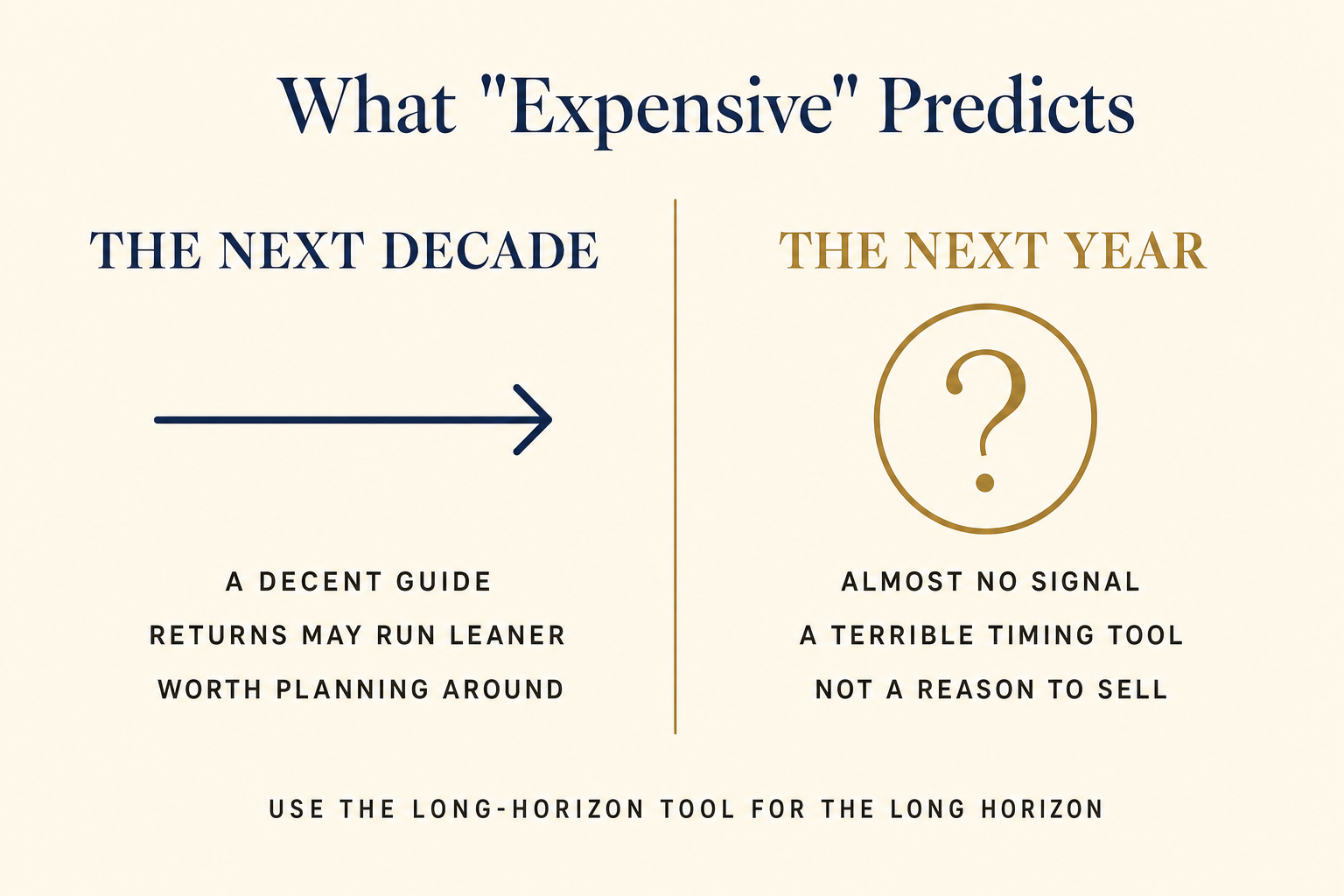
Here’s the part most headlines get backwards. Valuation is a reasonably good guide to the next decade and a genuinely terrible guide to the next year.
Over long stretches — ten, fifteen, twenty years — starting valuation and future returns are meaningfully linked. Historically, buying when the CAPE is very high has tended to be followed by below-average returns over the following decade, and buying when it’s low has tended to be followed by above-average returns. Not guaranteed. Tended to. It’s a gravitational pull, not a schedule.
Over the next twelve months, though, valuation tells you almost nothing about direction. An expensive market can get more expensive for years before it corrects. The late 1990s are the cautionary tale in both directions: the market looked expensive in 1996, and anyone who sold and sat in cash missed three more years of gains before the eventual downturn.
I spent years around trading desks, and this is a lesson the market teaches everyone eventually, usually at their own expense: being early is indistinguishable from being wrong. The old line is that the market can stay irrational longer than you can stay solvent. A high valuation is a statement about odds over a long horizon. It is not a starting gun — which is exactly why regulators like FINRA warn against trying to time the market at all.
Thomas’ Take: Valuation is a returns tool, not a timing tool. It can tell you the coming decade may be leaner than the last one. It cannot tell you whether that decade starts next month or in three years — and if your plan needs that answer to work, you don’t have a plan, you have a bet.
Why this matters more at the start of retirement
If you’re 35 and buying into an expensive market, a lean decade is almost a gift — you’re accumulating shares, and lower prices along the way let your ongoing contributions buy more. Time is on your side.
If you’re 63 and about to start drawing income, the same lean decade is the single most dangerous thing your plan can face. It has a name: sequence of returns risk. Two retirees can earn the exact same average return over 30 years and end up in completely different places — the one who hit a bad stretch early, while withdrawing, can run out of money, while the one who hit the same bad stretch later never feels it. The order of returns matters as much as the returns themselves.
A historically high starting valuation raises the odds that the early stretch is the weak one. That’s the real reason a reading near 41 deserves your attention — not because it forecasts a crash next Tuesday, but because it tilts the odds toward exactly the scenario that punishes new retirees hardest.
The answer isn’t to time the top — it’s to sequence your buckets
So what do you actually do? Not sell everything and wait. The cost of being wrong about the timing — sitting in cash through years of gains, and owing taxes for the privilege — is enormous, and you’d have to be right twice: once to get out, once to get back in. Almost nobody is.
Instead, you make the timing irrelevant. That’s the entire logic of the Now, Soon, Later bucket framework, and an expensive market is exactly the environment it was built for.
- The Now bucket — a couple of years of living expenses in cash and short-term instruments — means a bad first year in the market never forces you to sell shares to buy groceries. You spend from cash and leave the portfolio alone.
- The Soon bucket — a guaranteed income floor built from Social Security, any pension, and income-focused instruments — covers your essential bills with money that pays out the same whether the CAPE is 41 or 14. This is guaranteed income doing its job: it doesn’t care what the market costs.
- The Later bucket — your growth allocation, built on a sensible asset allocation — is the money you won’t touch for a decade or more. And a decade is precisely the horizon over which an expensive market has time to grow into its valuation or mean-revert without wrecking your plan.
Notice what just happened. The bucket structure converts a valuation problem — which nobody can time — into a time-horizon problem, which anyone can plan for. You’re not predicting when the expensive market corrects. You’re arranging your money so that it doesn’t matter when it does.
This is also the moment to run your own numbers rather than react to a headline — mine included. A planning tool like ProjectionLab lets you stress-test your plan against a deliberately weak first decade — a lower-return, higher-valuation-reversion scenario — and see whether your income floor and Now bucket carry you through without selling into the weakness. (ProjectionLab is a paid tool; the link is an affiliate link, which means I may earn a small commission at no extra cost to you. I only recommend tools I’d use myself.) Modeling the bad decade on purpose is far more useful than guessing whether it’s coming.
A hypothetical worth sitting with
Consider a hypothetical case, using round numbers for illustration, not a projection. Two neighbors, Marcus and Elena, are both 63 and both plan to retire next year. Each has about $800,000 invested, split similarly between stocks and bonds. Both are looking at the same headline: the most expensive market in 25 years.
Marcus has no income floor beyond Social Security and no cash cushion set aside. His entire retirement depends on that $800,000 performing — starting now, at these valuations. If the next few years are the lean ones, he’ll be selling shares into weakness to pay his bills, locking in losses at the worst possible time. He spends this weekend reading valuation charts and trying to decide whether to “get out until things settle down.”
Elena did the boring work first. She has two years of expenses in her Now bucket and a Soon-bucket floor — Social Security plus an income-focused annuity — that covers her essential bills for life. Her Later bucket is the same expensive market Marcus is staring at. But she doesn’t need to touch it for years. Same valuation, same portfolio, entirely different nervous system. She reads the same headline and goes back to her garden, because nothing she’ll spend in the next decade depends on what the CAPE does next.
Same market. The difference isn’t a forecast. It’s structure.
What to actually take away
An expensive market is real information, and it’s worth respecting. It just isn’t the information most people think it is. It doesn’t tell you to sell. It tells you the next decade may be leaner than the last — which is a reason to make sure the money you’ll spend soon isn’t riding on this market holding its price.
- Valuation guides the next decade, not the next year. Don’t use a long-horizon tool as a short-horizon signal.
- A high starting valuation matters most at the start of retirement, because it raises sequence-of-returns risk exactly when you’re most exposed to it.
- You don’t beat a valuation problem by timing the top. You beat it by sequencing your buckets so a lean decade can’t force a bad sale.
- Guaranteed income and a cash cushion are what let you own an expensive market calmly, instead of being owned by it.
You don’t need to know whether it’s 1999 all over again. You need a plan that survives it either way. If the last time we looked at this together was a record high or the question of whether you’re actually ahead after inflation, this is the same idea wearing a different hat — and it’s worth remembering that “the market” you own may be more concentrated than you think. The market’s price is the market’s business. Your plan’s job is to make that price something you can watch without flinching.
This article is published by Confluence Media Group LLC, an independent publisher of educational financial content. Thomas Clark is a Series 65 Investment Advisor Representative. The information provided is for educational and informational purposes only and is not personalized financial, tax, or legal advice. Past performance does not guarantee future results. All investing involves risk, including potential loss of principal. Consult a qualified professional before making financial decisions.
Confluence Media Group LLC is a separate entity from Confluence Capital Management, the investment advisory practice through which Thomas Clark provides advisory services. Advisory services are not offered through this publishing platform.
About Thomas Clark
Thomas Clark is the founder of Confluence Media Group LLC and a Series 65 Investment Advisor Representative. He has spent nearly two decades working with families on retirement planning, with a focus on Social Security optimization, retirement income coordination, and the bucket planning approach to building a guaranteed income floor.
Thomas writes and publishes at thomasclarkadvisor.com and is the author of The Just in Case Binder — a 148-page printable family financial organizer for households who want to make sure the people they love know where everything is.
He lives in North Carolina with his family.
Subscribe to the weekly newsletter · Get the Just in Case Binder

Thomas Clark is a Series 65 licensed investment advisor and experienced trader. He specializes in investing, retirement planning, and market analysis, helping individuals build wealth and make informed financial decisions.
