
Your Portfolio Doesn’t Vote in the Midterms
The midterm elections are tomorrow, and the urge to reposition your portfolio is strong. History and the Fed both say the result matters far less to your money than how you react to it.

Tomorrow is Election Day. Somewhere between now and the moment the results start rolling in, a lot of people are going to open their 401(k) and feel the urge to do something about it.
I’d encourage you to sit on your hands.
I don’t say that because the election doesn’t matter. It matters. I say it because the link between who wins on Tuesday and what your retirement account does over the next year is far weaker than the headlines want you to believe. The thing that reliably hurts investors around elections isn’t the result. It’s the reaction to it.
What market history actually says about elections
Here is the statistic you’ll see passed around this week: since 1950, there have been 19 midterm elections, and the S&P 500 has posted a positive return in the 12 months following every single one of them. The average gain across those stretches lands somewhere around 15 to 17 percent, depending on whose data set you use.
That sounds like a green light. It isn’t, and I won’t hand it to you that way, because the honest version comes with a caveat most people skip.
The midterm years when markets genuinely struggled — 1966, 1970, 1974 — didn’t struggle because of who won. They struggled because the economy was sliding into recession at the same time. The last time the S&P 500 actually lost ground in the 12 months after a midterm was 1939. So the pattern isn’t “stocks always rise after midterms.” It’s a small sample, it’s history rather than prophecy, and past performance guarantees nothing about the next cycle.
The real lesson sits underneath the stat. What drove those returns was the economy — growth, inflation, interest rates, and corporate earnings — not the balance of power in Congress. Markets care enormously about those four things. They care far less than you’d think about the party controlling the House.
The Fed already told you what matters more than the ballot
You don’t have to take my word for where the real action is. Look at last week.
On October 28, the Federal Reserve held its benchmark interest rate at a target range of 3.75% to 4.00%. The vote was a split 10-2, and here’s the detail worth noticing: the two dissenters wanted to raise rates, not cut them. The inflation fight isn’t finished, and the people who set the price of money are still arguing about it. Chair Kevin Warsh went out of his way to say that politics played no role in the decision, pointedly, with the election a week away. (You can read the decision straight from the source at the Federal Reserve.)
The market’s response to all of that? A shrug, and then a quiet gain. The S&P 500 closed at 7,743.98 that day, its third straight advance. Around the same stretch, the Bureau of Economic Analysis reported the economy growing at roughly a 3.2% annual pace in the third quarter.
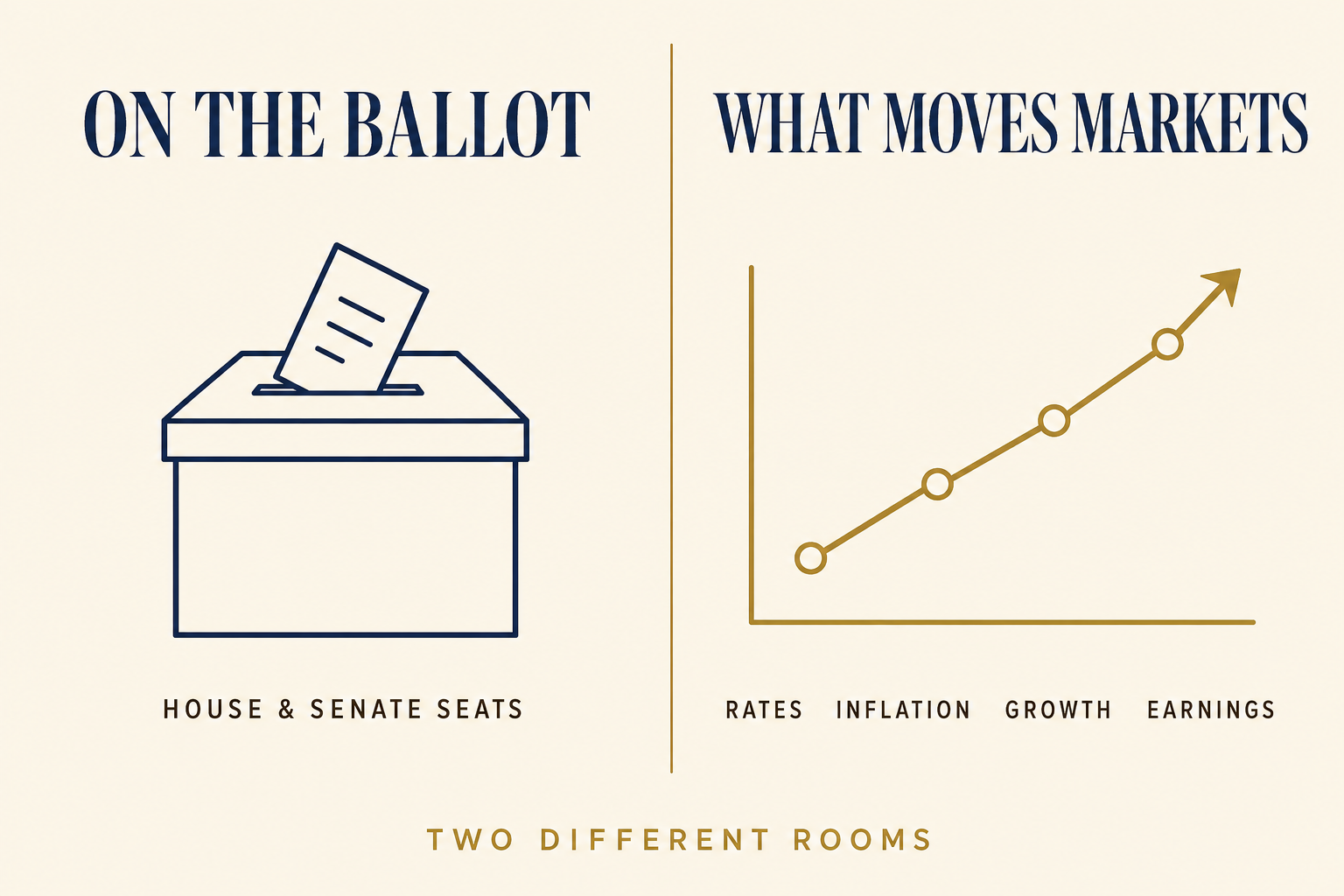
Rates, inflation, growth, earnings. Those are the levers that actually move your money. Not one of them is on Tuesday’s ballot.
Why “reposition now” and “wait and see” both lose
I spent years trading before I did anything else in this business, and election season brings out the exact instinct that trading teaches you to distrust: the urge to make a big, concentrated bet on a single event with a binary outcome.
Think about what it would actually take to profit from the election. You’d need two separate calls to go right. First, you’d have to predict the outcome. Then you’d have to predict how markets react to that outcome — which is a different and harder question, because markets spend weeks pricing in what they expect before the votes are even counted. The move comes from the surprise, and surprises are, by definition, the thing you didn’t see coming. Professionals who do this for a living rarely get both calls right. The idea that you’ll thread that needle from your kitchen table is the kind of confidence that empties accounts.
There’s also a plain mechanical reason not to brace for impact on election night: nothing changes that night. Whatever happens Tuesday, the newly elected Congress isn’t seated until January. The policy consequences, if any, unfold slowly over the following year, filtered through committees and compromises and a hundred other variables. There is no switch that flips at the moment a race is called.
The trading-desk version of this lesson is position sizing: you never stake the account on one roll of the dice, no matter how sure you feel. The retirement version is the same discipline wearing different clothes. I wrote more about that reflex in why you sell your winners and keep your losers, and about the difference between volatility and real risk in why volatility isn’t risk unless you’re a forced seller.
What a bucket plan does on election night: nothing
This is where the way you’ve built your plan does the heavy lifting, and it’s why I keep coming back to bucket planning.
The approach splits your money into three jobs. The Now bucket holds the cash and short-term reserves that cover your near-term living expenses. The Soon bucket is your guaranteed income floor — Social Security, any pension, and income-focused tools built to pay you no matter what the market does. The Later bucket is long-term growth, invested for a time horizon measured in years and decades, built to ride through many elections, not one.
Consider a hypothetical retiree named Walter, 68, in suburban Ohio. He keeps about two years of spending in his Now bucket. Between Social Security and a small pension, his Soon bucket covers most of his essential bills — the groceries, the utilities, the property taxes — with guaranteed income. The rest sits in a diversified Later bucket he doesn’t plan to touch for years.
When Walter watches the returns come in Tuesday night, here’s what’s actually at stake for him: nothing he needs to act on. His November grocery bill and his spring tax payment are already funded from buckets that don’t depend on the S&P 500. The Later bucket might wobble in the weeks ahead — markets do that — but he isn’t a forced seller of it, so a wobble is just a number on a screen. That structure is what lets him leave it alone. A guaranteed income floor doesn’t just pay the bills; it buys you the freedom to ignore the news. I made the fuller case for not playing the Later bucket too safe in the Later bucket is where retirees play it too safe.
The one move actually worth making
None of this means “do nothing and never look.” If the election is genuinely tempting you to sell, don’t ignore that feeling — but don’t act on it in the market, either. Treat it as information about your plan, not a signal about the market.
That urge usually points to one of two things. Either your income floor isn’t solid enough for you to shrug off the headlines, or your portfolio is carrying more risk than your stomach actually tolerates. Both are real problems. Both are worth fixing. Neither is fixed by panic-selling the morning after an election — that just locks in the damage and leaves you guessing about when to get back in. Fix the plan, not the holdings. I made the same argument the last time markets got loud in why your plan shouldn’t flinch.
If you want to pressure-test whether your own floor would hold through a rough year, that’s a far better use of this week’s energy than watching returns and refreshing your brokerage app.
Two different rooms
The ballot box and the brokerage account are two different rooms, and the trouble starts when people carry the emotion of one into the other.
Vote on Tuesday like it matters, because it does. Care about the result. Then close the laptop and leave your portfolio out of it. Your investments have already lived through every administration of your adult life — expansions and recessions, gridlock and sweeps, parties you liked and parties you didn’t. The plan worth having isn’t the one that bets correctly on who wins. It’s the one built to keep paying you no matter who does.
If this is the kind of plain-English, calm-in-the-noise take you want in your inbox, subscribe to the weekly newsletter.
This article is published by Confluence Media Group LLC, an independent publisher of educational financial content. Thomas Clark is a Series 65 Investment Advisor Representative. The information provided is for educational and informational purposes only and is not personalized financial, tax, or legal advice. Past performance does not guarantee future results. All investing involves risk, including potential loss of principal. Consult a qualified professional before making financial decisions.
Confluence Media Group LLC is a separate entity from Confluence Capital Management, the investment advisory practice through which Thomas Clark provides advisory services. Advisory services are not offered through this publishing platform.
About Thomas Clark
Thomas Clark is the founder of Confluence Media Group LLC and a Series 65 Investment Advisor Representative. He has spent nearly two decades working with families on retirement planning, with a focus on Social Security optimization, retirement income coordination, and the bucket planning approach to building a guaranteed income floor.
Thomas writes and publishes at thomasclarkadvisor.com and is the author of The Just in Case Binder — a 148-page printable family financial organizer for households who want to make sure the people they love know where everything is.
He lives in North Carolina with his family.
Subscribe to the weekly newsletter · Get the Just in Case Binder

Thomas Clark is a Series 65 licensed investment advisor and experienced trader. He specializes in investing, retirement planning, and market analysis, helping individuals build wealth and make informed financial decisions.
