
A Big Market Week — and Why Your Plan Shouldn’t Flinch
The Fed meets and Big Tech reports earnings in the same 48 hours — a week built to make you react. Here’s why a real retirement income floor turns a “pivotal” week into a spectator sport.

This week is engineered to make you do something. The Federal Reserve announces its interest rate decision Wednesday. Three of the largest companies in the stock market report earnings within about 48 hours of each other. And all of it lands just days after the sharpest technology selloff since the summer. If you are retired or close to it, the honest guidance is also the hardest to follow: watch if you want, but don’t touch anything.
I say that as someone who spent years trading. The instinct to position ahead of a big event is real, and I understand it. But the move that protects a retirement income plan during a week like this is almost always the move that feels like doing nothing. Let me walk through why, and what the week is actually testing.
A loud week, and very little of it is yours to control
Here is the setup. The Fed is widely expected to leave its benchmark rate unchanged at 3.75%–4.00% when it announces Wednesday, after raising rates in September. Microsoft and Alphabet report earnings Wednesday afternoon, and Amazon follows Thursday — the busiest stretch of a corporate earnings season that has been strong so far. And all of this comes after last Thursday, when the Nasdaq posted its biggest one-day drop since June on renewed worry about how much money is being spent on artificial intelligence.
Financial media has a word for weeks like this: pivotal. Every headline frames the next few days as a fork in the road, with your portfolio in the balance. I want to gently push back on that framing, because it quietly assumes something that isn’t true — that there is a correct action for you to take in response.
There usually isn’t. The Fed’s decision, the earnings numbers, the market’s mood on Thursday afternoon — none of it is within your control, and none of it is knowable in advance. What is within your control is how your retirement income is structured before the week begins. That is the whole ballgame, and it’s decided long before Wednesday.
“Pivotal” is a media word, not a planning word
Markets price in expectations ahead of time. By the time a retail investor reacts to a Fed decision or an earnings report, the professionals have already traded it — often hours or days earlier, on the expectation rather than the event. This is the hardest lesson from my trading years, and it applies double to anyone managing retirement money: you are not early, and you cannot reliably trade the news.
Worse, reacting tends to be asymmetric in the wrong direction. The retiree who sells into a scary Thursday and waits for the “all clear” usually buys back higher, having locked in the loss and missed the recovery. Decades of research on diversification and staying invested point the same way: time in the market beats timing the market, and that gap is widest precisely during the volatile stretches when timing feels most urgent.
If you want the fuller version of this argument, I made it a couple of weeks ago in a post on why the bond market often matters more than the stock headline, and again when I looked at how a single bad week can look completely different depending on what you own.
What actually decides whether a week like this hurts you
It isn’t the Fed’s words. It’s your structure — specifically, whether the money you need to spend in the near term is already out of the market’s reach.
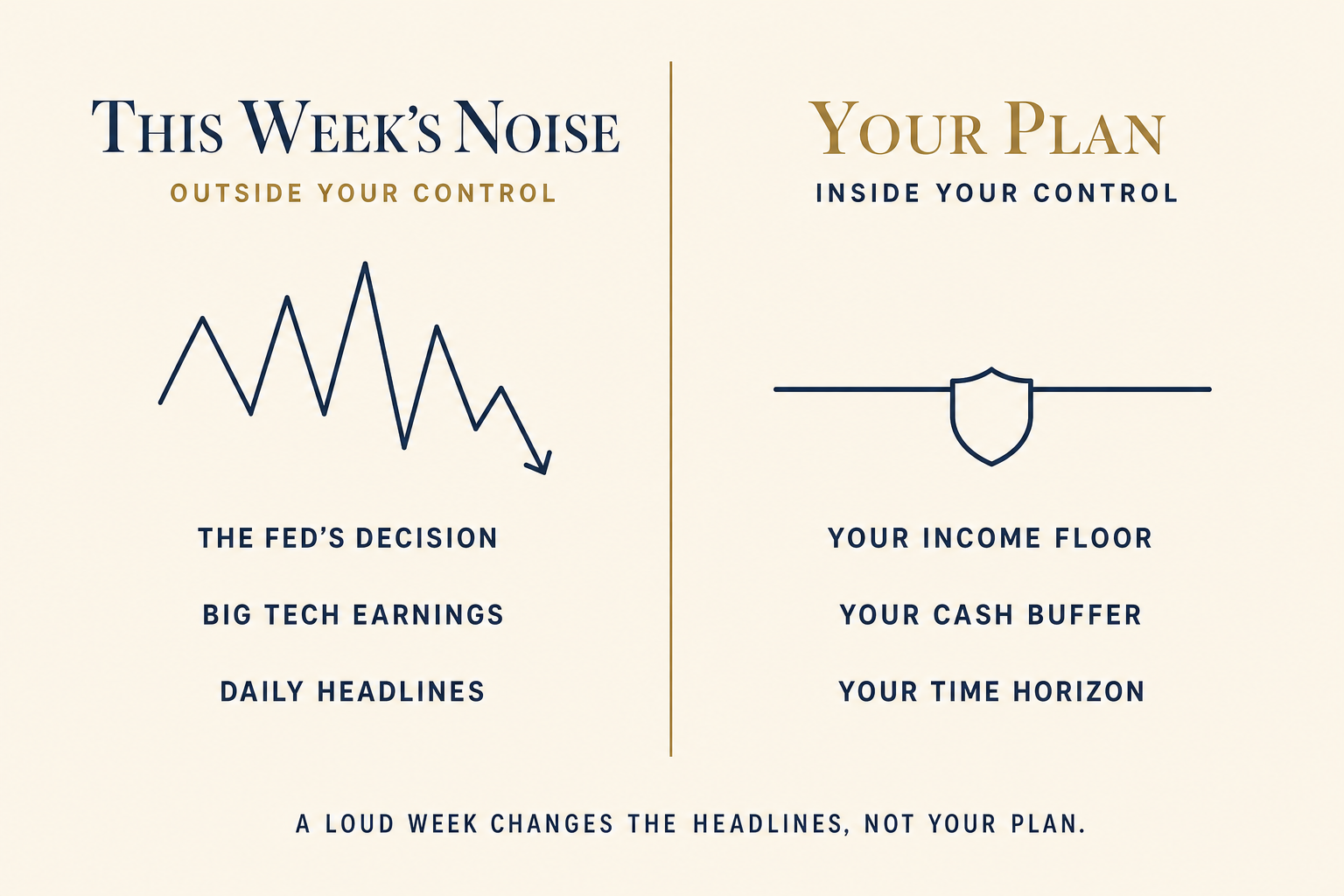
This is the heart of the bucket approach I write about constantly. You split retirement money into three jobs. The Now bucket holds current cash and short-term living expenses. The Soon bucket is your guaranteed income floor — Social Security, any pension, and income-focused tools like a fixed index annuity used for its income role — built to cover most of your essential bills no matter what the market does. The Later bucket is long-horizon growth, and it is the only part of your money that a week like this one touches at all.
When those first two buckets genuinely cover your spending, a brutal Thursday in the Nasdaq is a headline, not an emergency. Your grocery money, your utility payments, your property taxes — none of them depend on what Microsoft says about cloud revenue or what the Fed does with a quarter of a percent. That separation is not an accident. It is the entire point of building the floor first. If you want the mechanics, I laid out how to actually set up the buckets in a standalone guide.
There’s a counterintuitive consequence here that most retirees miss: a solid income floor doesn’t just protect you, it gives you more capacity to leave the Later bucket invested through turbulence, because a down market can’t force you to sell it. I made that case in the later bucket is where retirees play it too safe, and it’s worth understanding the difference between how much risk you can stomach and how much you can actually afford to take.
A hypothetical to make it concrete
Consider a hypothetical couple: Margaret and Dale, both 67, living outside Charlotte. Between Social Security and Dale’s small pension, their guaranteed income covers roughly 85% of their monthly bills. They keep about two years of additional spending in cash in the Now bucket. The rest — their old 401(k) balances — sits in a diversified mix in the Later bucket, money they don’t expect to touch for years.
For Margaret and Dale, this week is genuinely a spectator sport. If the Fed holds, fine. If Big Tech earnings send the market down another few percent, their floor doesn’t move, their cash doesn’t move, and their Later bucket has years to recover before they need a dollar of it. They can read the headlines with curiosity instead of dread.
Now picture the same couple with no income floor — nearly everything in the market, bills funded by selling shares each month. For them, every Fed day and every earnings miss is a gut-check, because a bad week directly threatens next month’s spending. Same market, same headlines, completely different experience. The difference isn’t their intelligence or their nerve. It’s the structure they built before the loud week arrived.
Thomas’ Take: The goal of a retirement plan isn’t to predict the Fed or guess which way earnings break. It’s to build a retirement where their decisions can’t reach your grocery money. When you’ve done that, “pivotal” weeks become boring — and boring is exactly what you want from the money you’re living on.
The one move that’s actually on the table
Doing nothing doesn’t mean being passive forever. There is a legitimate action a week like this can prompt — but it’s a scheduled one, not a panicked one.
If your plan calls for periodic rebalancing, or for refilling the Now bucket from gains, you do that on your calendar and your rules, not in reaction to Wednesday’s press conference. Selling a slice of a Later bucket that has grown, on a schedule you set in a calm moment, is disciplined. Selling because a headline scared you on a Thursday afternoon is the opposite. The actions can look identical on a brokerage statement; the difference is whether a plan or an emotion pulled the trigger.
And if this week exposes that you don’t have a floor — that a scary market genuinely threatens your spending — then that discomfort is the real signal. The lesson of the week isn’t what the Fed decides. It’s that building the floor should move to the top of your list, in the next calm stretch, before the following loud week shows up. If you want to pressure-test whether your own plan holds up across good and bad market paths, a modeling tool like ProjectionLab lets you run your retirement through different scenarios and see where the floor holds and where it gets thin.
Disclosure: the ProjectionLab link above is an affiliate link. If you subscribe, Confluence Media Group may earn a small commission at no additional cost to you. I only point readers toward tools I think are genuinely useful.
Key takeaways
- A Fed decision and the year’s biggest tech earnings all land this week, days after a sharp AI-driven selloff — but almost none of it is within your control.
- Markets price catalysts in advance; by the time you react to the news, you’re late, and reacting usually means selling low and buying back higher.
- Whether a volatile week hurts you is decided by structure, not by the Fed — specifically, whether your near-term spending is already out of the market.
- A guaranteed income floor turns “pivotal” weeks into spectator sports and actually raises your capacity to stay invested in the growth bucket.
- The only legitimate move this week is a scheduled one — rebalancing or refilling by plan, never in reaction to a headline.
Frequently asked questions
Should I move to cash before the Fed meeting just in case?
Moving to cash ahead of an event you can’t predict is market timing, and it requires being right twice — when to get out and when to get back in. Most people get the second decision wrong and return after the recovery. A better answer is to have your near-term cash needs already set aside in the Now bucket, so you never have to make the “just in case” trade at all.
Doesn’t a Fed decision change what I should own?
Rate changes matter for the economy and for bond prices, but they don’t change the job each of your buckets is doing. Your Now bucket is still short-term cash, your Soon bucket is still your guaranteed floor, and your Later bucket is still long-horizon growth. You can read the Fed’s own policy statements for context without turning them into a trading signal.
What if the big tech earnings really do trigger a correction?
Then the Later bucket — the only part exposed to it — has time on its side, which is exactly why that money belongs on a long horizon. A correction is painful to watch, but it only becomes a permanent loss if you’re forced to sell into it. The floor is what keeps you from being forced.
Markets will always have a loud week on the calendar. The work that protects you happens in the quiet ones. If posts like this are useful to you, subscribe to the weekly newsletter — I send one calm, useful email a week, no noise.
This article is published by Confluence Media Group LLC, an independent publisher of educational financial content. Thomas Clark is a Series 65 Investment Advisor Representative. The information provided is for educational and informational purposes only and is not personalized financial, tax, or legal advice. Past performance does not guarantee future results. All investing involves risk, including potential loss of principal. Consult a qualified professional before making financial decisions.
Confluence Media Group LLC is a separate entity from Confluence Capital Management, the investment advisory practice through which Thomas Clark provides advisory services. Advisory services are not offered through this publishing platform.
About Thomas Clark
Thomas Clark is the founder of Confluence Media Group LLC and a Series 65 Investment Advisor Representative. He has spent nearly two decades working with families on retirement planning, with a focus on Social Security optimization, retirement income coordination, and the bucket planning approach to building a guaranteed income floor.
Thomas writes and publishes at thomasclarkadvisor.com and is the author of The Just in Case Binder — a 148-page printable family financial organizer for households who want to make sure the people they love know where everything is.
He lives in North Carolina with his family.
Subscribe to the weekly newsletter · Get the Just in Case Binder

Thomas Clark is a Series 65 licensed investment advisor and experienced trader. He specializes in investing, retirement planning, and market analysis, helping individuals build wealth and make informed financial decisions.
