
One Bad Week, Two Very Different Markets
The Nasdaq had its worst week since June while the Dow gained — same five days, opposite directions. Here's what that split reveals about concentration risk, rotation, and why a bucket plan means you don't have to care which way one week breaks.

Stocks had a rough week. That was the headline Friday afternoon, and it was true — depending entirely on which stocks you mean.
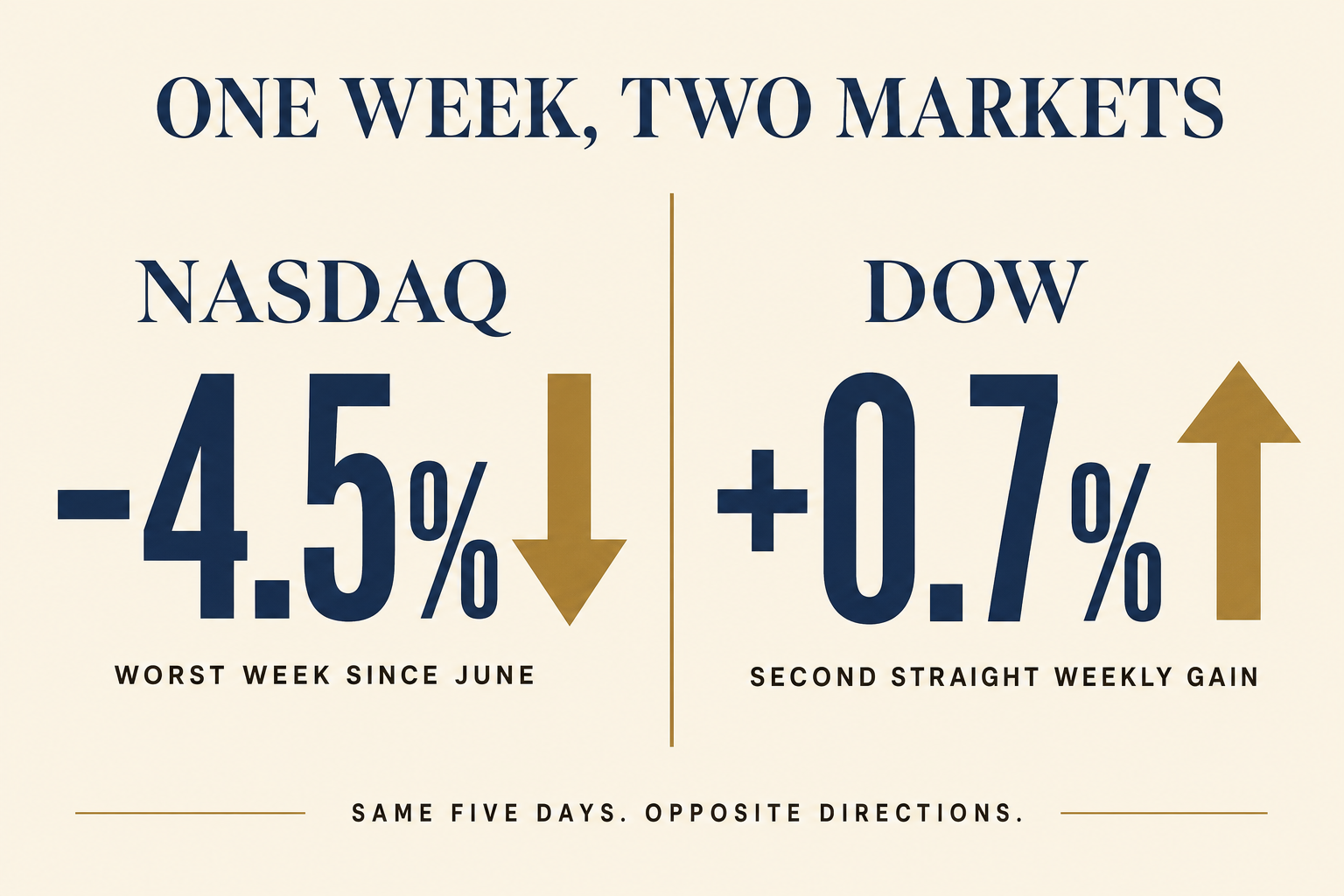
The Nasdaq Composite fell about 4.5% last week, its worst five days since June. The S&P 500 slipped close to 2%. And the Dow Jones Industrial Average? It finished higher — its second straight weekly gain. Same calendar, same economy, two markets moving in opposite directions.
If you only caught the word “selloff,” you would never guess that one of the three major indexes actually went up. That gap is the real story, and it says more about how your retirement money is built than any single day’s point move.
What actually happened
The damage was concentrated in one place: the artificial-intelligence trade. The largest technology names and the chipmakers did almost all of the falling. The chip-heavy corner of the market dropped more than 11% on the week, and on Friday the Nasdaq shed roughly 2% in a single session to close near 26,140.
The fear gauge noticed. The Cboe Volatility Index — the VIX, Wall Street’s rough measure of how nervous options traders are — climbed to about 20, its highest reading since late July. That is elevated, but it is a long way from panic. During the worst days of past market scares, the VIX has traded two and three times that level.
Meanwhile the Dow, which leans toward industrials, banks, and healthcare rather than big tech, quietly booked a gain for the week even after a small Friday dip. Bank earnings that landed mid-week were mixed — one Wall Street giant posted a blowout quarter while another had a rare revenue miss — but the old-economy index held up while the AI darlings stumbled.
The backdrop hasn’t changed much. The Federal Reserve’s target rate still sits at 3.75%–4.00%, and markets widely expect the Fed to hold steady at its late-October meeting, with rate cuts off the table for now. None of that is a crisis. What we saw was a rotation.
“The market” was never one thing
Rotation is one of those Wall Street words that sounds technical and means something simple: money moving within the stock market rather than leaving it. Last week, dollars rotated out of the expensive, crowded AI winners and into cheaper, overlooked corners — banks, industrials, the kind of companies that fill the Dow.
When that happens, “did the market go up or down?” becomes an unanswerable question. It depends entirely on which basket you’re looking at. The index that holds the names being sold falls. The index that holds the names being bought rises. Both are “the market.”
This is the mirror image of something I wrote about two weeks ago, when the S&P 500 set a record that most of its own stocks didn’t share. Back then, a handful of giants pulled the index up while the average stock lagged. Last week, those same giants pulled it down. The headline number and the experience of the typical company have been drifting apart for a while now.
The risk the index number hides
Here’s why this matters for your money and not just for market trivia. The S&P 500, and the Nasdaq even more so, have become remarkably top-heavy. A small group of technology names now makes up a historically large share of each index. That concentration is exactly what powered the multi-year run — and it’s exactly what did the damage last week.
Concentration cuts both ways, and that’s the part most people miss. The same handful of stocks that gave you an outsized gain on the way up will hand you an outsized loss on the way down. You don’t get the upside of concentration without the downside. They’re the same coin.
The trap is that this exposure hides inside funds that feel diversified. Consider a hypothetical couple, Priya and David, both 63, who are certain they’re well spread out: they own a total-market index fund in one account and a technology fund in another. In reality, a large slice of both rides on the very same few companies. On a week like last week, their “diversified” portfolio and their “aggressive” portfolio fall together, because underneath they’re holding a lot of the same thing. I walked through exactly how this happens in why your index fund isn’t as diversified as you think.
Thomas’ Take: Concentration is the one exposure almost nobody measures. People track their stock-versus-bond mix to the percentage point and never ask how much of the “stock” side is really a bet on five companies. In calm markets that question feels academic. In a week like last week, it’s the whole ballgame.
To be fair, diversification has a cost of its own. Spreading your money across the whole market means you give up some of the thrill when the leaders are running — a broadly diversified investor underperformed the concentrated index for much of the last two years. The point isn’t that concentration is evil and diversification is free. It’s that you should know which one you’re actually running, and own that choice on purpose.
The question that actually matters in retirement
For someone still working and decades from retirement, a week like this barely registers — it’s just more shares bought at a lower price. The stakes change when you’re drawing income from the same portfolio that just dropped. And even then, the honest question isn’t “did the market fall?” It’s “am I about to be a forced seller of the part that fell?”
That distinction is the whole reason I build plans around buckets. Your Now bucket — cash and near-cash — covers the immediate bills. Your Soon bucket builds a guaranteed income floor from Social Security, any pension, and income-focused tools, so the money you need in the next several years doesn’t depend on what the Nasdaq did this week. Only your Later bucket, the growth money with years ahead of it, felt last week’s drop at all — and a long time horizon is the biggest advantage that money can have when markets wobble. If this is new to you, start with how to set up your retirement buckets, and then why volatility only becomes real risk when it forces you to sell.
The honest way to see what a bad stretch would actually do to you is to put it on your own numbers, not a headline. Map your real spending, your expected Social Security, and what your income floor needs to cover, then model a sharp drop in the growth sleeve and watch how little — or how much — it changes the plan that pays your bills. A planning tool like ProjectionLab lets you build that scenario with your actual figures, so the answer comes from your plan instead of from CNBC. Seeing it on your own numbers lands very differently than watching a red screen.
Disclosure: the ProjectionLab link above is an affiliate link. If you subscribe through it, I may earn a commission at no additional cost to you. I only point to tools I’d actually sit down and use.
From the trader’s seat
Before I wrote about retirement, I spent years trading, and weeks like this one are familiar. When a trade gets crowded — when everyone owns the same names for the same reason — the exit gets narrow. The first hint of doubt sends a lot of people toward the same door at the same time, and the move looks violent even when nothing fundamental has broken.
That’s the difference between a crowded trade unwinding and the market breaking, and it’s worth learning to tell them apart. A rotation out of an over-owned sector is a normal part of how markets breathe. It’s not a signal to tear up a plan. The traders who survive long enough to get old aren’t the ones who called every turn — they’re the ones who sized their positions so that no single week could take them out of the game. That same discipline is really just matching your risk to your actual capacity for it, dressed in different clothes.
What to take from the week
A bad week for the hottest part of the market is not a bad week for a plan built with a floor underneath it. The news will keep collapsing dozens of different markets into one number and one mood, because one number is easier to say out loud at the top of the hour. Your job is quieter: know which market you actually own, know how much of it rides on a handful of names, and make sure the money you need soon isn’t sitting in the part that swings.
Do that, and a red Friday becomes what it should be — interesting, not alarming. If last week left you uneasy, that uneasiness is usually telling you something about your position size, not about the news. It’s worth listening to. It’s not worth panicking over.
- Two markets, one week: the Nasdaq fell about 4.5% — its worst week since June — while the Dow gained for a second straight week. “The market” fell and rose at the same time.
- It was a rotation, not a crash: money moved out of crowded AI and chip names and into banks and industrials. The VIX rose to about 20 — elevated, not panicked.
- Concentration cuts both ways: the same few giant stocks that drove the record run drove last week’s drop, and that exposure often hides inside “diversified” index funds.
- The retiree’s real question isn’t whether the market fell but whether you’re a forced seller of the part that did — which is what a Now/Soon/Later bucket plan is designed to prevent.
- Know the market you own, size your risk to your capacity, and let one index’s headline number be information, not instruction.
Frequently asked questions
Should I sell my technology funds after a week like this? Reacting to a single week is rarely the move, and selling into a drop locks in the loss. The more useful question is whether your overall mix — especially how much of it depends on a few concentrated names — still matches the risk you can actually afford to carry. That’s a portfolio-construction question to work through calmly, ideally with a professional who knows your full picture, not a decision to make on a Friday afternoon.
Is a 4.5% weekly drop in one index normal? Drops of that size happen more often than most people remember — several times in a typical year’s worst stretches. What makes a decline feel abnormal usually isn’t its size but whether you’re forced to sell into it. A plan with a cash cushion and a guaranteed income floor is what turns a scary number into a number you can sit through.
This article is published by Confluence Media Group LLC, an independent publisher of educational financial content. Thomas Clark is a Series 65 Investment Advisor Representative. The information provided is for educational and informational purposes only and is not personalized financial, tax, or legal advice. Past performance does not guarantee future results. All investing involves risk, including potential loss of principal. Consult a qualified professional before making financial decisions.
Confluence Media Group LLC is a separate entity from Confluence Capital Management, the investment advisory practice through which Thomas Clark provides advisory services. Advisory services are not offered through this publishing platform.
About Thomas Clark
Thomas Clark is the founder of Confluence Media Group LLC and a Series 65 Investment Advisor Representative. He has spent nearly two decades working with families on retirement planning, with a focus on Social Security optimization, retirement income coordination, and the bucket planning approach to building a guaranteed income floor.
Thomas writes and publishes at thomasclarkadvisor.com and is the author of The Just in Case Binder — a 148-page printable family financial organizer for households who want to make sure the people they love know where everything is.
He lives in North Carolina with his family.
Subscribe to the weekly newsletter · Get the Just in Case Binder

Thomas Clark is a Series 65 licensed investment advisor and experienced trader. He specializes in investing, retirement planning, and market analysis, helping individuals build wealth and make informed financial decisions.
