
Your Social Security Isn’t Frozen the Day You Claim
Claiming Social Security doesn't lock your benefit for life. If you keep working, the SSA quietly recalculates your check each year, and money withheld by the earnings test comes back at full retirement age.

Most people treat the day they claim Social Security as the day the number gets carved in stone. You file, the first deposit lands, and you assume that figure is now fixed for life except for the annual cost-of-living bump. It’s one of the most common beliefs I run into — and it’s wrong.
If you keep working after you claim, Social Security quietly looks at your earnings every year and can raise your monthly benefit. It doesn’t send a press release when it does. There’s no form to fill out and no phone call to make. The increase simply shows up. Understanding how that works changes how you think about working in your early retirement years, and it clears up one of the biggest sources of anxiety for people who claimed early and are still punching a clock.
Your benefit was never a single frozen number
Start with how the benefit is built in the first place. Social Security takes your highest 35 years of earnings, adjusts the older years for wage inflation so a dollar earned in 1995 is counted in today’s terms, and averages them. That average runs through a formula to produce your base benefit — what the agency calls your Primary Insurance Amount. (I walked through that formula step by step in how your Social Security benefit is actually calculated, if you want the full mechanics.)
Here’s the part that matters today: if you worked fewer than 35 years, the empty slots are filled with zeros. And even if you worked more than 35 years, some of those 35 “best” years might be from decades ago when you earned very little — a part-time stretch while raising kids, a slow year early in a career, a season of caregiving. Those low years are still sitting in your record, dragging the average down.
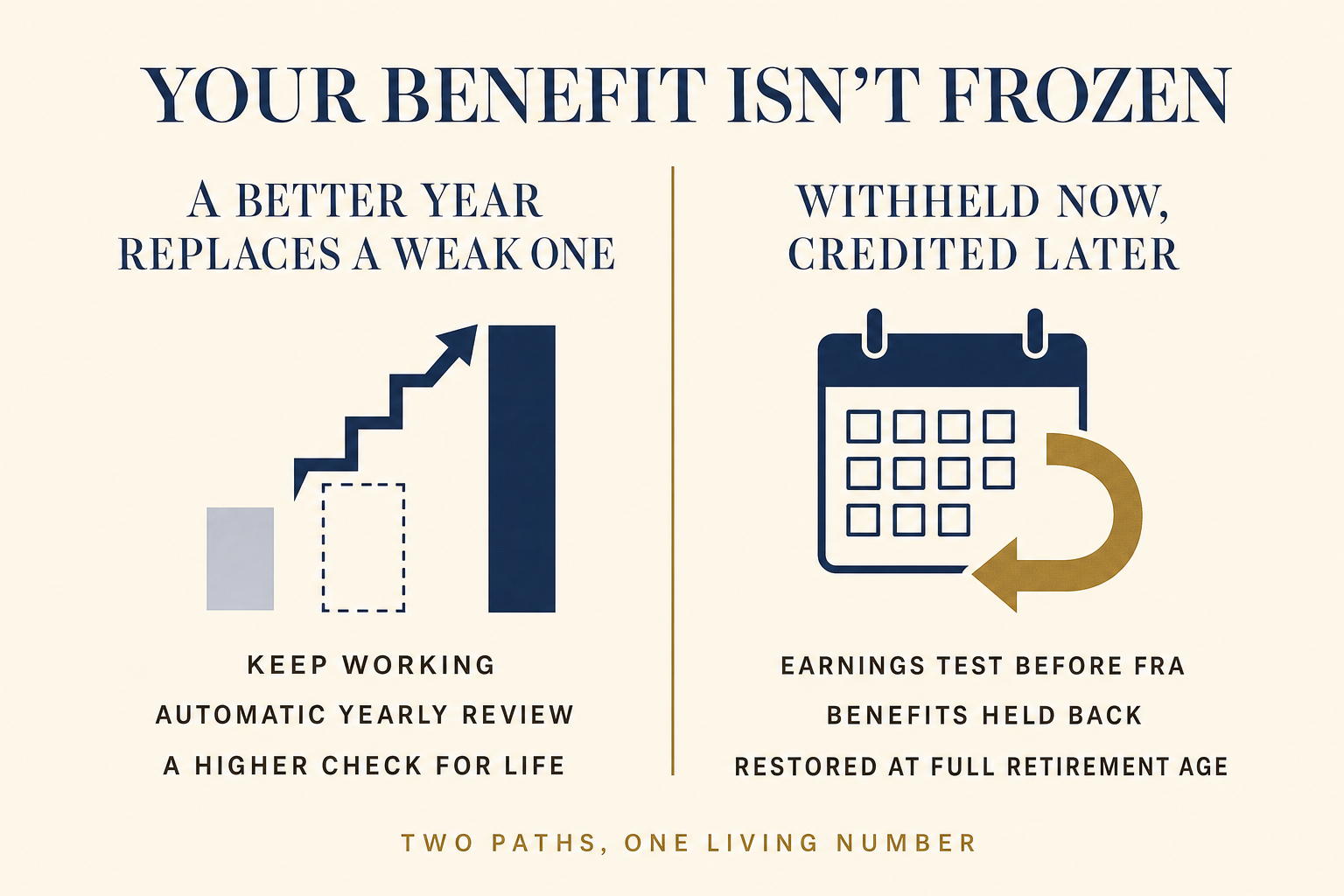
When you keep working, a current year of solid earnings can knock one of those weak years out of your top 35. That’s the whole mechanism. Your benefit isn’t frozen because the record it’s built on isn’t frozen.
Social Security checks your record every year — automatically
Each year, the Social Security Administration reviews the earnings of everyone who is both working and collecting benefits. If your latest year turns out to be one of your highest 35, the agency refigures your benefit and pays you the increase. Per the SSA, this is an automatic process — “if an increase is due, we calculate your new benefit amount and pay the increase retroactive to January” of the year after you earned the money.
In plain terms: you earn in, say, 2026. Sometime the following year, Social Security runs the review, and if 2026 beat one of your old low years, your check goes up — backdated to the previous January. You didn’t apply. You didn’t notice the review happen. The larger deposit just appears, and it stays larger for the rest of your life (and, for a surviving spouse, potentially beyond).
The SSA confirms the same thing in its own FAQ: your monthly retirement benefit can increase if your added earnings raise your lifetime record. Two honest caveats keep this from being hype. First, it only helps if the new year actually beats a year already in your top 35 — if you’re a lifelong high earner, your current year may not move the needle at all. Second, the increase is often modest. We’re usually talking about a nudge, not a windfall. But it’s a nudge in the right direction, for free, for life.
A hypothetical: Denise keeps working at 64
Consider a hypothetical case. Denise, 64, claimed Social Security at 62 to help cover the bills after she scaled back to part-time work as a hospital scheduler outside Durham, North Carolina. She assumed her benefit was locked at the reduced age-62 amount and never thought about it again.
But Denise is still earning roughly $42,000 a year. Tucked inside her top 35 years is a stretch from her early 30s when she worked part-time while raising her kids and earned very little. Wage-indexed, that current $42,000 year is worth more than that old low year — so Social Security’s annual review swaps the new year in for the old one and recalculates. The result in this illustration might be a modest bump of, say, $20 to $40 a month, which then compounds with every future cost-of-living adjustment and continues for life. (Figures here are round and illustrative, not a projection of anyone’s actual benefit.)
Denise didn’t do anything special to earn that increase except keep working and let the system do its annual math. The lesson isn’t “work forever to goose your check.” It’s that the paycheck she’s already collecting is quietly doing more than she realized.
The earnings test looks like a penalty — it’s really a timing shift
There’s a second way your benefit can rise after you claim, and it trips people up constantly: the retirement earnings test.
If you claim before your full retirement age and keep working, Social Security temporarily withholds some benefits once your earnings cross an annual limit. For 2026, the SSA set that limit at $24,480 for people who are under full retirement age all year — above it, the agency holds back $1 for every $2 you earn. In the year you reach full retirement age, the limit jumps to $65,160 with a gentler $1-for-$3 reduction, and only earnings before your birthday month count. Once you hit full retirement age, the earnings test disappears entirely. (You can see the current figures in SSA’s How Work Affects Your Benefits guide, and I broke the test down in detail in the Social Security earnings test, explained.)
The word “withheld” makes it sound like that money is gone. It isn’t. When you reach full retirement age, Social Security recalculates your benefit to account for the months it held back, and your monthly check steps up to give that value back over time. The earnings test doesn’t shrink your lifetime benefit — it reshuffles when you receive it. That’s a crucial distinction, because the fear of “losing” benefits pushes some people to quit working or claim strategies that cost them far more than the test ever would.
Where this fits in a real plan
None of this is a reason to keep working if you don’t want to. The automatic recalculation is a bonus, not a strategy — the increases are usually too small to justify staying in a job you’re ready to leave. The real high-leverage Social Security decisions are still your claiming age and the strength of your earnings record over a full career.
What it does change is how you frame the income you’re already earning. In the bucket planning approach I use, Social Security is the backbone of the Soon bucket — the guaranteed, inflation-adjusted income floor that covers your essential bills so your market money can stay invested for the long haul. Every automatic bump, however small, quietly raises that floor and sizes up what the Soon bucket can cover for the rest of your life.
And it reinforces a point I keep coming back to: the biggest claiming mistakes come from treating Social Security as more rigid than it is. It’s why I argue you should generally never delay past 70 but rarely rush to claim out of fear, and why full retirement age is a milestone, not a deadline. The system has more give in it than most people assume — including, it turns out, after you’ve already filed.
Thomas’ Take: I’ve watched people agonize over whether working in their 60s would “waste” the benefit they already claimed. The truth is closer to the opposite. If you’re working anyway, the system is quietly working for you too — topping up your record, giving back what the earnings test held, and nudging your income floor higher year after year. That’s not a reason to stay chained to a desk. It’s permission to stop worrying that you broke something by claiming early.
Key takeaways
- Your Social Security benefit is not locked the day you claim. If you keep working, it can be recalculated upward.
- Social Security automatically reviews your earnings each year and raises your benefit if a new year beats one of your top 35 — no application needed, paid retroactive to January.
- The increase only happens if the new year is high enough to replace an older, lower one, and it’s usually modest.
- Benefits withheld under the earnings test before full retirement age aren’t lost — your check is adjusted upward once you reach full retirement age.
- Treat the automatic bump as a bonus to your Soon-bucket income floor, not a reason to keep working longer than you want.
Frequently asked questions
Do I have to apply to get my benefit recalculated for a new year of earnings?
No. Social Security reviews working beneficiaries’ records automatically each year and pays any increase due. If you want to document a year sooner, you can supply earnings records, but for most people the automatic review handles it.
Will working after I claim always increase my check?
Not always. A new year only helps if it ranks among your highest 35 wage-indexed years. For lifelong high earners, a current year may not beat anything already in the record, so the benefit stays the same.
If the earnings test withholds some of my benefit, do I lose that money for good?
No. Once you reach full retirement age, Social Security adjusts your monthly benefit upward to credit the months that were withheld. The earnings test changes the timing of your benefits, not the lifetime total.
If you’re still weighing when to claim or how continued work fits your plan, run the scenarios for yourself with the free Social Security calculator before you make any decisions — seeing your own numbers side by side beats guessing every time.
This article is published by Confluence Media Group LLC, an independent publisher of educational financial content. Thomas Clark is a Series 65 Investment Advisor Representative. The information provided is for educational and informational purposes only and is not personalized financial, tax, or legal advice. Past performance does not guarantee future results. All investing involves risk, including potential loss of principal. Consult a qualified professional before making financial decisions.
Confluence Media Group LLC is a separate entity from Confluence Capital Management, the investment advisory practice through which Thomas Clark provides advisory services. Advisory services are not offered through this publishing platform.
About Thomas Clark
Thomas Clark is the founder of Confluence Media Group LLC and a Series 65 Investment Advisor Representative. He has spent nearly two decades working with families on retirement planning, with a focus on Social Security optimization, retirement income coordination, and the bucket planning approach to building a guaranteed income floor.
Thomas writes and publishes at thomasclarkadvisor.com and is the author of The Just in Case Binder — a 148-page printable family financial organizer for households who want to make sure the people they love know where everything is.
He lives in North Carolina with his family.
Subscribe to the weekly newsletter · Get the Just in Case Binder

Thomas Clark is a Series 65 licensed investment advisor and experienced trader. He specializes in investing, retirement planning, and market analysis, helping individuals build wealth and make informed financial decisions.
