
Divorced? You Can Claim Social Security on Your Ex
If your marriage lasted ten years, you may be entitled to Social Security on your ex-spouse's record — and claiming it doesn't reduce their check or even notify them. Here's how divorced-spouse benefits work, who qualifies, and why the check can nearly double after an ex-spouse dies.
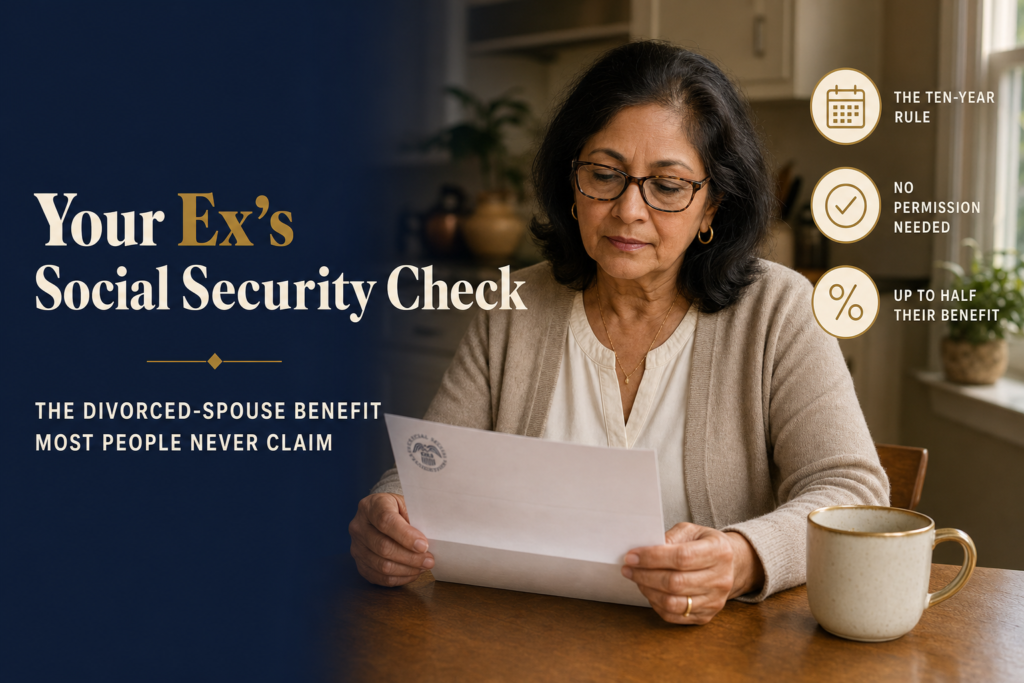
Here is something most divorced people are never told: if your marriage lasted ten years, you may be entitled to a Social Security check based on your ex-spouse’s earnings record — and claiming it takes nothing away from them.
Your ex won’t be notified. Their benefit doesn’t shrink by a dollar. If they’ve remarried, the new spouse’s benefit is untouched too. Yet every year, people who spent a decade or more married to a higher earner leave this money on the table, usually for one reason: no one ever told them it existed.
This is one of the quieter corners of Social Security, and it matters most for the person who stepped back from a career to raise kids or support a spouse’s, then watched the marriage end. Let me walk through exactly how divorced-spouse benefits work, who qualifies, and the two situations where this quietly becomes one of the most valuable checks in your retirement.
The ten-year rule is a bright line
The core requirement is simple to state and unforgiving in practice. Your marriage must have lasted at least ten years, measured from the legal marriage date to the date the divorce was final — not the date you separated. A marriage that ran nine years and eleven months qualifies you for nothing. There is no grace period and no rounding up.
Beyond the ten years, you have to be currently unmarried, and both you and your ex-spouse have to be at least 62. Your ex also has to have earned enough to qualify for Social Security in the first place, which nearly everyone with a full career has.
That hard cliff at ten years is worth knowing about in advance, because it’s one of the few places in the entire system where the timing of a legal formality carries a lifetime financial consequence. If a marriage is ending near that mark, the difference between year nine and year ten is not a rounding error — it’s a benefit that can pay out for the rest of your life.
What the check is actually worth
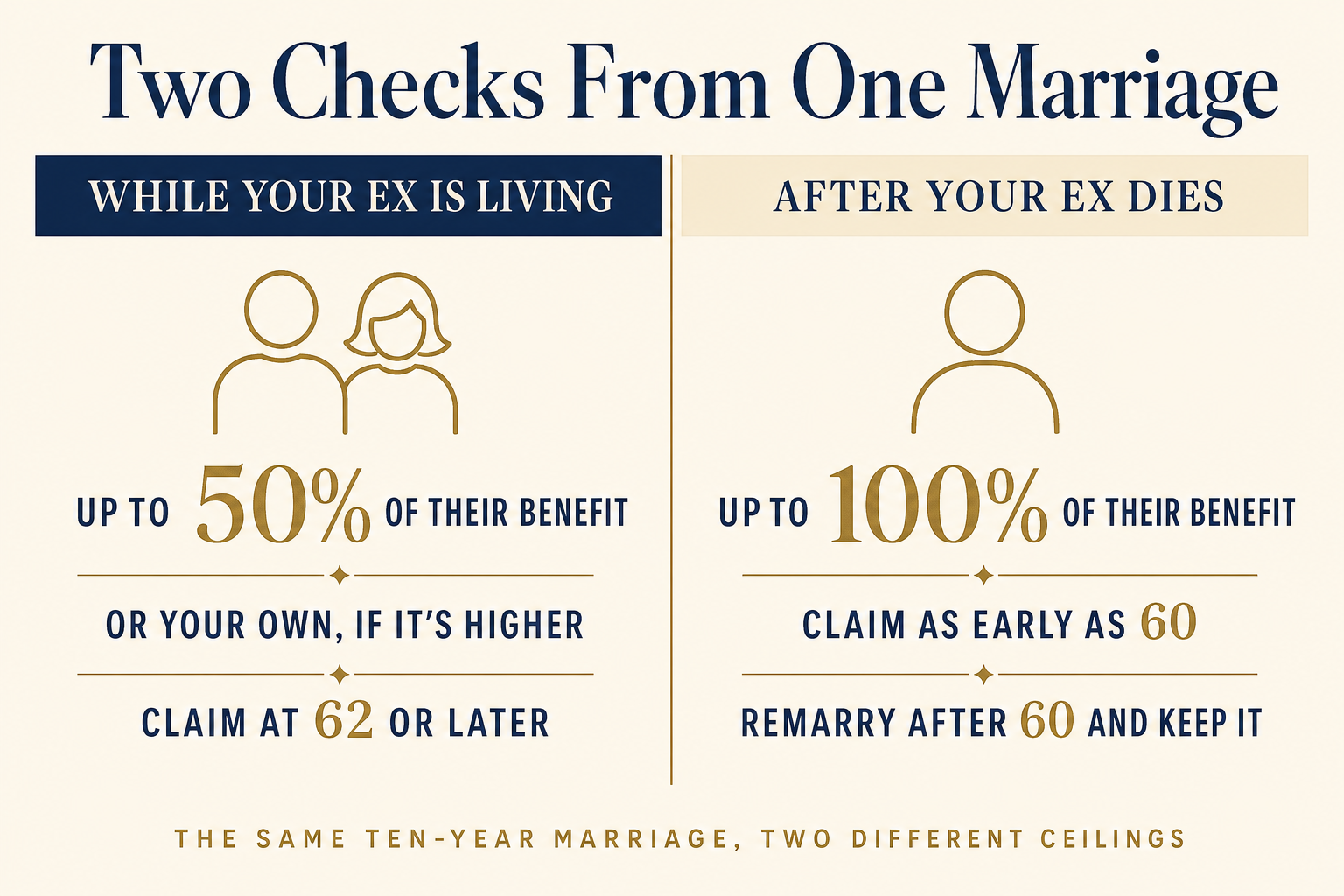
A divorced-spouse benefit is worth up to 50% of your ex’s primary insurance amount — that’s the benefit they’d receive at their own full retirement age — if you claim at your full retirement age, which is 67 for anyone born in 1960 or later. Claim earlier, as early as 62, and the amount is permanently reduced, the same way claiming your own benefit early reduces it.
One detail trips people up: it’s half of your ex’s full-retirement-age figure, not half of what they actually collect. If your ex delayed to 70 and boosted their own check, you don’t get half of that larger number — the divorced-spouse benefit is still capped at half of their full-retirement-age amount. (If you want the mechanics of how that base figure is set, I laid them out in how your Social Security benefit is actually calculated.)
There’s also a rule that decides whether you get your own benefit or the divorced-spouse benefit. When you file, Social Security pays your own retirement benefit first. If the divorced-spouse benefit would be higher, they top you up to that amount. You receive the higher of the two — not both stacked together. For anyone born after January 1, 1954, this “deemed filing” rule is automatic, which means the old strategy of claiming a spousal benefit now and switching to your own later is gone. This works much like the 50% rule for married couples, with a few divorce-specific twists.
You don’t need their permission — and it costs them nothing
This is the myth that keeps the most money unclaimed. People assume that filing on an ex’s record requires the ex’s cooperation, or that it will drag them back into contact, or that it somehow reduces what the ex — or the ex’s new spouse — receives. None of that is true.
Social Security does not notify your ex-spouse when you claim. Your claim has zero effect on their benefit, on their current spouse’s benefit, or on anyone else drawing on their record. Social Security isn’t a fixed pie carved up among claimants; a divorced-spouse benefit is paid on top, funded by the system, not deducted from anyone. You never have to speak to your ex to file.
What you will need is proof of the marriage and proof that it ended — typically a marriage certificate and the divorce decree. Their Social Security number makes the process smoother, but if you don’t have it, Social Security can often locate the record from other identifying information you provide.
You can claim even if your ex hasn’t
Married couples run into a wall here: a spouse generally can’t claim a spousal benefit until the working spouse actually files for their own. Divorced spouses get an exception. If you’ve been divorced for at least two years and both of you are 62 or older, you can claim on your ex’s record even if they haven’t filed yet.
This is the “independently entitled” rule, and it exists precisely so that a foot-dragging ex can’t hold your benefit hostage. You don’t have to wait for them to make up their mind about their own retirement. Your claim stands on its own.
When your ex dies, this becomes a much bigger number
Here is the part almost nobody plans for, and it’s the most valuable piece. When your ex-spouse dies, a surviving divorced spouse can collect survivor benefits worth up to 100% of what the ex was receiving — not 50%. The ten-year marriage requirement still applies, but the ceiling roughly doubles.
The timing rules loosen too. You can start survivor benefits as early as age 60 (50 if you’re disabled), though claiming before your full retirement age reduces the amount. And the remarriage rule flips in your favor: for the living-ex benefit, remarrying ends your eligibility, but for survivor benefits, remarrying after age 60 does not disqualify you. For someone who was married a long time to a higher earner, a surviving divorced-spouse benefit can be the difference between a thin retirement and a stable one — the same dynamic behind the survivor’s penalty that catches so many widowed retirees off guard.
Remarriage and more than one qualifying marriage
If you remarry, you generally lose the ability to claim on a living ex — unless that later marriage also ends, at which point eligibility can be restored. The full set of moving parts is in how remarriage affects your Social Security benefits.
And if you were married two or more times, each for at least ten years, you are not forced to claim on the first. Social Security lets you claim on whichever ex-spouse’s record produces the higher benefit. People who married and divorced more than once often assume the marriages somehow cancel each other out. They don’t — you simply get to use the best one.
A hypothetical to make it concrete
Consider a hypothetical case: Patricia, 64, divorced after 22 years of marriage. She spent most of those years raising three children and working part-time, so her own Social Security benefit at full retirement age comes to about $1,100 a month. Her ex-husband, David, was the primary earner; his full-retirement-age benefit is roughly $2,800.
Because their marriage lasted well past ten years and Patricia hasn’t remarried, she can claim a divorced-spouse benefit worth up to half of David’s full-retirement-age amount — around $1,400 — instead of her own $1,100. She’s filing a few years before her own full retirement age of 67, so that figure is reduced somewhat, but it still lands above her own benefit. Deemed filing means Social Security pays her own $1,100 first and tops her up to the divorced-spouse amount. David is never contacted, his check is unchanged, and his current wife’s benefit is untouched.
Now move the story forward. If David dies first, Patricia’s status shifts from divorced spouse to surviving divorced spouse — and her ceiling jumps from half of David’s benefit to as much as 100% of it. The same decade-plus of marriage that felt financially irrelevant the day the divorce was final turns into one of the load-bearing pieces of her retirement income. (Patricia and David are illustrations; the figures are round numbers chosen to show the mechanics, not a projection of anyone’s actual benefit.)
Thomas’ Take: I think of a divorced-spouse benefit as a Soon-bucket asset that people forget they own. In my Now, Soon, and Later framework, the Soon bucket is the guaranteed income floor — Social Security, pensions, income-focused annuities — the money that covers your essential bills no matter what the market does. A divorced-spouse or surviving-divorced-spouse benefit is guaranteed, inflation-adjusted income for life. If you qualify for one and never claim it, you’re leaving a piece of your floor unbuilt and almost certainly drawing harder on your investments to fill the gap. For a single retiree, whose income floor has no second earner behind it, that’s a costly thing to overlook — I wrote more about that in bucket planning for the solo retiree.
Key takeaways
- A marriage that lasted at least ten years can entitle you to Social Security on your ex’s record — even decades after the divorce.
- Claiming takes nothing from your ex, their current spouse, or anyone else, and your ex is never notified.
- You receive the higher of your own benefit or up to half your ex’s full-retirement-age benefit — not both (deemed filing).
- Divorced two or more years and both of you are 62+? You can claim even if your ex hasn’t filed yet.
- If your ex dies, the benefit can rise to 100% as a surviving divorced spouse — and remarrying after 60 doesn’t disqualify you.
Frequently asked questions
Does my ex-spouse have to know or agree before I can claim on their record?
No. Social Security doesn’t notify them, doesn’t need their consent, and doesn’t reduce their benefit or their current spouse’s. You’ll need your marriage certificate and divorce decree; their Social Security number helps but isn’t strictly required.
We were married nine and a half years. Is there any way to still qualify?
No. The ten-year rule is measured from the legal marriage date to the date the divorce was finalized, and there’s no grace period. Nine years and eleven months doesn’t qualify. It’s one of the few Social Security rules with a hard cliff rather than a sliding scale.
I’ve remarried. Can I still claim on my first husband’s record?
Not while you’re married. Remarriage ends eligibility for a living-ex divorced-spouse benefit. The exception is survivor benefits: if your ex has died and you remarried after age 60, you can still collect as a surviving divorced spouse.
The check a lot of people never claim
Social Security rewards the people who know its rules exist. The divorced-spouse benefit is one of the clearest examples — no strategy, no market timing, no risk, just a check a great many people are entitled to and never claim, because the topic feels awkward or because a finished marriage seems like it should leave nothing behind. It leaves quite a lot behind, and the rules are firmly on your side about it.
If you were married for a decade or more and you’re now single, this is worth ten minutes of your attention before you decide when and how to file. Deciding when to claim matters at least as much as deciding whether to — which is exactly why break-even age is the wrong question to anchor on. The worst outcome is discovering at 75 that you could have been collecting a larger check since 62.
Before you file on your own record, it’s worth seeing how the numbers compare side by side. You can run different claiming ages and benefit estimates through the Social Security Calculator to get a feel for the tradeoffs, then take the divorced-spouse question straight to the Social Security Administration — they can pull the actual figures from your ex’s record and confirm what you’re eligible for. Government sources lay out the eligibility rules for divorced-spouse benefits, the deemed-filing and spousal rules, survivor benefits for a surviving divorced spouse, and the reductions for claiming early.
This article is published by Confluence Media Group LLC, an independent publisher of educational financial content. Thomas Clark is a Series 65 Investment Advisor Representative. The information provided is for educational and informational purposes only and is not personalized financial, tax, or legal advice. Past performance does not guarantee future results. All investing involves risk, including potential loss of principal. Consult a qualified professional before making financial decisions.
Confluence Media Group LLC is a separate entity from Confluence Capital Management, the investment advisory practice through which Thomas Clark provides advisory services. Advisory services are not offered through this publishing platform.
About Thomas Clark
Thomas Clark is the founder of Confluence Media Group LLC and a Series 65 Investment Advisor Representative. He has spent nearly two decades working with families on retirement planning, with a focus on Social Security optimization, retirement income coordination, and the bucket planning approach to building a guaranteed income floor.
Thomas writes and publishes at thomasclarkadvisor.com and is the author of The Just in Case Binder — a 148-page printable family financial organizer for households who want to make sure the people they love know where everything is.
He lives in North Carolina with his family.
Subscribe to the weekly newsletter · Get the Just in Case Binder

Thomas Clark is a Series 65 licensed investment advisor and experienced trader. He specializes in investing, retirement planning, and market analysis, helping individuals build wealth and make informed financial decisions.
