
QLACs: A Guaranteed Paycheck That Starts at 85
A QLAC lets you move part of your IRA into a deferred annuity that pays guaranteed income for life starting as late as age 85 — and shrinks your required withdrawals until it does. Here's how the 2026 rules work, who it fits, and the tradeoffs to weigh.

Here’s the retirement math almost nobody likes to sit with: you have to make your money last for a number of years you don’t get to know in advance. Plan for 90 and live to 97, and the last seven years are the ones you were most afraid of. Plan for 100 and die at 82, and you spent three decades being more careful than you ever needed to be.
The unknown length of your own life is the hardest variable in any retirement plan — and it’s the one spreadsheets quietly fudge. There’s a tool built directly into the tax code for exactly this problem, and most people have never heard its name: the Qualified Longevity Annuity Contract, or QLAC.
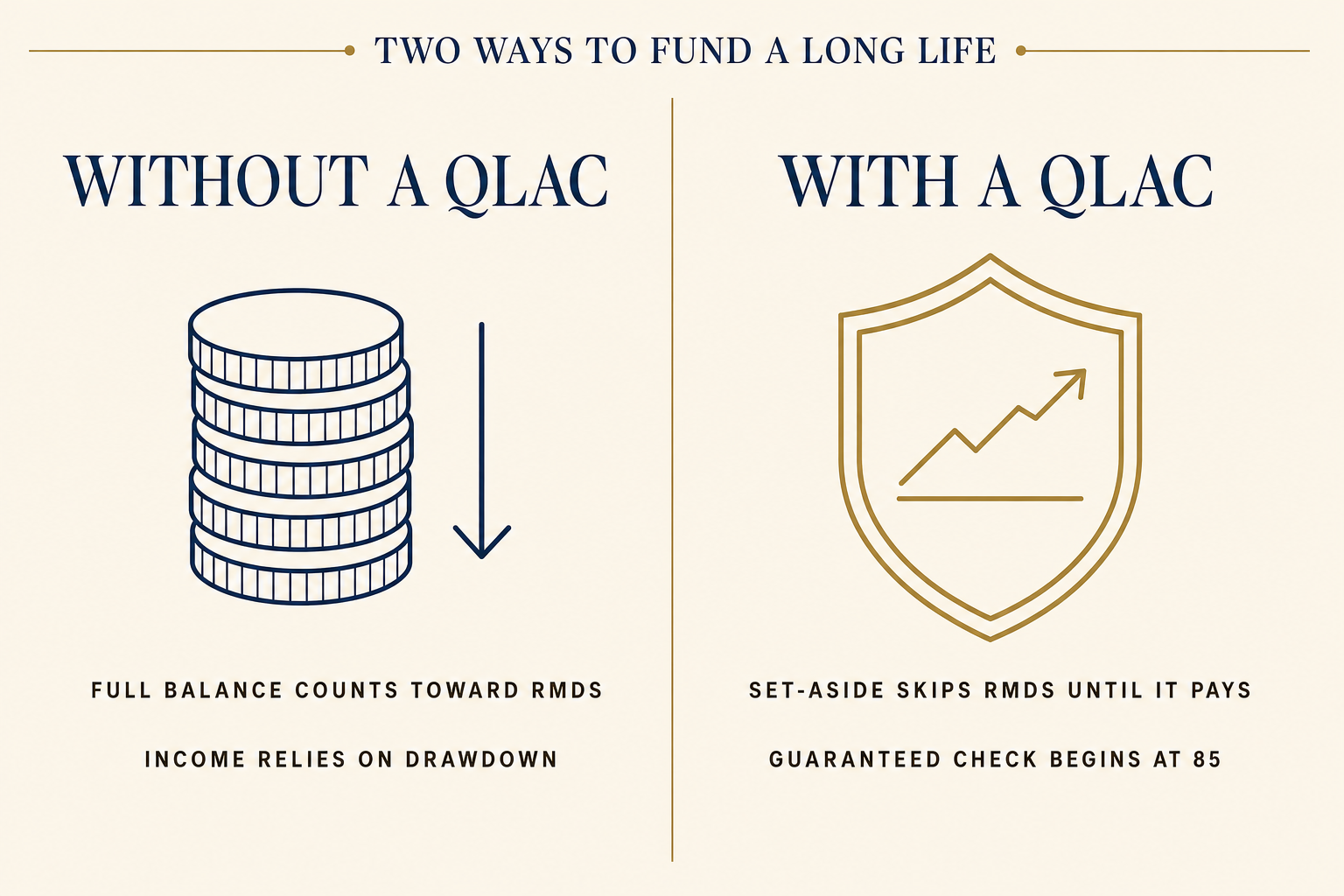
It does something unusual. It lets you move a slice of your retirement account aside today and turn it into a guaranteed monthly check that switches on in your mid-80s — right when you’d otherwise be most worried about running dry. As a bonus, the money you move into it stops counting toward your required minimum distributions until that income begins. Let’s walk through how it actually works, who it’s for, and the tradeoffs nobody selling one likes to lead with.
What a QLAC actually is
A QLAC is a specific, IRS-sanctioned type of deferred income annuity you buy inside a retirement account. “Deferred income annuity” sounds complicated, but the idea is simple: you hand an insurance company a lump sum now, and in exchange it promises you a fixed monthly income for the rest of your life — starting not today, but on a future date you choose, as late as age 85.
That’s the whole machine. One number in now, one guaranteed number out later. There are no market sub-accounts, no index crediting formulas to decode, no surrender-value tables with moving parts. In that sense a QLAC is the opposite of the complicated products that have given annuities a bad name. It belongs to the plain-vanilla, income-first corner of the annuity world — the same corner a pension or Social Security lives in. If you want the full map of how the different annuity types compare, I laid it out in this guide to the four types of annuities.
The two problems a QLAC is built to solve
First, longevity risk. That’s the technical name for the plainest fear in retirement — outliving your money. I’ve written before about how most retirement plans quietly ignore longevity risk, and a QLAC is one of the few tools designed to attack it head-on. Because you’re pushing the start date out to your 80s, the monthly payout for a given premium is larger than it would be on an immediate annuity. The insurer is pricing in fewer expected payment years, plus the reality that not everyone who buys will live to collect. Those “mortality credits” are why deferred income, bought young and started late, is so efficient as pure longevity insurance.
Second, the RMD drag. Starting at age 73, the IRS requires you to pull a minimum amount out of your traditional retirement accounts every year and pay tax on it, whether you need the money or not — the required minimum distribution. The premium you move into a QLAC is carved out of the account balance the IRS uses to calculate those withdrawals, up to the legal limit, until the QLAC’s income turns on. Lower balance, smaller required withdrawal, less forced taxable income in your 70s. Just be clear-eyed that this is a deferral, not an escape hatch — when the QLAC income eventually starts, it’s taxable then.
The 2026 rules, in plain numbers
Congress rewrote the QLAC rulebook in the SECURE 2.0 Act of 2022, and the current figures matter, so here they are for 2026:
- Maximum you can move in: $210,000 per person. This is a lifetime cap counted across all of your eligible accounts combined, not a per-account or per-year figure. A married couple can each use their own limit, for roughly $420,000 between them.
- Latest start age: 85. Payments generally must begin no later than the first day of the month after you turn 85.
- Eligible accounts: traditional IRAs, SEP and SIMPLE IRAs, and most employer plans — 401(k), 403(b), and governmental 457(b).
- Not eligible: Roth IRAs and Roth 401(k)s (they have no lifetime RMDs to defer anyway), inherited IRAs, and traditional pensions.
One important piece of history: SECURE 2.0 repealed an older, clumsier rule that capped your QLAC premium at 25% of your account balance. That percentage limit is gone. Today it’s a clean dollar figure — $210,000 — indexed to inflation in $10,000 steps, which is why the number can sit still for a year or two before ticking up.
Pro Tip: The $210,000 is a lifetime total across every retirement account you own. If you buy one QLAC now and think about a second one later, the two premiums have to fit under the same ceiling together. Keep a record of what you’ve used, because the insurer only sees its own contract — not your limit across the whole household.
A hypothetical, so the numbers feel real
Consider a hypothetical case — illustrative figures, round on purpose, not a quote or a projection. Eleanor is 62, recently retired from a career in hospital administration, and healthy, with a mother who lived to 94. She has about $900,000 across her IRA and old 401(k). Her Social Security and a small pension already cover most of her essential bills, so the real question keeping her up isn’t the next market dip — it’s the back half of a potentially very long life.
Eleanor moves $150,000 of her IRA into a QLAC and sets it to begin at 85. For the next decade-plus, that $150,000 no longer counts in her RMD calculation, so her required withdrawals in her 70s are smaller and her taxable income is lower. Then, at 85, a guaranteed monthly check she can’t outlive begins and runs for the rest of her life. She’s spent a sixth of her portfolio to buy herself permission to use the rest without white-knuckling every withdrawal. Whether that’s a good trade depends on everything below — but you can see the shape of what the tool is for.
Where a QLAC fits in bucket planning
Regular readers know I organize retirement income into three buckets — Now, Soon, and Later. The Soon bucket’s whole job is a guaranteed income floor: the baseline of money that shows up every month no matter what the market does. A QLAC is a way to stretch that floor all the way to the far end of life, the stretch of years that’s hardest to fund because it’s the most uncertain.
It’s worth saying plainly: the best longevity annuity most people will ever own is Social Security, and claiming it well does more for the average household than any product can. A QLAC doesn’t replace that — it supplements it, for people who’ve already made good claiming decisions and still want to firm up the deep end of the plan. If you haven’t yet worked out how big your income floor actually needs to be, start there. The floor sizing comes first; the tool to fill a gap in it comes second.
Thomas’ Take: The value of a QLAC was never really about the rate of return, and if a salesperson is pitching you one on “what it earns,” you’re in the wrong conversation. What you’re actually buying is the freedom to spend your other money. When you know a guaranteed check is waiting at 85, you stop rationing your 70s against a tail risk that may never arrive. That psychological permission is the product.
The tradeoffs nobody leads with
A QLAC is a commitment, and an honest look means naming what you give up:
Liquidity. The money is gone as a lump sum. You can’t call the insurer in a bad year and ask for it back. That’s the point — it’s income insurance, not a savings account — but it means you should only ever fund a QLAC with money you’re confident you won’t need before it pays out.
Dying early. A bare-bones QLAC that pays nothing if you die before 85 gives you the most income per dollar, but it also means a short life forfeits the premium. Riders can fix this — a “return of premium” or “cash refund” feature returns the unused money to your heirs — but every rider you add lowers the monthly income. There’s no free lunch; you’re choosing between a bigger check and a safety net for your estate.
Inflation. A fixed payment that starts in 20-plus years will buy less then than it sounds like now. You can add a cost-of-living adjustment, but — same pattern — it reduces your starting income. Decide deliberately whether you want level payments or growing ones.
Credit risk. The guarantee is only as strong as the insurer behind it. Favor highly rated carriers, understand that state guaranty associations provide a backstop only up to certain limits, and consider splitting a large premium across more than one company.
Notice what this product isn’t: there’s no market exposure, no index formula, no variable sub-accounts. That’s deliberate. A variable annuity bolts market risk and layered fees onto something that’s supposed to be your safe, boring, guaranteed income — which is exactly why variable annuities don’t belong in this part of a plan and a plain deferred-income contract like a QLAC can.
Who it fits — and who it doesn’t
A QLAC tends to fit someone who is healthy, has real reason to expect a long life, holds enough other assets to stay liquid and flexible, and wants to do two things at once: quiet the “what if I live to 95” fear and trim their required withdrawals in their 70s.
It tends not to fit someone who may need the money sooner, who has a shorter life expectancy, whose guaranteed income already covers the essentials with room to spare, or who places a high value on leaving every dollar liquid for heirs. None of those make a person wrong — they just mean the trade a QLAC offers isn’t the trade they need.
Because the right answer turns on your other assets, your health and family history, and the guaranteed income you already have, a QLAC is a decision worth modeling before you commit a dollar to it. A planning tool like ProjectionLab lets you build your plan with your real numbers and see what setting aside, say, $100,000 or $150,000 does to your required withdrawals in your 70s and your income in your late 80s — side by side, before you ever call an insurer.
Disclosure: the ProjectionLab link above is an affiliate link. If you subscribe, Confluence Media Group LLC may earn a commission at no additional cost to you. I only point to tools I’d actually use, and this is educational information, not a recommendation to buy any specific investment.
Key takeaways
- A QLAC is a plain deferred-income annuity, bought inside a retirement account, that pays a guaranteed lifetime income starting as late as age 85.
- In 2026 you can move up to $210,000 per person (a lifetime limit across all eligible accounts) into one, and that premium is excluded from your RMD calculation until the income begins.
- Its job is longevity insurance — covering the uncertain back end of a long life — not growth or legacy.
- The real tradeoffs are liquidity, early death, and inflation. Riders can soften each one, but every rider lowers the income you receive.
Frequently asked questions
Is a QLAC one of the annuities people warn me about? It’s a different animal from the variable annuities that earn most of the criticism. A QLAC has no market sub-accounts and no complex crediting formula — it’s a fixed promise of future income, closer in spirit to a pension than to an investment product.
What happens to the money if I die before payments start? On a basic contract, nothing passes to your heirs — that’s part of why the income is higher. If that bothers you, a return-of-premium or cash-refund rider returns the unused money to your beneficiaries, at the cost of a lower monthly payout.
Can my spouse be covered too? Yes. A QLAC can be structured as a joint contract so payments continue for as long as either spouse is living, and each spouse can also use their own $210,000 limit on separate contracts. Joint coverage, like any added protection, means a lower starting income than a single-life version.
The length of your life is the one number your plan can’t know. A QLAC is one of the few honest answers to that — not a way to win, just a way to stop being afraid of the question. If you’re weighing how guaranteed income fits the rest of your picture, read the pension lump-sum-versus-monthly-check breakdown next, and consider subscribing to the weekly newsletter for more on building an income floor that lasts as long as you do.
This article is published by Confluence Media Group LLC, an independent publisher of educational financial content. Thomas Clark is a Series 65 Investment Advisor Representative. The information provided is for educational and informational purposes only and is not personalized financial, tax, or legal advice. Past performance does not guarantee future results. All investing involves risk, including potential loss of principal. Consult a qualified professional before making financial decisions.
Confluence Media Group LLC is a separate entity from Confluence Capital Management, the investment advisory practice through which Thomas Clark provides advisory services. Advisory services are not offered through this publishing platform.
About Thomas Clark
Thomas Clark is the founder of Confluence Media Group LLC and a Series 65 Investment Advisor Representative. He has spent nearly two decades working with families on retirement planning, with a focus on Social Security optimization, retirement income coordination, and the bucket planning approach to building a guaranteed income floor.
Thomas writes and publishes at thomasclarkadvisor.com and is the author of The Just in Case Binder — a 148-page printable family financial organizer for households who want to make sure the people they love know where everything is.
He lives in North Carolina with his family.
Subscribe to the weekly newsletter · Get the Just in Case Binder

Thomas Clark is a Series 65 licensed investment advisor and experienced trader. He specializes in investing, retirement planning, and market analysis, helping individuals build wealth and make informed financial decisions.
