
Sinking Funds: Why Your Emergency Fund Keeps Failing
Your emergency fund keeps failing because you keep raiding it for expenses that were never emergencies — the holidays, the insurance premium, the property tax bill. A sinking fund gives every predictable, irregular cost a home of its own, funded a twelfth at a time.
Every January, people tell me their emergency fund failed. The car needed tires, the holidays ran long, the property tax bill landed, and the account they’d built up over the summer was suddenly back to zero. Their conclusion is always the same: they need a bigger emergency fund.
They almost never do. The emergency fund isn’t too small. It’s being asked to do a job it was never designed for. And the fix isn’t more willpower or more savings — it’s a second, separate pot of money with a boring name and a surprisingly powerful effect: the sinking fund.
Your emergency fund keeps failing because most “emergencies” aren’t
An emergency is something you genuinely could not have seen coming — a job loss, an emergency-room visit, a transmission that dies without warning. That’s what an emergency fund is for, and most Americans don’t have enough of it. Only 47% say they could cover a surprise $1,000 expense from savings, according to Bankrate’s January 2026 survey, and a third would reach for a credit card instead.
But look honestly at what actually drains the account over a year. Holiday gifts. The annual insurance premium. Property taxes. The kid’s braces. A roof that’s been quietly aging for fifteen years. Veterinary bills for a twelve-year-old dog. None of those are emergencies. Every one of them was visible from a mile away. You just didn’t have a place to put the money, so it came out of the emergency fund — and then the emergency fund wasn’t there when a real emergency showed up.
That’s the trap. When the only savings you have is labeled “emergencies,” every predictable-but-irregular expense becomes a withdrawal from your safety net. The account never gets ahead because it’s absorbing costs it was never meant to carry.
A sinking fund is the exact opposite of an emergency fund
A sinking fund is money you set aside gradually for a known expense you’ll face later. The term is centuries old — it comes from corporate finance, where companies “sink” money into a reserve over time to retire a bond or replace equipment, so the bill doesn’t land as a single shock. You can run your household the same way.
The distinction is simple but it changes everything. An emergency fund answers the question “What if something I can’t predict goes wrong?” A sinking fund answers “How do I pay for something I know is coming?” One is for surprises. The other is for Tuesdays you can see on the calendar.
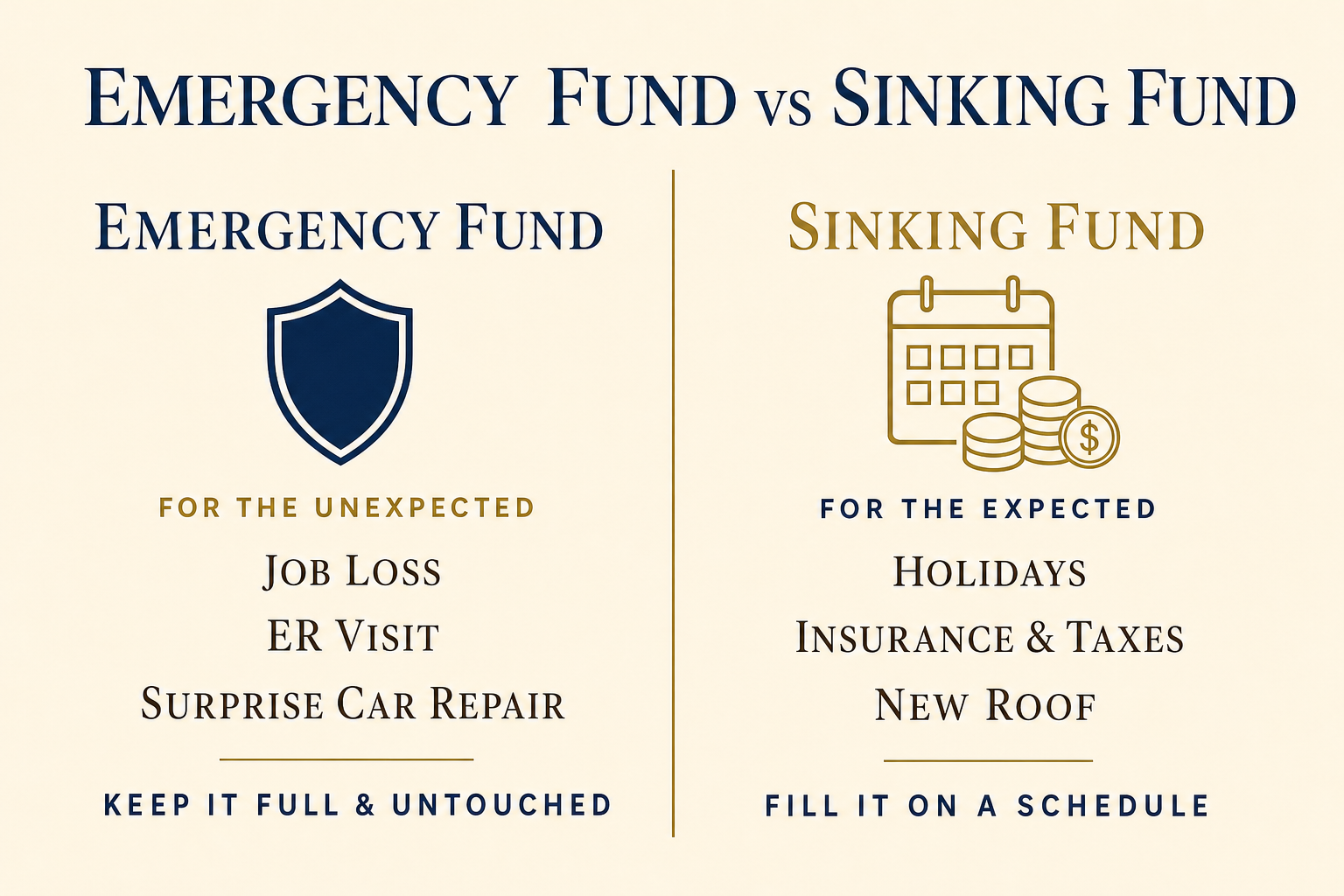
Here’s the part that trips people up: the two are not interchangeable. The whole point of an emergency fund is that it stays full and untouched, so that when the genuinely unexpected hits, it’s there. The moment you start paying for Christmas out of it, you’ve converted your safety net into a checking account with extra steps. Keeping them separate is what lets each one do its job.
Finding your sinking-fund expenses is a 20-minute job
Pull up last year’s bank and card statements and look for the big, lumpy, non-monthly charges — the ones that made you wince when they hit. Those are your sinking-fund categories. For most households the list is shorter than they expect and almost identical year to year:
- Holidays and gifts (the single most-raided category, and the most predictable)
- Insurance premiums billed every six or twelve months
- Property taxes, if they’re not escrowed into your mortgage
- Annual subscriptions and memberships
- Car maintenance, registration, and the eventual replacement
- Home repairs — the roof, the HVAC, the water heater that will fail on its own schedule
- Medical and dental work you’re putting off but know is coming
Write down what each one costs you in a year. That total is the money your budget has been pretending doesn’t exist. Spreading it out is the entire trick.
The math is almost embarrassingly simple
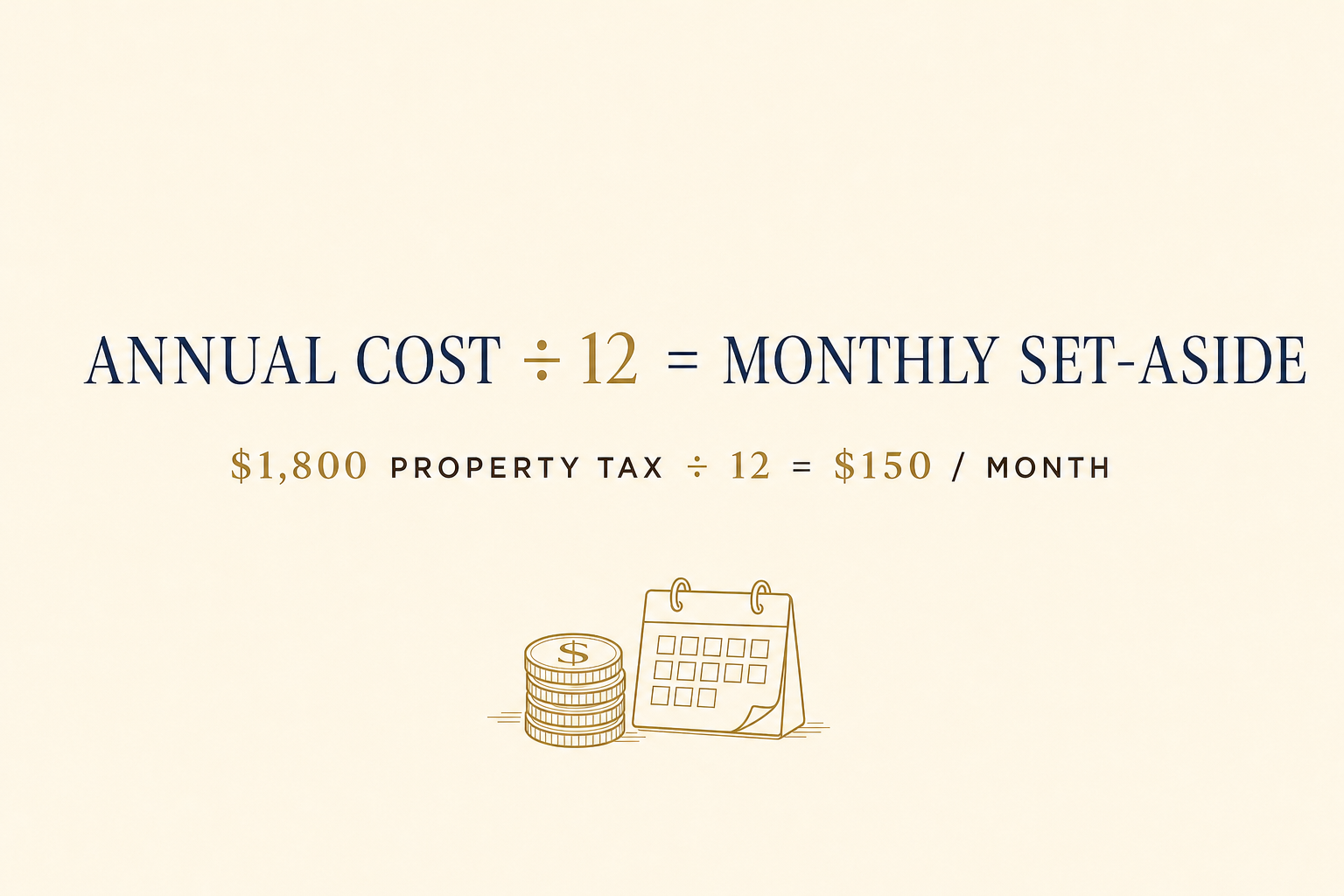
Take the annual cost of each item and divide by twelve. That’s what you move into the sinking fund every month. When the bill arrives, the money is already there, and it never touches your emergency fund or your regular spending.
Consider a hypothetical case: Dana, 58, a dental hygienist outside Columbus. Her wince list adds up to about $4,800 a year — roughly $1,500 for the holidays, $1,800 in property taxes, a $900 insurance premium, and $600 she sets aside for car repairs that always seem to find her. Divided by twelve, that’s $400 a month into a separate savings account. It’s not glamorous, and it doesn’t earn her much. But in December, when her neighbors are reaching for credit cards charging north of 22% — the average rate on balances that carry interest, per the Federal Reserve — Dana’s holiday money is already sitting in an account, spent before she spends it.
You can keep it in one account and track the categories on a notepad, or open a few separate savings accounts if seeing them split out keeps you honest. The mechanics matter less than the principle: the money has a job before it arrives, so it never gets spent on something else.
Why this works when budgeting willpower doesn’t
There’s a behavioral reason sinking funds succeed where “just spend less” fails. Economists call it mental accounting — the human tendency to treat money differently depending on the label we put on it. For years that’s been framed as a bias, a flaw in how we think about a dollar that should be a dollar no matter where it sits.
But labeling money is only a flaw when the labels are arbitrary. Give money a deliberate, honest label — “this $150 is December’s gifts, not spending money” — and the same instinct becomes a tool. You stop raiding the fund not because you’ve gritted your teeth harder, but because spending it now feels like stealing from a specific future obligation. That’s mental accounting working for you instead of against you, which is a theme I come back to often: the goal isn’t to override how your brain handles money, it’s to build a system that works with it.
Sinking funds don’t retire when you do
If anything, they matter more in retirement, not less. This is where the idea connects to the bucket planning approach I write about constantly. Your Now bucket — the cash and near-term money that covers living expenses — shouldn’t just hold next month’s bills. It should carry a sinking-fund layer for the lumpy costs retirement is full of: a new roof, a car to replace the one you drove for fifteen years, dental implants Medicare won’t touch, the quarterly estimated taxes the IRS expects if you’re managing your own withdrawals.
Here’s why that layer earns its keep. A retiree without sinking funds has only one place to go when a $14,000 roof bill lands: the growth portfolio. And if that bill arrives during a market correction — like the one we just watched rattle the Nasdaq — you’re forced to sell stocks at a low to pay for shingles. That’s the single most destructive thing a retiree can do to a portfolio, and it’s entirely avoidable. A sinking fund means the predictable big expenses never force a bad-timing sale. Your income floor stays intact, your Later bucket stays invested, and a known cost stays a known cost instead of becoming a portfolio event.
The quiet account that makes everything else calmer
Nobody brags about their sinking fund. It won’t beat the market, it won’t compound into a fortune, and it makes for terrible dinner conversation. But it quietly removes the single most common reason household budgets blow up — and the most common reason emergency funds never stay full. Give every expense you can see coming a home of its own, fund it a twelfth at a time, and December stops being the month that undoes your whole year. That’s not a budgeting trick. It’s just refusing to be surprised by things that were never surprises.
Key takeaways
- Most “emergencies” that drain your emergency fund are predictable expenses in disguise — holidays, insurance, property taxes, car and home repairs.
- A sinking fund is money set aside gradually for a known, irregular expense. It’s the opposite of an emergency fund, and the two should stay separate.
- The math is one step: annual cost ÷ 12 = what you set aside each month.
- Labeling money by purpose turns “mental accounting” from a bias into a tool — it works with how your brain handles money instead of against it.
- In retirement, sinking funds keep a lumpy expense from forcing you to sell investments at a bad time.
Frequently asked questions
How is a sinking fund different from just budgeting?
A budget plans your monthly flow. A sinking fund handles the expenses that don’t fit a monthly rhythm — the ones that arrive once or twice a year and blow a normal budget apart. You’re pre-paying your future self so the lumpy bill becomes a non-event.
Where should I keep the money?
Somewhere separate from both your checking and your emergency fund, and somewhere you won’t accidentally spend it. A high-yield savings account is a common choice because it’s liquid and kept at arm’s length. The exact account matters far less than keeping the money labeled and out of your everyday spending.
How many sinking funds should I have?
As many as you have recurring lumpy expenses — but you can track them all inside one account on a simple list if multiple accounts feel like clutter. Start with the one that burned you last year. For most people, that’s the holidays.
This article is published by Confluence Media Group LLC, an independent publisher of educational financial content. Thomas Clark is a Series 65 Investment Advisor Representative. The information provided is for educational and informational purposes only and is not personalized financial, tax, or legal advice. Past performance does not guarantee future results. All investing involves risk, including potential loss of principal. Consult a qualified professional before making financial decisions.
Confluence Media Group LLC is a separate entity from Confluence Capital Management, the investment advisory practice through which Thomas Clark provides advisory services. Advisory services are not offered through this publishing platform.
About Thomas Clark
Thomas Clark is the founder of Confluence Media Group LLC and a Series 65 Investment Advisor Representative. He has spent nearly two decades working with families on retirement planning, with a focus on Social Security optimization, retirement income coordination, and the bucket planning approach to building a guaranteed income floor.
Thomas writes and publishes at thomasclarkadvisor.com and is the author of The Just in Case Binder — a 148-page printable family financial organizer for households who want to make sure the people they love know where everything is.
He lives in North Carolina with his family.
Subscribe to the weekly newsletter · Get the Just in Case Binder

Thomas Clark is a Series 65 licensed investment advisor and experienced trader. He specializes in investing, retirement planning, and market analysis, helping individuals build wealth and make informed financial decisions.
