
The Fed Meets This Week. Watch Your Cash, Not Your Stocks.
The Fed announces its rate decision Wednesday, and markets expect a hike. Here’s the part of your retirement plan it actually moves — and it isn’t your stock portfolio.

On Wednesday afternoon, the Federal Reserve will announce what it’s doing with interest rates, and going into the meeting, markets are pricing in roughly an 85% chance of a quarter-point hike. Most of the coverage you’ll see this week frames that as a stock-market story: will equities rally, will they sell off, what does it mean for your portfolio.
That’s the wrong place to look. The Fed’s decision lands hardest on the part of your retirement plan almost nobody is watching this week — your cash and your income — and barely touches the part everyone is glued to. If you’re within a decade of retirement or already there, that distinction is worth more than any guess about Wednesday’s headline.
The Fed only sets one end of the yield curve
The Fed controls exactly one interest rate: the federal funds rate, the overnight rate banks charge each other to lend reserves. That’s the short end of what’s called the yield curve — the ladder of interest rates running from overnight cash out to 30-year bonds. When the Fed moves the funds rate, the yields on everything short and cash-like move almost in lockstep: high-yield savings, money market funds, Treasury bills, short-term CDs.
The long end is a different animal. Ten-year Treasury yields, 30-year mortgage rates, and the returns on your stock portfolio are set by the market’s collective bet on growth and inflation years out — not by a committee vote. The Fed can nudge those expectations, but it doesn’t set the number. This is why you’ll sometimes see the Fed raise short rates while long-term mortgage rates drift the other way. Two different ends of the curve, two different drivers.
So when the announcement hits at 2 p.m. Wednesday, here’s what’s actually happening: the Fed is reaching directly into the yield on your cash, and only indirectly — through mood and expectation — at the yield on everything else.
Why this lands on your Now bucket first
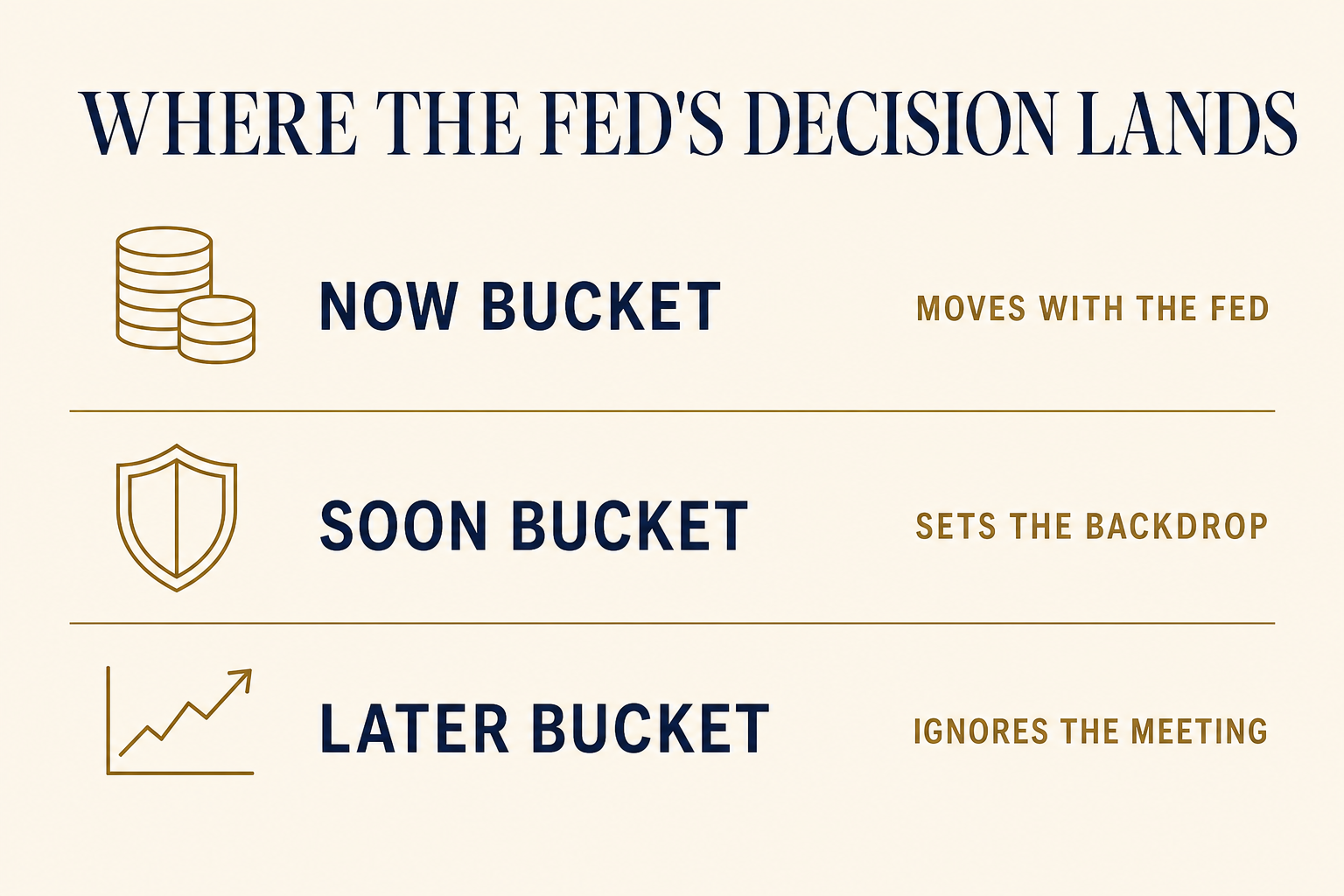
If you’ve read much of what I write, you know I organize retirement money into three buckets: Now, Soon, and Later. The Now bucket is your liquidity — the cash and near-cash you’d spend in the next year or two, sitting in savings, money markets, and short CDs. That bucket is wired directly to the Fed’s short rate.
Right now that’s mostly good news for savers. Top CDs are still paying in the neighborhood of 4.35% to 4.60%, and money market funds are around 4%. A month or two ago the worry was that falling rates would quietly cut your Now bucket’s paycheck. Today, with inflation stubborn and the Fed leaning hawkish, that pressure has eased — cash is being paid reasonably well, and a hike would nudge it up rather than down. I wrote about that shift when cash finally started paying your Now bucket again.
The trap on a week like this isn’t the Fed’s decision. It’s overreacting to it. When cash yields look attractive, the temptation is to lock up money you’ll actually need soon into a longer CD for an extra tenth of a percent, or to swing the other way and let far too much pile up in cash because it feels safe. Both are real mistakes — I’ve written before about the hidden cost of holding too much cash in retirement. The Now bucket’s job is liquidity, not yield-chasing. Size it to what you’ll spend, ladder it so pieces come due when you need them, and let the rate be whatever the Fed makes it.
The Soon bucket: a higher-rate backdrop, not a starting gun
The Soon bucket is your guaranteed income floor — Social Security, any pension, and income-focused Fixed Index Annuities used for the job they’re actually good at: producing reliable income, not chasing growth. The bond ladders and income products that build that floor tend to offer more generous terms when rates are elevated, because the guarantees are priced off those same rates.
So yes, a higher-for-longer environment is a reasonable backdrop for building an income floor. But notice the framing: it’s a backdrop, not a starting gun. The reason to lock in part of your guaranteed income is that your plan needs that floor — that you’re close enough to retirement to want your essential expenses covered by something that doesn’t care what the market does. The trigger is your plan, not a bet that this meeting or the next one moves rates your way. If you try to time the perfect rate to build your floor, you’ll spend years underfloored waiting for a number nobody can promise you. I’ve walked through how to size that income floor to your actual essential expenses rather than to the rate environment.
Thomas’ Take: A guaranteed income floor is insurance against your own retirement, not a trade you put on when the Fed cooperates. Build it because your bills need covering, not because rates twitched.
The Later bucket should ignore Wednesday entirely
Your Later bucket — the stocks and growth assets you won’t touch for a decade or more — has no business reacting to a Fed meeting. That’s the money whose entire job is long-run growth, and the Fed does not set your long-run equity returns. It never has.
I made this case in detail a week ago: don’t try to time the market around the Fed. The short version holds up. The people who sell before the announcement to “get ahead of it” and the people who pile in to “front-run the reaction” are playing the same losing game from opposite sides. The far bigger risk to a retiree’s Later bucket isn’t the Fed — it’s the order of your returns in the first few years of retirement, which is exactly why the Now and Soon buckets exist: so you never have to sell Later-bucket stocks into a bad market to pay the light bill.
What to actually do this week
For most people the honest answer is: match each dollar to the bucket it belongs to, and then let Wednesday happen without you.
Consider a hypothetical case. Ellen, 61, is a school administrator in Raleigh planning to retire in about four years. She has roughly $80,000 in cash earning next to nothing in a checking account, a 401(k) she’s still contributing to, and a nagging sense she should “do something” before the Fed meeting. The financial press has her convinced the announcement is a moment to act.
It isn’t — but her buckets are. Her Now bucket cash has a clear job: move the portion she won’t need for a year or two into a laddered mix of money markets and short CDs so it actually earns the going rate, while keeping enough liquid to sleep at night. Her Soon bucket is a four-year project: start mapping which essential expenses her Social Security will cover and where a modest income floor might fill the gap, sized to her bills, not to the rate cycle. Her Later bucket — the 401(k) — keeps doing what it’s doing, untouched by Wednesday. None of that requires her to guess what the Fed will do. All of it requires her to know what each dollar is for.
That’s the whole point. The Fed’s decision is a headline; your bucket structure is the plan. One of them you can control.
If you want to see how your own plan holds up under different rate paths — a Fed that stays higher for longer versus one that starts cutting next year — that’s worth modeling against your real numbers rather than guessing. A planning tool like ProjectionLab lets you run your Now, Soon, and Later buckets through those scenarios and watch whether your income floor and cash reserves hold. (ProjectionLab is a paid tool; the link is an affiliate link, which means I may earn a small commission at no extra cost to you. I only recommend tools I’d use myself.)
This article is published by Confluence Media Group LLC, an independent publisher of educational financial content. Thomas Clark is a Series 65 Investment Advisor Representative. The information provided is for educational and informational purposes only and is not personalized financial, tax, or legal advice. Past performance does not guarantee future results. All investing involves risk, including potential loss of principal. Consult a qualified professional before making financial decisions.
Confluence Media Group LLC is a separate entity from Confluence Capital Management, the investment advisory practice through which Thomas Clark provides advisory services. Advisory services are not offered through this publishing platform.
About Thomas Clark
Thomas Clark is the founder of Confluence Media Group LLC and a Series 65 Investment Advisor Representative. He has spent nearly two decades working with families on retirement planning, with a focus on Social Security optimization, retirement income coordination, and the bucket planning approach to building a guaranteed income floor.
Thomas writes and publishes at thomasclarkadvisor.com and is the author of The Just in Case Binder — a 148-page printable family financial organizer for households who want to make sure the people they love know where everything is.
He lives in North Carolina with his family.
Subscribe to the weekly newsletter · Get the Just in Case Binder

Thomas Clark is a Series 65 licensed investment advisor and experienced trader. He specializes in investing, retirement planning, and market analysis, helping individuals build wealth and make informed financial decisions.
