
The Social Security Bridge: How to Afford to Wait
Delaying Social Security can raise your check for life — but only if you can replace the income in the meantime. Here's how to build a Social Security bridge from your buckets so you can afford to wait.

Most of the Social Security advice you’ll read treats the claiming decision like a riddle: run the break-even math, guess how long you’ll live, pick an age. But after nearly two decades of sitting with people in the months before they retire, I’ve come to believe the real question is almost never when should I claim? It’s can I afford to wait?
Those sound like the same question. They’re not. Waiting until 70 gives you a permanently larger, inflation-adjusted check for the rest of your life — and for a surviving spouse, the rest of their life. Almost everyone understands that waiting pays. What stops them isn’t the math. It’s the gap: the years between the last paycheck and the first Social Security deposit, when the bills still come but no income does.
The people who delay successfully aren’t braver or more patient. They built something first. I call it a Social Security bridge, and it’s one of the most valuable structures you’ll ever assemble in your financial life.
Why waiting pays — and why that’s not the hard part
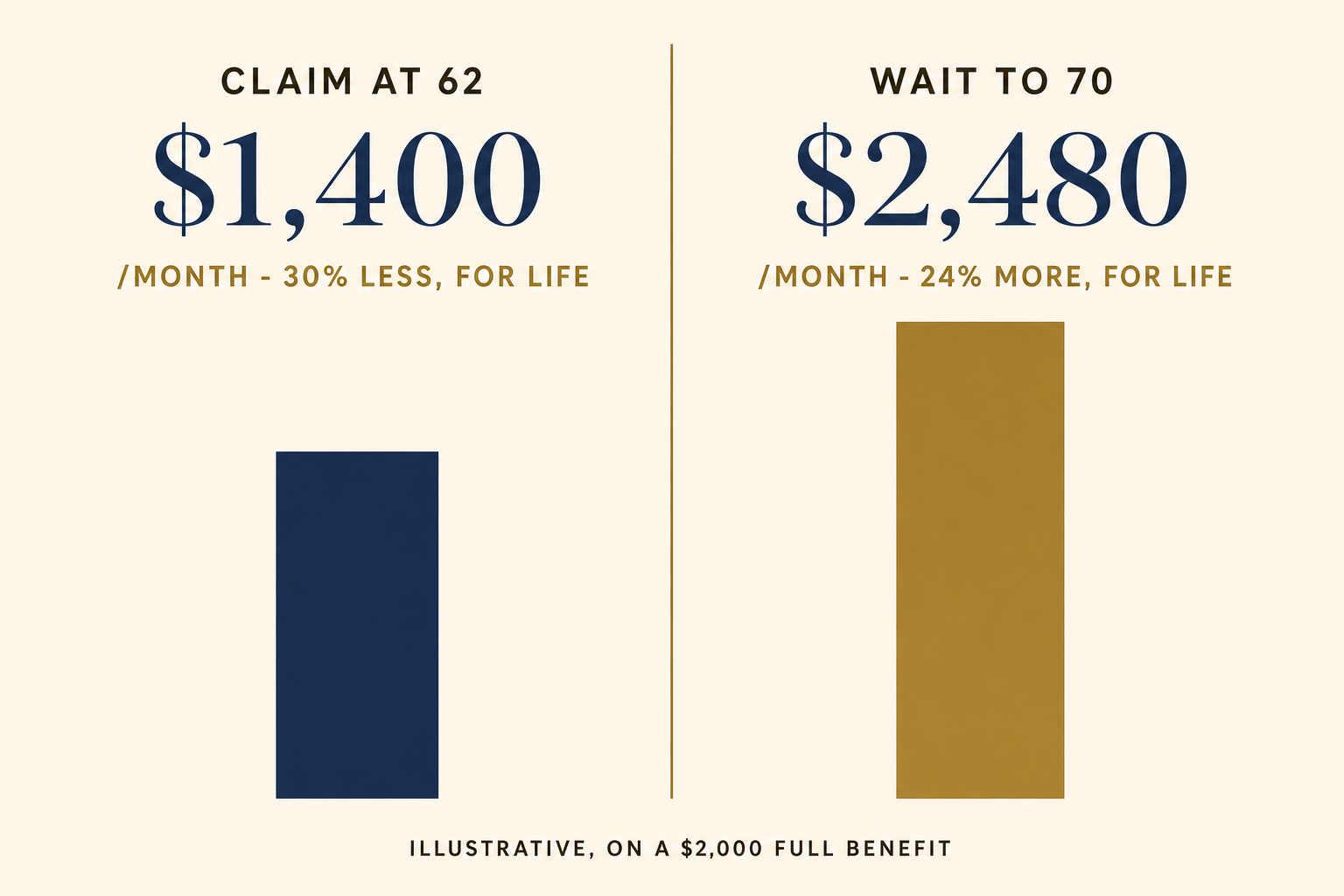
Start with the numbers, because they’re genuinely large. If your full retirement age is 67, which it is for everyone born in 1960 or later — claiming at 62 locks in a permanent benefit that’s about 30% smaller than your full amount. Wait past 67, and your benefit grows by 8% for each year you delay, all the way to age 70, where it maxes out at roughly 24% above your full benefit.
Put those endpoints together and the spread is striking. The Consumer Financial Protection Bureau sums it up in a single chart title: waiting can move your benefit “from 30% less than full benefit, to 24% more.” On a full benefit of $2,000 a month, that’s $1,400 if you claim at 62 versus about $2,480 if you wait until 70 — a difference of more than $1,000 every month, guaranteed, adjusted for inflation every year, for as long as you live.
Here’s the part most people miss: those delayed credits stop cold at 70. There is no reward for waiting past your 70th birthday, so the goal is never “wait as long as possible” — it’s “wait to 70, then claim.” I wrote a whole piece on why delaying past 70 only leaves money on the table, because it’s a surprisingly common and expensive mistake.
So the case for waiting is clear. The obstacle is never the math. It’s cash flow. If you retire at 64 and want to delay to 70, something has to pay for six years of groceries, property taxes, and health insurance. That something is the bridge.
What a Social Security bridge actually is
A Social Security bridge is a dedicated pool of money whose only job is to replace your Social Security income during the years you’re deliberately not taking it. You spend this money down on purpose. That’s the mental hurdle: watching an account shrink feels like failure, when in this case it’s the plan working exactly as designed.
Think of it as buying something concrete. Every dollar you draw from the bridge is purchasing a permanently larger, government-guaranteed, inflation-protected paycheck, the kind of income you cannot buy as cheaply anywhere else. You’re not spending down your savings. You’re converting a pile of ordinary money into a stream of guaranteed lifetime income, which is exactly the trade a well-built retirement plan is supposed to make.
This is where bucket planning earns its keep. In the Now / Soon / Later framework I use, the bridge lives in the Now and Soon buckets — the safe, non-market money you’ve set aside for near-term spending. It is not something you fund by selling stock in your Later bucket during a bad market. The whole point of keeping a few years of spending in stable assets is so that a decision like this one isn’t held hostage to what the market did last Tuesday.
Where the bridge money comes from
A bridge doesn’t require a separate account or a special product. It requires you to look across what you already have and decide which dollars do this job. In practice, the money comes from a few predictable places:
- Cash and near-cash in your Now bucket — high-yield savings, money market funds, short-term Treasurys, and CDs you can ladder to mature as each year’s expenses come due.
- The guaranteed income you already have — a pension, or an income-focused fixed index annuity in your Soon bucket, reduces how big the bridge has to be, because it’s already covering part of the gap.
- Taxable and tax-deferred accounts, drawn in the right order — the sequence matters more than people think, and getting it wrong can cost you in taxes and lost flexibility. I walk through it in the withdrawal order most people get wrong.
One expense deserves special mention, because it’s the quiet bridge-killer: health insurance before Medicare. If you retire before 65, you’re buying your own coverage until Medicare kicks in, and that cost has to be built into the bridge. It’s a big enough problem that I gave it its own breakdown of the 60-to-65 gap. Underestimate it, and the bridge comes up short in exactly the years you can least afford a surprise.
A hypothetical bridge, start to finish
Consider a hypothetical couple: Marcus and Elena, both 64, who just retired outside Minneapolis. (Their numbers are illustrative and rounded on purpose; the point is the structure, not the dollars.) Marcus was the higher earner; his full benefit at 67 would be about $2,800 a month, and if he waits to 70 it grows to roughly $3,470. Elena’s own full benefit is smaller, about $1,600.
The conventional move is for both of them to claim now and stop the bleeding from their savings. The bridge move looks different. Elena claims her own benefit in the next year or two, since her delayed credits are worth less in absolute dollars, and getting some guaranteed income flowing eases the pressure. Marcus doesn’t claim at all. Instead, the couple sizes a bridge to replace roughly what Marcus would have collected, drawing from their Now-bucket cash and CDs each year until he turns 70.
What do they get for spending that money down? Marcus’s check lands about 24% higher and stays that way for life, rising with every cost-of-living adjustment. And because Social Security pays the larger of two benefits to a surviving spouse, that bigger check becomes Elena’s floor if Marcus dies first. For a couple, delaying the higher earner’s benefit isn’t just a bigger paycheck — it’s survivor insurance for whoever lives longest. That’s the real prize, and it’s why I think so much harder about the higher earner’s claiming age than the lower earner’s.
Thomas’ Take: The gap years between retiring and claiming are the most valuable tax and income real estate most people will ever own — and the ones they most often waste. A bridge doesn’t just let you delay Social Security. It creates a stretch of low-income years when you control your taxable income almost completely, which is the ideal window for Roth conversions in the gap years. Spend those years asleep at the wheel and you give up two wins at once.
Run your own numbers before you decide anything
Everything above is the shape of the decision, not the answer to it. The answer depends on your actual benefit amounts, your spouse’s, your health, and how much safe money you can route to a bridge without starving the rest of your plan. Before you make a move this consequential, it’s worth seeing the trade in your own figures.
Our free Social Security claiming calculator lets you compare claiming ages side by side and see how the monthly numbers change, a useful first look at how big a bridge you’d actually need, and what it buys you.
When a bridge doesn’t make sense
I’d be doing you a disservice if I pretended delaying is always right. It isn’t. A bridge is the wrong move in several honest cases:
- Your health or family history points to a shorter horizon. The value of waiting comes from collecting that bigger check for many years. If that’s unlikely, claiming earlier can be the sound choice. I think of Social Security less as an investment bet and more as longevity insurance, and insurance you won’t use isn’t worth the premium.
- You don’t have the assets to bridge with. If delaying means taking on debt or leaving yourself with no cash cushion, the bridge is built on sand. The income you need today wins over the larger income you’d get later.
- The lower earner’s benefit. Delaying the smaller of two benefits usually doesn’t move the needle enough to justify the drawdown. Concentrate the waiting on the higher earner, where the survivor math does the heavy lifting.
The right size and shape of a bridge is personal. But the principle is close to universal: if you want a bigger Social Security check for life, don’t look for a claiming trick. Look at whether you can build a few years of income to carry you to 70. That’s where the leverage is, and how big your income floor needs to be is the companion question worth answering alongside it.
Key takeaways
- The useful Social Security question is rarely “when should I claim?” It’s “can I afford to wait?” — and a bridge is what makes waiting possible.
- Delaying from 62 to 70 can move your benefit from about 30% below your full amount to about 24% above it, guaranteed and inflation-adjusted for life. Credits stop at 70.
- A bridge is safe, near-term money (your Now and Soon buckets) spent on purpose to replace Social Security income during the gap years.
- For couples, delaying the higher earner’s benefit also raises the survivor’s lifetime floor, often the biggest reason to build the bridge.
- Skip the bridge when health, assets, or the math argue against it. Delaying is powerful, not mandatory.
Frequently asked questions
How many years does a Social Security bridge usually cover?
It depends on when you retire and when you plan to claim. Someone who retires at 64 and delays to 70 is bridging six years; someone who retires at 67 and delays to 70 is bridging three. The earlier you retire relative to your claiming age, the larger the bridge.
Does waiting to 70 mean I lose the benefits I could have collected earlier?
You do forgo those earlier payments — that’s the cost the bridge covers. In exchange you get a permanently higher check. Whether the trade pays off depends largely on longevity, which is why it functions more like insurance than an investment.
Should both spouses delay to 70?
Not necessarily. In many households it makes sense for the higher earner to delay while the lower earner claims earlier, because the higher earner’s benefit sets the survivor benefit for whoever lives longer. The right combination is specific to your two benefit amounts and your situation.
The claiming decision gets framed as a one-day event: you turn some age, you file, it’s done. The people who get the most out of Social Security treat it as a project that starts years earlier: the year they decide to build the bridge. Decide early, build deliberately, and when you reach 70 the larger check is simply waiting for you.
This article is published by Confluence Media Group LLC, an independent publisher of educational financial content. Thomas Clark is a Series 65 Investment Advisor Representative. The information provided is for educational and informational purposes only and is not personalized financial, tax, or legal advice. Past performance does not guarantee future results. All investing involves risk, including potential loss of principal. Consult a qualified professional before making financial decisions.
Confluence Media Group LLC is a separate entity from Confluence Capital Management, the investment advisory practice through which Thomas Clark provides advisory services. Advisory services are not offered through this publishing platform.
About Thomas Clark
Thomas Clark is the founder of Confluence Media Group LLC and a Series 65 Investment Advisor Representative. He has spent nearly two decades working with families on retirement planning, with a focus on Social Security optimization, retirement income coordination, and the bucket planning approach to building a guaranteed income floor.
Thomas writes and publishes at thomasclarkadvisor.com and is the author of The Just in Case Binder — a 148-page printable family financial organizer for households who want to make sure the people they love know where everything is.
He lives in North Carolina with his family.
Subscribe to the weekly newsletter · Get the Just in Case Binder

Thomas Clark is a Series 65 licensed investment advisor and experienced trader. He specializes in investing, retirement planning, and market analysis, helping individuals build wealth and make informed financial decisions.
