
The Year-End Session That Runs Your Retirement
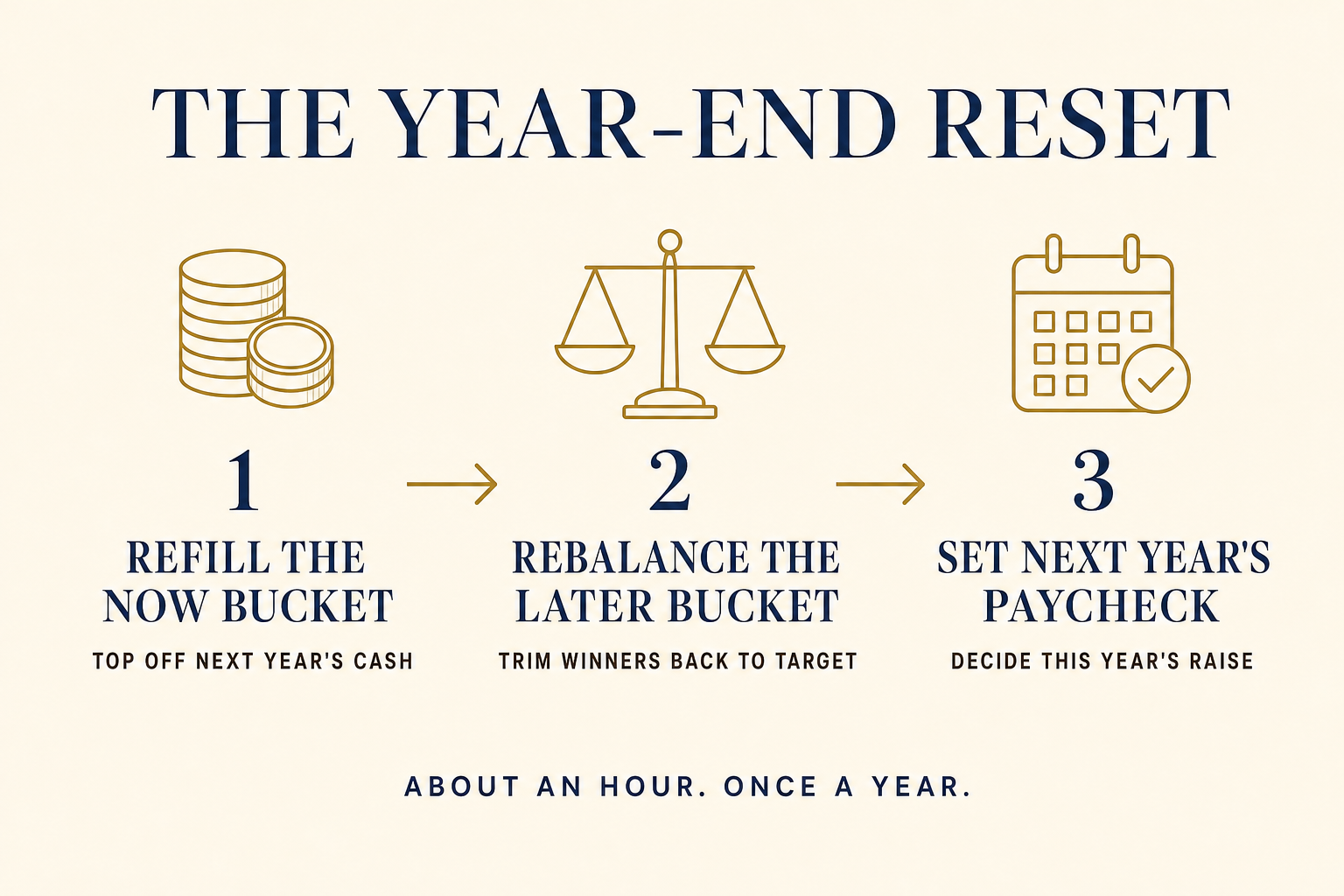
A retirement plan isn't a dashboard you watch — it's a system you service once a year. Here's the year-end reset in three moves: refill the Now bucket, rebalance the Later bucket, and set next year's paycheck.

A couple of weeks ago the Nasdaq slid into a correction, and my inbox filled up with the same question in a dozen forms: should I be doing something?
For most retirees, the honest answer is no — not today, and not because of a headline. But there is a day when you should sit down and do something deliberate with your retirement plan. It comes once a year, it takes less than an hour, and most people skip it entirely. They’d rather check their balance forty times in a bad week than spend one focused hour in December setting the plan up to run on its own for the next twelve months.
That hour is the whole game. A bucket plan isn’t a dashboard you watch. It’s a system you service. Here’s the year-end session that services it — three moves, in about the time it takes to watch a ballgame’s first few innings.
A plan you watch is a plan you’ll eventually wreck
Start with the mindset, because it’s where this goes wrong. The accumulation years train you to pay attention. You check the 401(k), you feel good when it’s up, you tell yourself to hold when it’s down. Attention felt like diligence.
In retirement, that same habit turns against you. When you’re drawing income instead of adding to the pile, every glance at a falling balance is an invitation to do the one thing that actually hurts you — sell growth assets into a decline to raise cash you didn’t need to raise. Watching doesn’t make the plan safer. It makes you the single biggest risk to it.
The fix isn’t willpower. It’s structure. You build the plan so it already knows what to do, then you step back and let it do it — and you only open the hood on a schedule you set in advance, not when CNBC tells you to. For most retirees, once a year is the right schedule. Here’s what you do when you’re under the hood.
Move 1 — Refill the Now bucket
The Now bucket is the cash and short-term money that covers your spending for the next year or two. It’s what lets you ignore the market, because the money you’ll actually spend soon isn’t in the market. The year-end job is simple: top it back up so it’s full heading into the new year.
Where the cash comes from matters. In a normal-to-good year, you refill from the natural output of the portfolio first — dividends, interest, and the proceeds of trimming whatever grew beyond its target (that’s Move 2, and the two happen together). You’re not timing anything. You’re sweeping the year’s harvest into next year’s grocery money.
The question of how much to hold is its own decision, and I’ve written separately about sizing the Now bucket and the cadence of refilling it. The one rule that overrides the calendar: if the market is deep in a decline, you don’t force the sale. You let a down year’s refill wait and live off the cash you already set aside for exactly this. That flexibility is the reason the Now bucket exists.
Move 2 — Rebalance the Later bucket back to target
The Later bucket is your growth money — the part of the portfolio that’s supposed to take market risk because it has years before you’ll touch it. Over a year, it drifts. A strong run in stocks leaves you holding more stock than you intended; a weak one leaves you holding less. Either way, your actual risk no longer matches the risk you chose.
Rebalancing is how you put it back. You trim what grew past its target and add to what lagged, returning the mix to the allocation you set when you were thinking clearly. The SEC’s own investor education frames this plainly: rebalancing forces you to sell high and buy low in a mechanical way, independent of how you feel about any of it.
It feels backward every time. You’re selling your winners. But selling the winners is the point — it’s how you lock in a growth bucket’s job without letting a hot sector quietly become your whole retirement. And the cash those trims throw off is exactly what tops up the Now bucket in Move 1. The two moves are one motion.
This is also the moment to notice if you’ve drifted too conservative. A lot of retirees, spooked by a rough stretch, let the Later bucket shrink until it can’t do its only job — outrunning inflation across a thirty-year retirement. The Later bucket is where retirees most often play it too safe. The annual reset is when you catch that and fix it.
Move 3 — Set next year’s paycheck
Now you decide what to pay yourself for the coming year. This is the move that turns a pile of money into a retirement paycheck — a steady, known amount landing in your checking account, funded from the buckets you just refilled.
Part of the raise is handed to you. Social Security gives itself a cost-of-living adjustment every year — 3.6% for 2027, landing in January payments. That’s the guaranteed floor keeping pace on its own. The question is what to do with the portfolio-funded part of your income on top of it.
The instinct is to raise your whole paycheck by inflation automatically. Sometimes that’s fine. But in a year the Later bucket fell, a smarter move is to hold your discretionary withdrawal flat rather than pull more from a smaller base — the core idea behind spending guardrails. Give yourself the full raise in good years; skip the discretionary raise in bad ones. Your essentials are already covered by the floor, so the flex sits where it belongs — on the wants, not the needs.
This is the move worth modeling on your own numbers rather than mine. A planning tool like ProjectionLab lets you set next year’s withdrawal, carry it forward against your real balances and spending, and see whether this year calls for the full raise or a flat hold — before you commit to it in January.
Disclosure: the ProjectionLab link above is an affiliate link. If you subscribe through it, I may earn a commission at no additional cost to you. I only point to tools I’d actually sit down and use.
Forty-five minutes, start to finish
Consider a hypothetical case — an illustration with round numbers, not a projection. Ray and Susan are 68 and 66, retired three years. Between them, Social Security covers about $4,000 a month of their roughly $5,500 in spending; the gap comes from a $700,000 portfolio split across a Now bucket of cash, a Soon bucket of guaranteed income, and a Later bucket of stock and bond funds.
Their December session: Ray pulls up the accounts. The Later bucket had a good year, so stocks have drifted a few points above target — he trims them back, and the sale plus the year’s dividends throw off enough to refill the Now bucket to a full two years of the gap. He checks the allocation; it’s back where they chose it. Then the paycheck. Social Security’s COLA lifts the floor automatically, and because it was a good year, they give the portfolio-funded slice its inflation raise too, bumping the monthly transfer modestly. Susan writes the new number on the same index card they use every year.
That’s it. They close the laptop. The plan now runs itself until next December, and when the market does something dramatic in March, they already know their answer: nothing. The cash is set, the mix is right, the paycheck is decided.
Thomas’s Take: The retirees who sleep best aren’t the ones watching the closest. They’re the ones who did the thinking once, wrote it down, and gave themselves permission to stop looking. An hour of deliberate work in December buys eleven months of not caring what the market does — and not caring, at the right moments, is worth more than any stock pick.
Why the reset is what lets you ignore the headlines
Everything about this comes back to one idea: your essential bills are covered by a guaranteed floor, so the market gets to do whatever it wants with the rest. That’s what the income floor bought you during the correction — the freedom to not react.
But the floor and the buckets don’t maintain themselves. Cash gets drawn down. Allocations drift. Inflation nibbles at the paycheck. Left alone for years, even a good plan slowly falls out of tune. The annual reset is the tune-up — the one scheduled, deliberate act that keeps the structure sound so the structure can keep you calm. Do it once a year, on purpose, and you earn the right to ignore everything in between.
Key takeaways
- A retirement plan is serviced, not watched. Set a schedule to open the hood — once a year for most retirees — and leave it closed the rest of the time.
- Refill the Now bucket from the year’s harvest. Dividends, interest, and rebalancing proceeds top up next year’s spending cash — unless the market is deep in a decline, in which case you let the refill wait.
- Rebalance the Later bucket to target. Trim the winners back to your chosen allocation; the cash funds the refill, and the discipline keeps a hot sector from becoming your whole retirement.
- Decide next year’s paycheck on purpose. Take the full inflation raise in good years; hold the discretionary portion flat after a down year. Social Security’s COLA raises the guaranteed floor for you.
- The reset is what makes “do nothing” safe. One deliberate hour in December is what lets you ignore the headlines for the other eleven months.
Frequently asked questions
Does once a year really beat checking more often? For the maintenance decisions — refilling, rebalancing, setting the paycheck — yes. More frequent checking rarely improves those choices and often tempts you into reacting to noise. The exception is a true triggered event, like a deep market decline that tells you to pause a refill rather than force a sale. That’s a rule you set in advance, not a reason to watch daily.
When exactly should I do it? Late in the year works well because a few other deadlines cluster there anyway — if you’re 73 or older, your required minimum distribution is due by December 31, and taking it can double as your Now-bucket refill. Any consistent date is fine; the point is that it’s scheduled, not reactive.
What if I hold target-date funds that rebalance themselves? Then Move 2 is largely handled inside the fund, and your session is shorter — you still refill the Now bucket and set the paycheck. The thinking doesn’t disappear; it just gets easier, which is the whole idea.
A good retirement plan isn’t the one you monitor most closely. It’s the one built well enough that you can leave it alone — and the annual reset is the small, deliberate act that earns you the leaving-alone. Give it an hour in December. Then go enjoy the other eleven months you just bought back.
This article is published by Confluence Media Group LLC, an independent publisher of educational financial content. Thomas Clark is a Series 65 Investment Advisor Representative. The information provided is for educational and informational purposes only and is not personalized financial, tax, or legal advice. Past performance does not guarantee future results. All investing involves risk, including potential loss of principal. Consult a qualified professional before making financial decisions.
Confluence Media Group LLC is a separate entity from Confluence Capital Management, the investment advisory practice through which Thomas Clark provides advisory services. Advisory services are not offered through this publishing platform.
About Thomas Clark
Thomas Clark is the founder of Confluence Media Group LLC and a Series 65 Investment Advisor Representative. He has spent nearly two decades working with families on retirement planning, with a focus on Social Security optimization, retirement income coordination, and the bucket planning approach to building a guaranteed income floor.
Thomas writes and publishes at thomasclarkadvisor.com and is the author of The Just in Case Binder — a 148-page printable family financial organizer for households who want to make sure the people they love know where everything is.
He lives in North Carolina with his family.
Subscribe to the weekly newsletter · Get the Just in Case Binder

Thomas Clark is a Series 65 licensed investment advisor and experienced trader. He specializes in investing, retirement planning, and market analysis, helping individuals build wealth and make informed financial decisions.
